
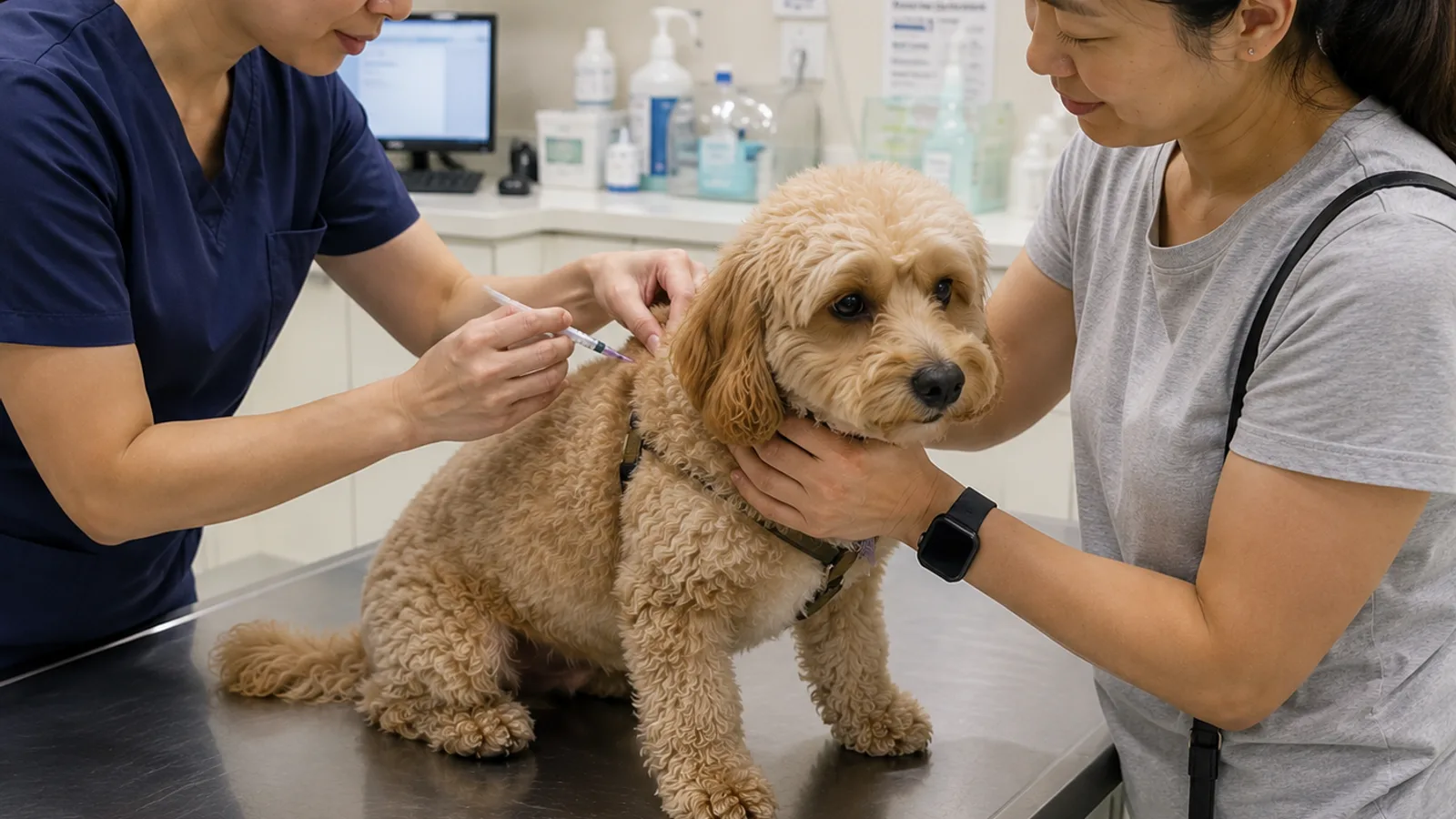

The core puppy vaccine series runs on the same week markers whether your dog grows up to weigh four kilos or forty. What changes with size and breed is the calendar around the needle: when the sterilisation window opens, how often to come back for a check, and the extra care a flat-faced dog needs every time it visits a clinic in Singapore heat. This is the size-banded view, sitting on top of the core schedule.
1. The core Singapore schedule, unchanged by size
Start from the schedule that holds for every dog in Singapore, then read the size nuance on top of it. The Singapore Veterinary Association framework, which most clinics follow, puts the DHPP combined vaccine at three points before the first birthday: a first shot at roughly six to eight weeks, a second at ten to twelve weeks, and a third at fourteen to sixteen weeks. DHPP covers distemper, infectious canine hepatitis, parainfluenza, and parvovirus. A first booster follows at twelve months, and adult DHPP then runs on a triennial cadence rather than annually.
Rabies sits at around twelve weeks, but only matters if the dog will travel; Singapore has been rabies-free since 1953 and the vaccine is non-core for a resident dog. Leptospirosis and kennel cough are officially non-core too, yet most Singapore vets treat them as effectively standard: lepto because the disease is endemic and spreads through rat-contaminated water in our drains and park edges, and kennel cough because boarding kennels, daycare, and grooming salons require an in-date shot to admit a dog. None of this changes with breed. The full reasoning, costs, and the case for each non-core shot sit in the vaccinations guide.
The first year, vaccination cadence
Indicative blend of common Singapore clinic protocols. The sterilisation window widens with size; your vet sets the exact dates.
2. How size nuances the calendar
The vaccine doses are not weight-based, so a Chihuahua and a Great Dane get the same shots on the same week markers. What shifts is the body around the schedule: how fast the dog matures, when it is sensible to sterilise, and how soon it ages into the conditions that warrant more frequent checks. Read your band below, then confirm the dates with your vet.
Small breeds
Toy poodle, Chihuahua, Maltese, Shih Tzu, Pomeranian
Same core series, same week markers. Small dogs finish growing sooner, so the sterilisation window opens earlier, often around six months. Their teeth crowd more, so dental disease tends to arrive young; the annual visit should always include a dental check.
Medium breeds
Cocker Spaniel, Singapore Special mixes, Beagle, Border Collie
The reference case. Core series on the standard markers, first annual booster at twelve months, leptospirosis and kennel cough alongside. Most of the size-specific nuance below sits relative to this band.
Large and giant breeds
Labrador, Golden Retriever, German Shepherd, Husky
Same vaccine schedule, but later physical maturity. The growth plates close later, so many vets and orthopaedic studies support delaying sterilisation past the first year for some large dogs. Joint screening and weight control matter more here than the vaccine timing.
Brachycephalic (flat-faced)
Pug, French Bulldog, English Bulldog, Shih Tzu, Pekingese
The vaccine schedule does not change. What changes is everything around the clinic visit: heat on the journey, and the care needed for any procedure under general anaesthesia. These are the dogs to book first thing in the morning and to keep cool in transit.
3. Brachycephalic dogs: the heat and anaesthesia notes
Brachycephalic breeds are the flat-faced dogs: pugs, French bulldogs, English bulldogs, shih tzus, Pekingese, and Boston terriers among them. Their shortened skull crowds the airway, which has two consequences worth planning around in Singapore, neither of which is about the vaccine itself.
The first is heat. A flat-faced dog cools itself less efficiently than a long-nosed one, and the trip to a clinic in midday Singapore heat is a genuine stressor. Book the first appointment of the morning, keep the car air-conditioning on before the dog gets in, and avoid leaving the dog in a warm waiting room. Our heatstroke first aid guide is worth reading once before you need it, because brachycephalic dogs feature heavily in heat emergencies here.
The second is general anaesthesia. Sterilisation and routine dental work both need the dog asleep, and a narrow airway makes airway management more demanding. This is not a reason to avoid the procedures; it is a reason to choose a clinic that does these regularly and plans the airway, recovery, and pain control with the breed in mind. Ask the clinic directly how it handles brachycephalic anaesthesia. A vet who answers with specifics rather than reassurance is the one you want. The finding a vet guide covers how to read a clinic on a first visit.
4. Sterilisation timing, by size
Sterilisation is the decision where breed size matters most, and it is the one most worth taking slowly. The vaccine schedule is settled; the surgery date is not, and the right answer depends on the individual dog.
- Small breeds: usually eligible from around six months, once the puppy series is complete. They finish growing early, so there is less reason to wait.
- Medium breeds: commonly between six and twelve months, depending on the dog and the vet's read of its growth.
- Large and giant breeds: a growing body of orthopaedic evidence supports waiting until the growth plates close, often twelve to eighteen months, in some lines, because early sterilisation has been linked to higher joint risk in certain large breeds. This is an active area of veterinary discussion rather than a settled rule.
There is no single correct date that applies to every dog, and the balance of benefits shifts with sex, breed, behaviour, and your living situation. Decide it with the vet who has examined your dog, not from a number found online. The AVS licence fee structure rewards sterilisation regardless of when you do it; the licence guide has the fee detail.
5. Vet-visit cadence as the dog ages
Vaccination is only one reason to see the vet. The wellness visit is where leptospirosis and kennel cough boosters are given, weight is tracked, and early dental, joint, cardiac, or airway problems get caught while they are still cheap to manage. How often you go shifts with size and breed.
- Healthy adult, any size: once a year is the baseline. The annual visit covers the short-duration boosters and a full physical exam.
- Large, giant, and brachycephalic breeds: many owners move to twice-yearly checks from middle age, because these dogs age into joint, cardiac, and airway issues sooner than small breeds.
- Senior dogs: roughly the last third of the breed's expected lifespan, which arrives at different ages for different sizes. Six-monthly visits with bloodwork become the norm. Our senior dog care guide covers the second half of the relationship.
Lifespan tracks size in reverse: small breeds often live into their mid-teens, while giant breeds may be considered senior by seven or eight. That means a giant breed reaches the twice-yearly senior cadence years earlier than a toy breed of the same age in calendar years. Your vet will tell you when your specific dog crosses that line.
6. Putting it together for your dog
The practical sequence for a new owner: confirm the puppy's start point and let the vet set the three core DHPP dates, add leptospirosis and kennel cough on the vet's advice, and pencil in rabies only if travel is on the horizon. Then look up your dog's adult size band to plan the sterilisation conversation and the long-run visit cadence. If you are still choosing a breed, the breed directory lists adult size, HDB eligibility, and the health notes for each, so you can see the schedule implications before the dog comes home.
Frequently asked questions
Does a small breed need a different vaccination schedule to a large breed in Singapore?
Are brachycephalic dogs like pugs and French bulldogs higher risk for vaccination?
When should I sterilise my dog in Singapore, and does breed size matter?
How often should my dog see the vet after the puppy series?
Is leptospirosis vaccination more important for some breeds?
Notice one little habit together →A small idea to try, with progress kept in your Pack.