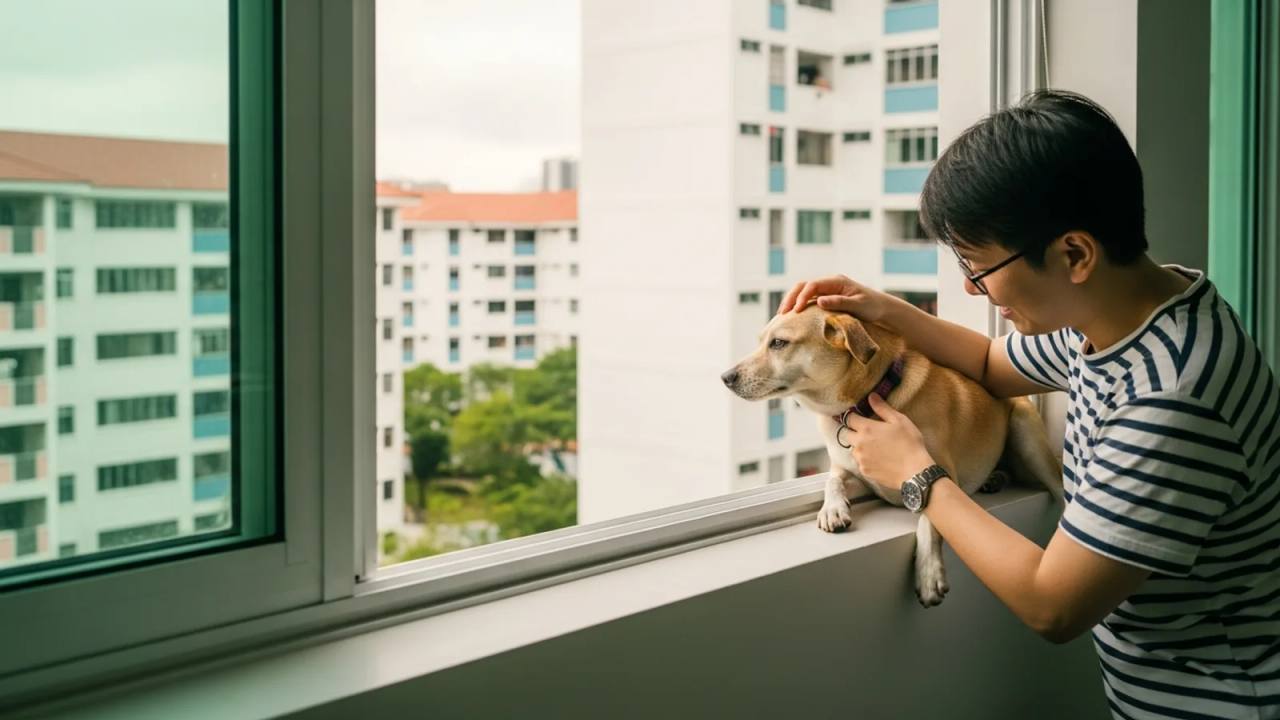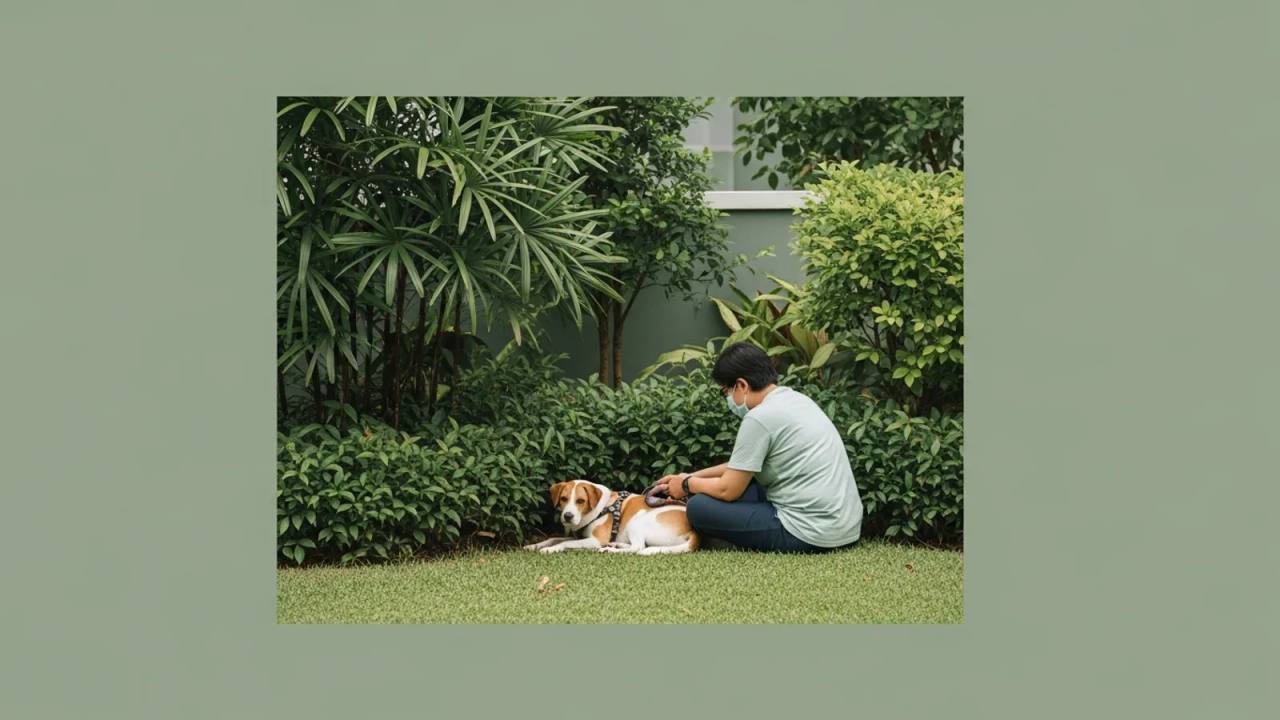

Dog owners in Singapore flats often assume a dog that sits reliably in the corridor understands the command everywhere else. It rarely works that way, and the gap between corridor obedience and real-world reliability is where most HDB training plans quietly fall apart. Small changes to when, where and how a household trains usually close that gap faster than any new command ever could.
By the numbers
- 31-33 degrees C Typical early afternoon temperature in Singapore that raises heat stress risk during training
Every trainer working in Singapore's flats hears some version of the same complaint: the dog sits perfectly at home, then falls apart the moment the lift doors open. That gap is rarely about the dog being stubborn or the owner doing something wrong in a single session. It is almost always the accumulation of a handful of small, repeatable habits that flat living makes easy to fall into. Below are the mistakes that show up most often, along with what actually fixes them.
Why Does Training Only Work in the Corridor, Not Downstairs?
Flats offer a narrow, quiet, predictable training space, which is exactly why so many owners default to it. A dog learns a cue there quickly because there is nothing else competing for its attention. The mistake is assuming that a reliable sit in the corridor means the dog understands sit as a general concept. Dogs do not generalise the way people expect. A cue learned in one location, under one set of conditions, often needs to be retaught in each new environment before it holds.
The fix is deliberate, staged exposure. Once a command is solid in the corridor, the same cue needs practice at the lift lobby, at the void deck, near the playground, and eventually somewhere with real distraction, such as another dog or a food stall. Each new location should start with easier criteria and shorter distances before building back up to the corridor standard. This is the core idea behind structured group classes, which exist specifically to add controlled distraction that a flat corridor cannot provide. The UDO guide to dog training in Singapore breaks down how to sequence this kind of distraction proofing without overwhelming a young or nervous dog. The AKC's training resources also cover proofing commands across environments in more depth, and are worth a read for owners putting together a full plan (akc.org).
Is That Barking a Discipline Problem or a Stress Signal?
Thin walls, shared corridors and constant ambient noise make barking one of the most common complaints in flat living, and one of the most commonly mishandled. Owners often treat it purely as a discipline issue, correcting the dog every time it barks at a footstep or a delivery. In many cases, though, the barking is a stress or discomfort response rather than a behaviour the dog is choosing on purpose. Noise anxiety, boredom, and heat discomfort can all present as repetitive barking, and punishing a stress response typically increases anxiety rather than resolving it.
The AVSAB's position statements are explicit on this point: punishment-based responses to anxiety-driven behaviour tend to suppress the visible symptom while leaving the underlying stress unaddressed, sometimes making it worse (avsab.org). A more useful approach starts with identifying the trigger. If a dog barks every time someone passes in the corridor, blocking the sightline to the door or adding background white noise often reduces the trigger itself. If barking spikes during the hottest part of the day, heat discomfort is worth ruling out before assuming it is purely behavioural. The UDO piece on positive reinforcement training covers how to reward calm behaviour around triggers instead of only reacting after the barking starts, which tends to produce faster, more lasting results.
Are Over-Crating and Mixed House Rules Undermining the Training?
Two habits tend to travel together in small flats, and both quietly undo whatever progress training sessions produce. The first is over-crating out of space guilt: an owner feels the flat is too small, so the dog spends long stretches in the crate simply to free up floor space, rather than as part of a structured routine. Used this way, the crate becomes associated with confinement rather than calm, which defeats the purpose of crate training entirely. A properly sized crate, introduced gradually and used for shorter, predictable stretches, works far better than a larger crate used inconsistently.
The second habit is inconsistent household rules. One family member allows the dog on the sofa, another does not. One person uses a cue to mean lie down, another uses the same word to mean get off the furniture. Dogs read these inconsistencies as unpredictable rules rather than flexible ones, and the training stalls while the dog tries to work out which version applies at any given moment. Before starting or restarting a training programme, it is worth having every household member agree on the same words, the same furniture rules and the same response to unwanted behaviour. The ASPCA's dog care resources include practical guidance on setting up consistent household routines that support training rather than working against it (aspca.org). Consistency, applied by everyone in the flat, resolves more training issues than any single technique.
- Agree on one word per behaviour, and one response to unwanted behaviour, across every household member.
- Introduce the crate gradually with short, positive stretches rather than using it as a default holding space.
- Write the house rules down somewhere visible so visitors and family members follow the same version.
A dog that sits perfectly in a quiet corridor has not learned to sit. It has learned to sit in that corridor.
Common questions
- Why does my dog listen at home but ignore me downstairs or at the void deck?
- This is generalisation failure, not defiance. A cue learned in one low-distraction spot has to be retaught in several new locations before a dog treats it as a rule rather than a corridor-only habit.
- Is it bad to crate my dog for most of the day because the flat feels too small?
- Crating out of space guilt usually means the crate gets used inconsistently and without proper introduction, which makes it stressful rather than calming. A correctly sized crate used for shorter, predictable periods works far better than an oversized one used out of guilt.
- How do I stop my dog barking at every corridor noise?
- Figure out first whether the barking is triggered by noise sensitivity, boredom or heat discomfort, since punishing a stress response tends to make it worse. Managing the trigger, such as white noise or visual blocking near the door, usually works faster than correction.
- What is the best time of day to train a dog in Singapore?
- Early morning or after sunset, when temperatures and humidity are lower and a dog's focus is not competing with heat discomfort. Midday sessions in direct sun or on hot pavement tend to shorten attention span and increase the risk of overheating.
- Should everyone in the household use the same commands and rules?
- Yes. Dogs do not generalise word for word the way people assume, so switching between sit and down cues, or allowing the sofa with one person and not another, slows learning considerably. Agreeing on one shared rule set before training starts prevents most of this.
- Do I need to hire a licensed trainer in Singapore?
- There is no government licence for dog trainers in Singapore, so credentials vary widely. Looking for a trainer with recognised certification, such as through the CCPDT, and a stated positive reinforcement approach is a more reliable filter than licensing.
Sources
- Meteorological Service Singapore: supports "31-33 degrees C"weather.gov.sg
- 31-33 degrees C
How we verify content Fact-checking policy How we stay free