
- Expat guide
- POV
Singapore's heat is not simply a matter of temperature. Daily highs typically sit between 31 and 33 degrees Celsius, but it is the near-constant high humidity that makes outdoor conditions genuinely demanding for dogs. Evaporative cooling products are marketed with compelling logic, yet that logic depends on dry air that Singapore rarely supplies. Understanding why popular gear underperforms here, and what the physics of a saturated atmosphere actually allows, helps owners spend their energy and money where it counts.
By the numbers
- 82% Mean annual relative humidity in Singapore (1991-2020, Changi Climate Station), source: Meteorological Service Singapore
- 31 to 33°C Typical daily maximum temperature range in Singapore (1991-2020, Changi Climate Station), source: Meteorological Service Singapore
- 171 days Average number of rain days per year in Singapore (1991-2020, Changi Climate Station), source: Meteorological Service Singapore
Why Singapore's Air Makes Most Cooling Vests Irrelevant
Walk into any pet shop in Singapore and you will find a rack of evaporative cooling vests, bandanas, and collar wraps marketed as essential summer gear. The science behind them is sound in the right conditions: water held in a fabric matrix evaporates, drawing heat away from the dog's body in the process. The problem is that Singapore's atmosphere is rarely in the right condition to cooperate. According to the Meteorological Service Singapore, the mean annual relative humidity at Changi Climate Station sits at around 82 percent, based on 1991 to 2020 averages. Air that is already carrying 82 percent of the moisture it can hold has very limited capacity to absorb more. Evaporation slows dramatically, and the cooling effect that these products promise simply does not materialise the way it would in a dry continental climate. Understanding this single physical fact should reshape every purchasing decision you make for your dog.
This is not a minor performance gap. When relative humidity climbs toward the upper end, which MSS notes can exceed 90 percent in the early morning, evaporative cooling essentially stops functioning altogether. Singapore records rain on an average of 171 days of the year, meaning that for nearly half the calendar the humidity conditions are at their most hostile to evaporative products. Even on dry days, that 82 percent baseline leaves little room for the mechanism to work. Spending money on a premium evaporative vest is not necessarily wasted, but treating it as a primary cooling tool in Singapore is a misunderstanding of the physics involved.
What the Temperature Actually Looks Like Day to Day
To manage heat effectively, it helps to know the shape of a typical Singapore day. The Meteorological Service Singapore records that daily maximum temperatures usually do not rise above 31 to 33 degrees Celsius, while daily minimums usually do not fall below 23 to 25 degrees Celsius. Hot afternoons with a maximum above 32 degrees Celsius are described as common. May carries the highest average monthly temperature, with a 24-hour mean of 28.6 degrees Celsius, while December and January represent the coolest months at a 24-hour mean of 26.8 degrees Celsius.
What these figures reveal is that even the coolest month offers no real thermal relief for a dog. A 24-hour mean of 26.8 degrees Celsius, combined with persistent humidity, means that a dog cannot dissipate body heat easily at any point in the year. There is no cool season to wait for. This makes the idea of seasonal cooling strategies largely irrelevant. Heat management in Singapore must be a year-round, daily discipline rather than something you think about only in the hottest months.
Conductive Cooling: The Approach That Actually Works
Conductive cooling operates on a different physical principle. Instead of relying on evaporation into surrounding air, it transfers heat directly from the dog's body into a cooler material in contact with the skin. This mechanism is not defeated by high humidity because it does not need the air to absorb anything. Several practical tools apply this principle effectively.
- Water-soaked towels applied to the body. Draping a cool, wet towel over the neck, armpits, and groin targets areas where blood vessels sit close to the surface. The contact itself draws heat out of the dog without depending on evaporation. Refreshing the towel every few minutes maintains the effect.
- Cooling mats with gel or water inserts. Pressure-activated gel mats and water-filled pads work conductively. They are most effective when stored in a cool area or briefly refrigerated before use, and they function indoors where airflow from a fan or air conditioning can support the cooling.
- Cool water for the paws and belly. Allowing your dog to stand in a shallow tray of cool water, or gently wetting the paw pads and undercarriage with a damp cloth, provides meaningful conductive relief because blood returning from the extremities is cooled before it circulates back through the core.
- Air conditioning as the primary environmental tool. In a Singapore context, a climate-controlled indoor space is not a luxury for a dog. It is the single most reliable cooling environment available, precisely because it lowers both temperature and humidity simultaneously.
None of these approaches requires purchasing specialist gear. A wet towel and access to cool water cost nothing. This matters in a city where pet product marketing is aggressive and prices for branded cooling equipment can be substantial.
Walk Timing and Shade Management: Behavioural Controls That Outperform Gear
No piece of equipment compensates fully for taking a dog out at the wrong time of day. Given that hot afternoons with a maximum above 32 degrees Celsius are common throughout the year according to MSS data, the midday and early afternoon window is the highest-risk period for any outdoor activity. Restructuring walks to the early morning or after sunset is the most impactful single adjustment a Singapore dog owner can make, and it costs nothing.
Early morning walks, ideally completed before 8am, take advantage of the overnight temperature drop and lower solar radiation. Evening walks after 7pm benefit from reduced direct sun, though ground surfaces such as asphalt and concrete retain heat for several hours after sunset and can remain hot enough to cause paw pad burns. Testing the pavement with the back of your hand for a few seconds before allowing your dog to walk on it is a practical habit worth forming.
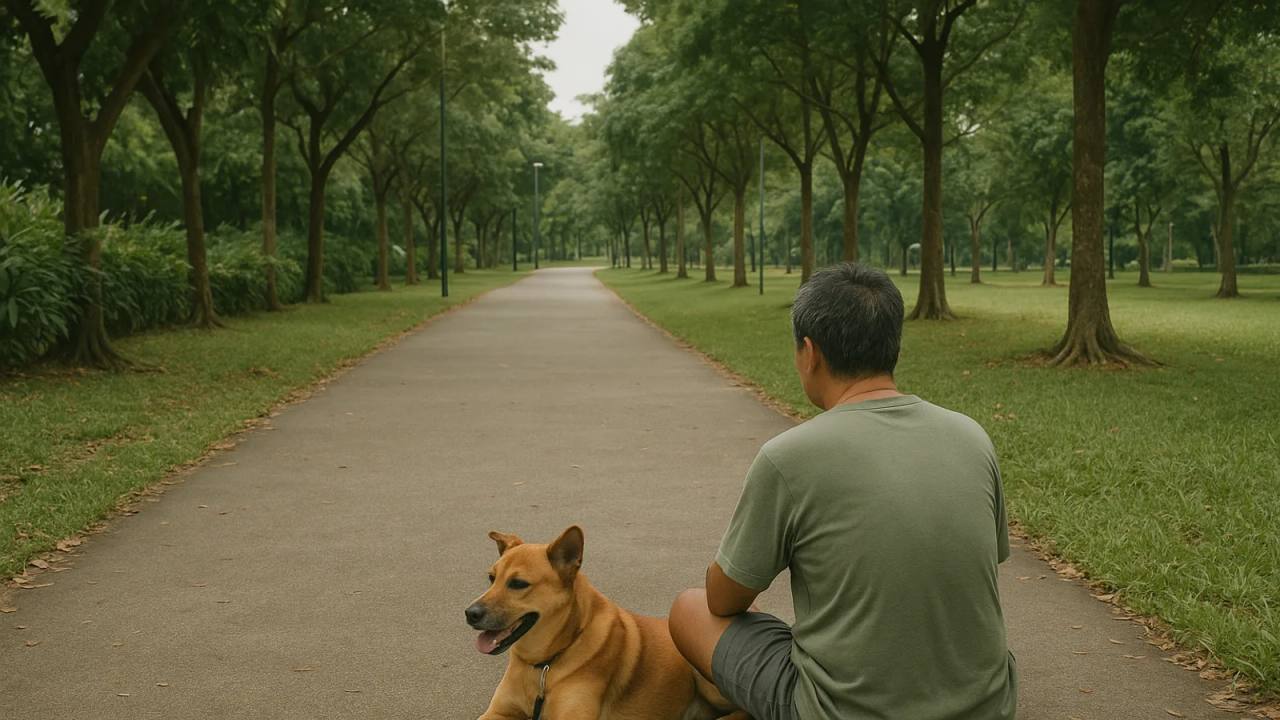
Shade management during any outdoor time is equally important. Selecting routes through parks with tree cover rather than open footpaths dramatically changes your dog's heat load. Keeping stops brief and avoiding open ground during the hotter parts of the day should be standard practice regardless of what cooling gear you have brought along. Gear is a supplement to these decisions, not a replacement for them.
HDB Living, Limited Space, and the Cooling Environment at Home
A significant proportion of Singapore dog owners live in HDB flats, and the home environment shapes cooling options in meaningful ways. Under the Housing and Development (Animals) Rules 2024, HDB residents are permitted to keep one dog of an approved small breed per residential unit. Small and toy breeds are well represented in Singapore households partly because of this rule, and many of these breeds have short muzzles that compromise their ability to pant efficiently, making heat management even more critical.
In a typical HDB flat, indoor cooling options are constrained by layout and space. A few practical arrangements help. Positioning your dog's resting area directly in the airflow of a fan or air conditioning unit, providing a cool gel mat in that same spot, and ensuring fresh water is always within easy reach forms the backbone of an effective indoor cooling setup. Elevated mesh beds that allow air to circulate underneath the body also provide conductive and mild convective cooling that a padded bed on the floor cannot match.
Owners on private premises with more space and access to gardens face different considerations. Shaded outdoor areas with good airflow can be comfortable in the morning and evening, though even shaded outdoor temperatures in Singapore rarely allow true rest during the midday period. A paddling pool in a shaded garden is a genuinely effective cooling tool for dogs that tolerate water. The Animal and Veterinary Service notes that private premises may house up to three cats or dogs, or a combination of both, meaning multi-dog households in private properties have proportionally greater cooling demands to manage.
Practical Takeaway: A Singapore-Specific Cooling Priority List
The following order of priorities reflects what the evidence and the local climate actually support. Work through this list before considering any additional gear purchase.
- Restructure walk timing immediately. Move all outdoor exercise to before 8am or after 7pm as a non-negotiable baseline. Check pavement temperature by hand before each walk.
- Use air conditioning as the primary cooling environment. This is your most powerful tool. If your dog spends significant time in an uncooled room during the day, that is the first thing to address.
- Apply conductive cooling methods at home. A cool wet towel, a gel mat positioned under a fan, a shallow tray of water for paw cooling, and constant access to fresh drinking water cover the majority of situations.
- Choose shaded, tree-covered routes for all outdoor time. Route planning is free and highly effective.
- Consider evaporative products only as a minor supplement. If you choose to use a cooling vest or bandana, pre-wet it thoroughly and use it alongside, not instead of, the approaches above. Accept that its performance will be limited by Singapore's humidity.
- Know the warning signs of heat stress. Excessive panting, drooling, bright red gums, disorientation, and collapse are serious. If you observe these, move your dog to a cool environment, apply cool (not icy) water to the body, and contact a veterinarian immediately. You can find information on the veterinary licensing framework in Singapore through the Animal and Veterinary Service.
Singapore's climate, characterised by year-round heat, persistent humidity around 82 percent, and minimal seasonal relief, demands a different approach to dog cooling than most product marketing assumes. The physics of evaporation do not lie. Prioritising behavioural controls, environmental adjustments, and conductive cooling methods over gear purchases is not a compromise. In Singapore, it is simply the correct order of priorities.
Common questions
- Why do evaporative cooling vests and bandanas underperform in Singapore?
- Evaporative cooling works by drawing heat away from the body as water turns to vapour and disperses into the surrounding air. When relative humidity is already around 82 percent on average, and frequently reaches 100 percent during prolonged rain, the air has almost no remaining capacity to absorb additional moisture. The vest or bandana stays damp but delivers very little cooling benefit because evaporation is severely slowed or halted entirely.
- What types of cooling gear do work in Singapore's conditions?
- Conductive cooling approaches transfer heat directly without relying on evaporation. A towel soaked in cool water and laid across the dog's neck, groin, and paw pads removes heat through direct contact. Similarly, a damp mat placed in shade, or a shallow tray of cool water for the dog to stand in, provides genuine relief regardless of ambient humidity. These methods work because they do not depend on the air being dry.
- When is the riskiest time of day to walk a dog in Singapore?
- Hot afternoons, when temperatures with a maximum above 32 degrees Celsius are common, combine with sustained high humidity to create the most demanding conditions. Early morning, typically before 8 am, and after 7 pm when solar radiation has reduced, offer meaningfully lower heat load. Shortening walks and moving them to these windows is more protective than any item of cooling gear worn during a midday outing.
- Are there surfaces that make heat stress worse for dogs?
- Concrete and tarmac absorb solar radiation throughout the day and radiate it back at paw level well into the evening, often reaching temperatures significantly higher than the recorded air temperature. Dogs absorb this conducted heat through their pads and also hold their heads close to the radiating surface. Choosing shaded paths, grassy verges, or covered walkways reduces both the paw-contact heat and the radiated heat the dog experiences.
- What should owners watch for as early signs that a dog is struggling with the heat?
- Excessive or frantic panting, a reluctance to continue walking, seeking shade and lying down, bright red gums or tongue, and thick ropy saliva are early indicators that a dog's thermoregulation is under stress. At this point the priority is to stop, move to shade, offer water, and apply cool wet cloths to the neck, groin, and paws. Heatstroke is a veterinary emergency and any dog that collapses or loses coordination should be taken to a vet immediately.
Sources
- Singapore mean annual relative humidityweather.gov.sg
- 82%
- 31 to 33
- 171
- 90 percent
How we verify content Fact-checking policy How we stay free