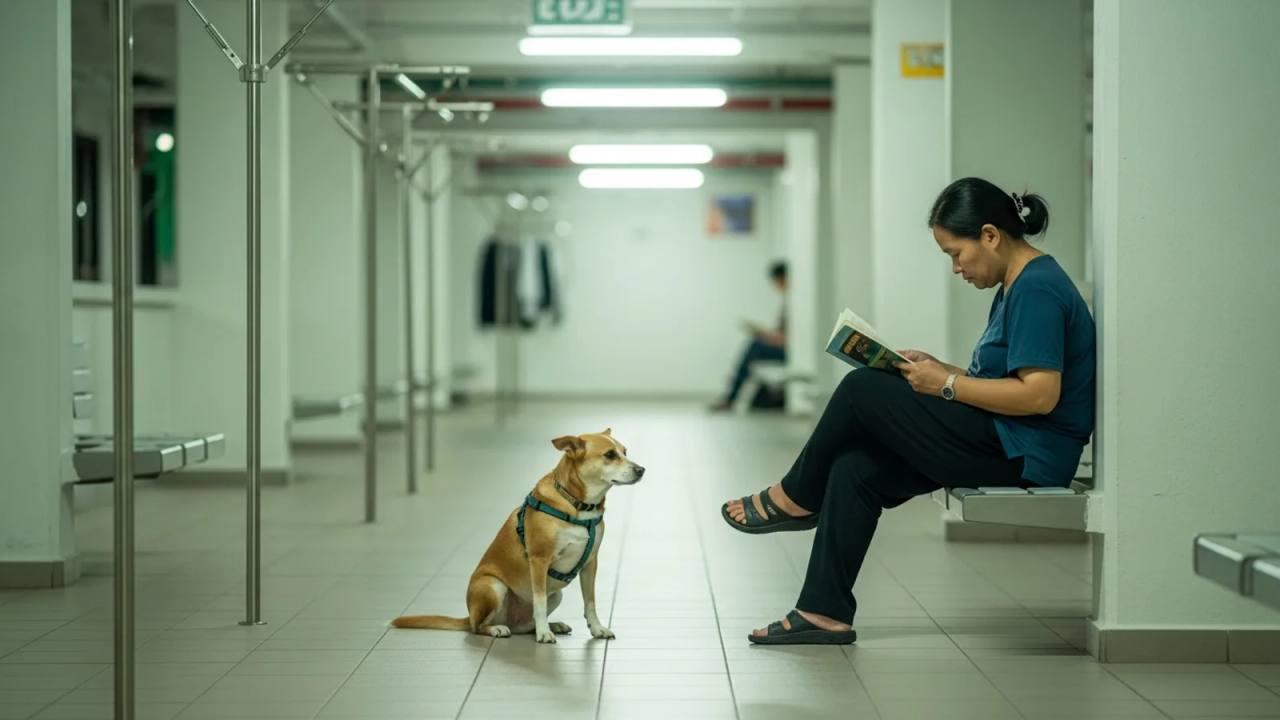

Is sudden fear always a puppy fear period?
A puppy who used to walk into the lift may suddenly stop at the doors. The change can be unsettling, especially when you have worked hard on gentle socialisation. Development may be part of the explanation, but you cannot diagnose a fear period from age or a familiar trigger alone. Pain, illness and a frightening experience can also change behaviour.
The American Kennel Club describes periods of increased sensitivity, commonly around 8 to 11 weeks and again between 6 and 14 months. Treat those as broad educational ranges, not a timetable every puppy follows or an instruction to dismiss symptoms. They are not Singapore-specific measurements.
Some puppies show conspicuous changes and others do not. A confident puppy becoming cautious is not proof that its owner made a mistake. Equally, a history of good socialisation does not guarantee a quick recovery. Focus on what the puppy is experiencing now and what support is needed.
What should I do in the moment?
Allow space from the thing that is worrying the puppy. Avoid dragging, cornering or holding them close to it to demonstrate that it is harmless. The AKC recommends letting the puppy control proximity and keeping experiences manageable. It is fine to leave without achieving a greeting or another repetition.
For example, if a delivery trolley startles your puppy in the lobby, step into a safe clear area rather than blocking the lift doors while trying to train. On another occasion, observe a trolley from farther away. The useful starting point is the puppy’s response, not a prescribed number of metres. Keep exits available and avoid trapping neighbours or other animals in the exercise.
A puppy taking a treat is not conclusive proof of comfort. Watch the whole response: posture, attempts to retreat, ability to disengage and recovery afterwards. Do not use food to lure a puppy into a situation it is trying to escape. Space, a pause or ending the outing may be the most helpful choice.
Socialisation should build comfort, not a completed checklist
AVSAB explains that exposure alone is not enough. Experiences that overwhelm a puppy can increase fear rather than reduce it. Adapt their intensity and pace to the individual. There is no need to compensate for a difficult day with more encounters the next morning.
In a Singapore home, useful practice might begin with a quiet lift lobby, a stationary umbrella at a comfortable distance, or a visitor who gives the puppy room. These are examples to adapt, not mandatory exercises. Ask household members and helpers to follow the same approach so the puppy is not repeatedly pushed into a situation another person has just found difficult.
Check the health side too. The AVSAB socialisation statement supports appropriate early experiences before vaccination is complete, with safeguards. Your vet should help choose suitable settings based on this puppy’s health, vaccination history and local infection risk. A crowded dog run is not equivalent to a managed puppy class.
What should I record?
Keep a short description of the trigger and context rather than labelling the puppy stubborn or aggressive. Useful notes include the location, what happened immediately beforehand, how the puppy reacted and how long it took to settle afterwards. Record accompanying physical changes such as limping, ear discomfort, altered appetite or sensitivity to touch.
For example: “Backed away when the harness touched the left shoulder; comfortable watching people from the sofa; less willing to jump today.” That gives a vet more useful information than “second fear period”. Do not recreate a frightening event to film it. Existing footage can help if obtained without increasing distress or putting anyone at risk.
When do we need professional help?
PDSA recommends a veterinary check for behaviour problems because pain and illness can contribute. Contact your vet for a marked change, persistent distress, fear that spreads to more situations or difficulty with ordinary care and outings. You do not need to wait two weeks to qualify for help.
Sudden aggression or a risk of biting needs prompt professional guidance and immediate separation from the triggering situation where this can be done safely. Do not punish warning signals or ask children to test whether the puppy will tolerate handling. PDSA advises contacting the vet promptly when aggression appears. Severe pain or other acute illness requires urgent assessment.
When choosing training help, ask what methods are used, how the professional handles a frightened dog, and whether they work with your vet. AVSAB recommends reward-based methods. A promise to fix fear through dominance, punishment or forced exposure is not an evidence-based plan.
How do we know things are improving?
Look for comfortable everyday choices: the puppy can observe and disengage, recover after a surprise or return to an activity without being pressured. Progress need not mean greeting every person or ignoring every sound. Compare like situations and leave room for rest, changes in the environment and the puppy’s physical condition.
Keep the next step small enough to remain manageable. If the current plan repeatedly produces freezing, escape attempts or escalating distress, change the plan with professional help. An improvement this week is encouraging, but there is no guaranteed date on which a developmental label makes the problem disappear.
Frequently asked questions
At what ages can puppy fear periods occur?
AKC describes broad ranges around 8 to 11 weeks and 6 to 14 months. They are educational ranges, not a diagnosis or a schedule every puppy follows.
Should I wait two weeks before calling the vet?
No. A marked change, persistent distress, physical symptoms or sudden aggression warrants veterinary advice without waiting for a fixed period.
Should I force my puppy to approach the trigger?
No. Allow distance and an exit, and build experiences at a manageable pace.
Does taking a treat prove the puppy is comfortable?
No. Consider posture, retreat attempts, ability to disengage and recovery as well.
Should all outings stop?
Adapt the setting and demands to the puppy and your vet’s health advice. Avoid overwhelming encounters; a quieter suitable activity may still be possible.
Did I cause this by socialising badly?
A change in confidence does not establish its cause or assign blame. Assess the current needs and seek help when needed.
Sources and editorial review
AKC: developmental sensitivity and handling; AVSAB: socialisation quality; AVSAB: early socialisation safeguards; AVSAB: reward-based methods; PDSA: assessment of behaviour problems; PDSA: sudden aggression. Editorial source review: 12 September 2026. Household examples are practical suggestions, not an individual veterinary treatment plan.
Common questions
- At what ages can puppy fear periods occur?
- AKC describes broad ranges around 8 to 11 weeks and 6 to 14 months. They are educational ranges, not a diagnosis or a schedule every puppy follows.
- Should I wait two weeks before calling the vet?
- No. A marked change, persistent distress, physical symptoms or sudden aggression warrants veterinary advice without waiting for a fixed period.
- Should I force my puppy to approach the trigger?
- No. Allow distance and an exit, and build experiences at a manageable pace.
- Does taking a treat prove the puppy is comfortable?
- No. Consider posture, retreat attempts, ability to disengage and recovery as well.
- Should all outings stop?
- Adapt the setting and demands to the puppy and your vet’s health advice. Avoid overwhelming encounters; a quieter suitable activity may still be possible.
- Did I cause this by socialising badly?
- A change in confidence does not establish its cause or assign blame. Assess the current needs and seek help when needed.
Sources
- AKC: developmental sensitivity and handlingakc.org
- AKC: developmental sensitivity and handling
- AVSAB: socialisation qualityavsab.org
- AVSAB: socialisation quality
- AVSAB: early socialisation safeguardsavsab.org
- AVSAB: early socialisation safeguards
- AVSAB: reward-based methodsavsab.org
- AVSAB: reward-based methods
- PDSA: assessment of behaviour problemspdsa.org.uk
- PDSA: assessment of behaviour problems
- PDSA: sudden aggressionpdsa.org.uk
- PDSA: sudden aggression
Start with a quiet moment together →A small idea to try, with progress kept in your Pack.
How we verify content Fact-checking policy How we stay free