
The rules
Is there a leash law in Singapore?
Editorial migration review, 17 September 2026. Current official guidance linked; original publication date preserved.
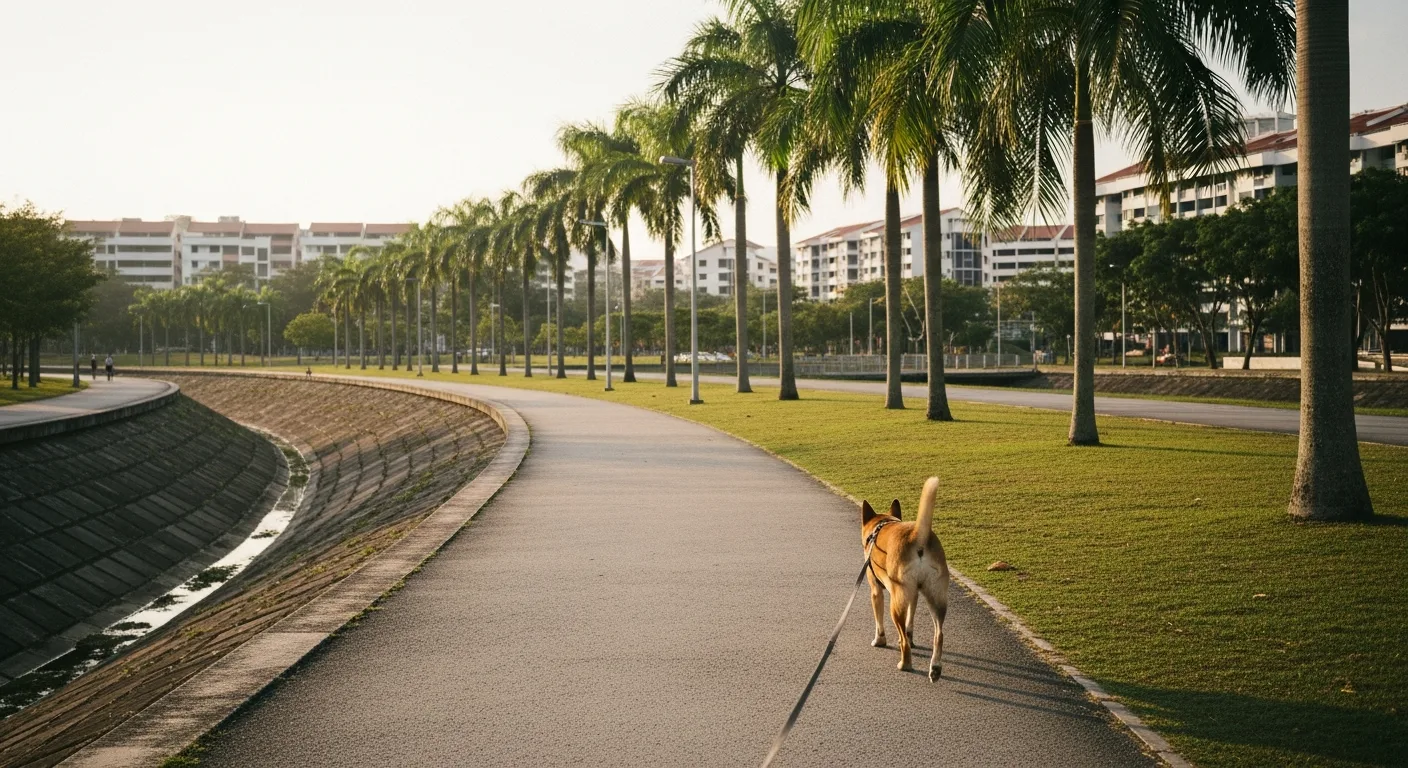
Yes. AVS says dogs in public spaces must be leashed, properly supervised and controlled. Follow the rules at the particular venue, including a designated dog run. Specified dogs and dogs with an individual muzzle condition have additional requirements. A quiet path or a dog’s friendly temperament is not an exemption.
By the numbers
- Muzzle and lead Both required in public for every Specified dog, in Part 1 and Part 2 alike Source
- 15 Breed categories carrying the muzzle-and-lead requirement in public Source
- All dogs Must be licensed and microchipped to their owner under the 2024 Rules Source
- 1 dog The HDB limit, so a multi-dog walk from one flat is already outside the rules Source
- 3 Combined cats and dogs allowed at private residential premises Source
The rule every owner has to follow
AVS’s current licensing guidance requires dogs in public spaces to be leashed and properly supervised and controlled. Check the applicable licence conditions and site rules rather than relying on a habit that other owners appear to follow.
A designated off-leash area has its own conditions. Check the signs, the dog’s eligibility and any continuing muzzle requirement. Put the lead back on before leaving. A public lawn, beach or empty connector is not automatically an off-leash area.
Access and control are separate: keeping a dog leashed does not allow entry to a place where dogs are prohibited. Check the route before leaving home, especially around nature reserves and attraction boundaries.
Muzzling: the extra rule for certain breeds
Check AVS’s specified-dogs list and the dog’s actual licence conditions. Dogs in both parts of that list have additional public-control requirements. An individual dog may also have a muzzle condition, so do not decide from a general “family breed” label.
The categories distinguish import restrictions from conditions for dogs already legally licensed. Do not describe every listed breed as either universally forbidden to keep or unrestricted to import. Our specified-dogs guide explains the distinction and links the current official requirements.
Introduce required equipment with appropriate support, and choose a suitable fit. A muzzle does not replace a lead, supervision or keeping distance from a difficult situation. Ask the vet or a qualified behaviour professional for help if fitting or handling is a problem.
What "under control" means in practice
The rule is not simply that a leash is clipped on. It is that the dog is under control. A long retractable line paying out ten metres across a shared path, with the dog weaving between cyclists and strangers, is a leash in name but not control in fact, and it will not satisfy an officer or a nervous neighbour. Keep the working length short in tight, busy spaces, and save the longer line for open, empty stretches where you can reel it in instantly.
Control also means you can actually hold the dog if it lunges. A leash looped loosely over a wrist while you look at your phone is how dogs bolt into traffic and how bites happen. Near roads, in lift lobbies, and around children, keep the dog close and your hand committed to the lead.
- Keep the dog leashed and controlled in public spaces.
- Shorten the working length near roads, crowds and narrow paths without forcing the dog into another animal’s space.
- Keep identification and PALS contact details current; check the current licence conditions.
- Use off-leash areas only under their stated rules and the dog’s own conditions.
- Meet any specified-dog or individual muzzle requirement.
Why the rule is stricter than it looks
Two things sit behind the leash law. The first is public safety in a dense, shared city where a park lawn doubles as a jogging route, a children’s play space, and a cycling path all at once. An off-leash dog that is friendly to you is still an unknown quantity to the toddler it bounds toward. The second is that Singapore’s public spaces are used by plenty of people who are frightened of dogs or come from cultures where dogs are kept at a distance, and the leash is the compromise that lets everyone share the same pavement.
Give the dog appropriate exercise and enrichment within the rules: a suitable leashed route or an eligible designated off-leash area. If you receive a notice or direction, respond to its actual terms rather than assuming a single fine amount applies to every situation.
Frequently asked questions
Must a dog be leashed in a public space?
AVS requires dogs in public spaces to be leashed, supervised and controlled. Follow the applicable site and licence conditions.
Does a quiet beach mean I can let the dog run free?
No. An empty space is not an off-leash permission. Use an authorised area under its stated conditions.
Which dogs need a muzzle?
Check the current specified-dogs rules and any condition placed on the individual dog’s licence.
Does a lead allow access to every park?
No. Some areas prohibit pets. Access permission is separate from keeping the dog under control.