
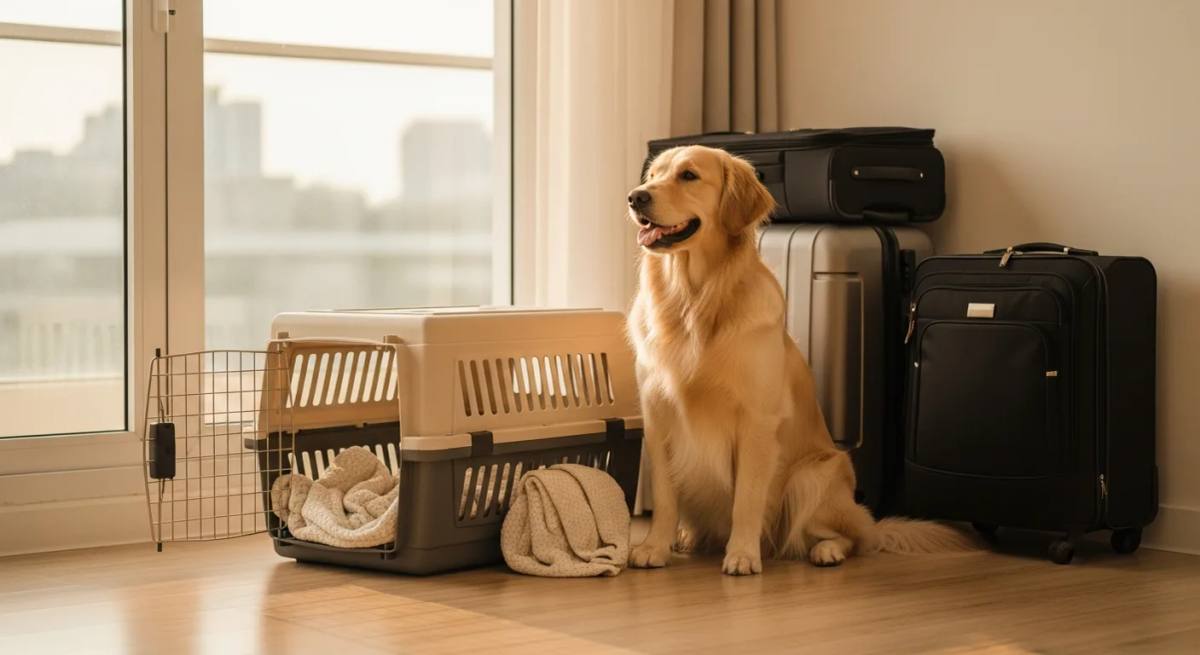

Relocating a pet out of Singapore, or bringing one in, means trusting a company to handle three things you cannot easily verify yourself: the crate meets airline standards, the paperwork is correct, and your pet is treated properly at every handover. None of that is unusual, and thousands of pets fly safely out of Changi every year. What matters is choosing a company that is honest about what it does and does not cover, and doing your own basic checks rather than taking a glossy website at face value.
By the numbers
- 12 Verified pet relocation companies on UrbanDogOwner
- 0 Of those, confirmed to also handle cats
- SGD 2,000-7,000 Typical door-to-door relocation cost
- SGD 400-1,500 Typical flight-booking or paperwork-only support
- 6 Destination regions covered across the roster
- IATA crate The one requirement every airline enforces
What a relocation company does, and what it does not
A pet relocation company's job is logistics: booking pet-safe space on an airline (either in the cargo hold under Live Animals Regulations, or occasionally as excess baggage in the cabin for small pets on certain routes), supplying and fitting an IATA-compliant travel crate, preparing export and import documentation, and, on the fuller-service end, courier collection and delivery on both sides of the trip. Some also liaise with quarantine facilities where a destination requires it.
What it is not is a substitute for the two parts of the process that stay with licensed professionals and government agencies. The veterinary health certificate that most countries require still has to come from a licensed export vet, not from the relocation company itself, and the Singapore export permit is still issued by the Animal and Veterinary Service (AVS). A good relocation company will tell you this upfront and help you book the vet appointment at the right time; a company that implies it can skip the vet step, or that its own staff can issue a health certificate, is one to question closely.
IPATA, AVS recognition, and why credentials are the first filter
The International Pet and Animal Transportation Association (IPATA) is the industry body for professional pet shippers worldwide, and its member directory is a reasonable starting point when you are trying to work out whether a company is a real, established operator rather than a one-person side hustle. IPATA membership is not a legal requirement to operate in Singapore, but it is a signal that a company has met a baseline of professional standards and has ongoing accountability to an industry body.
On the Singapore import side, there is now a firmer requirement: since April 2026, every dog and cat entering Singapore needs an AVS-recognised agent to handle clearance at the Centre for Animal and Plant Quarantine (CAPQ), and pet owners can no longer self-clear their own pet at the centre. If you are bringing a pet into Singapore, confirming AVS recognition for CAPQ clearance specifically, not just general pet-transport experience, is now a non-negotiable check.
IATA crate requirements and quarantine basics
Almost every airline that carries pets in the cargo hold requires a crate that meets IATA's Live Animals Regulations: enough space for the animal to stand up, turn around, and lie down in a natural position, secure ventilation on at least two sides, a solid leak-proof floor, and no protruding hardware. A relocation company that talks fluently about crate sizing, ventilation, and IATA specifications is speaking the industry's actual language; one that hands you a generic pet carrier and calls it done is cutting a corner that airlines and, more importantly, your pet's comfort will notice. Get the crate early and let your dog or cat get used to it at home well before the travel date.
On quarantine and import rules: every destination country sets its own requirements, and they change over time, so this guide will not state a specific country's rules as settled fact. As a general framework, most countries ask for up-to-date vaccinations (rabies titre testing and a minimum waiting period are common), a veterinary health certificate issued within a set window before travel, and, depending on the country and your pet's paperwork, anything from no quarantine at all to several weeks of isolation on arrival. Check the destination country's current requirements directly with its government agency or embassy, and treat what a relocation company tells you as a helpful starting point to verify independently, not the final word. If your move involves Malaysia specifically, note that the relocation company being based in Singapore is a separate question from the destination itself; a Singapore-based company shipping a pet to Malaysia is ordinary relocation business, distinct from the short cross-border day-trip guidance covered in our travelling to Johor Bahru with your dog guide.
What does it actually cost?
Pricing varies enormously by destination, pet size, and how much of the process you hand over, so treat the figures below as general Singapore market ranges rather than a quote for your specific move. At the lean end, paperwork-only or flight-booking-only support, where you handle the vet visits and crate yourself and the company just books the flight and checks your documents, typically runs about SGD 400 to 1,500. A mid-tier service that manages documentation and CAPQ or destination-quarantine coordination while you still do the vet prep and crate training sits around SGD 1,500 to 3,000. A full door-to-door service, where the agent manages everything from the vet appointment to crate delivery to post-arrival transport at the other end, commonly runs SGD 3,000 to 7,000 or more, depending on the destination and the size of the crate. Airfare (roughly SGD 1,000 to 4,000, depending on the airline's live-animal policy and the crate's weight and size) and the crate itself (roughly SGD 200 to 800 for an IATA-compliant model) are often billed as separate line items on top of the agent's fee, so always ask for an itemised breakdown rather than accepting a single round number.
Red flags to watch for
A few warning signs are worth taking seriously, on their own or in combination:
- No real Singapore office or landline. A mobile number and a WhatsApp handle are not the same as a checkable business address you could visit if something went wrong.
- No independent reviews. Testimonials on the company's own website are easy to write; look for reviews on Google, IPATA's own listing, or an expat forum thread you can read in full.
- Demands full payment upfront with no milestones. A reasonable agent structures payment around booking confirmation, crate delivery, and completion, not one lump sum before anything is booked.
- Vague on the actual airline and route. A company that will not name which airline it plans to use, or dodges when asked about cargo-hold conditions, has not actually booked anything yet.
- No plan for delays or a failed vet check. Flights get cancelled and pets occasionally fail a pre-travel health check close to departure. A company with no answer for "what happens then" has not thought it through.
None of these on their own is automatically disqualifying, since small operators can be excellent and large ones can still cut corners, but a company that clears every one of these checks has done the basic homework that a nervous pet owner cannot always do from the outside.
Verified Singapore pet relocation companies
UrbanDogOwner tracks 12 pet relocation companies that we have independently checked against their own website: a real Singapore contact, a description of what they actually offer, and, for a handful of them, explicit confirmation that they also handle cats. Between them they cover destinations across Australia, Europe, Malaysia, New Zealand, UK, Worldwide. Each listing links straight to the company's own website. These directory choices are editorial, with no affiliate commission attached, so the questions that matter stay centred on your pet's journey.
Browse the full, filterable roster on the Singapore pet relocation directory, where you can narrow by destination, by flight-booking-only versus full door-to-door service, and see which companies confirm they also ship cats.