
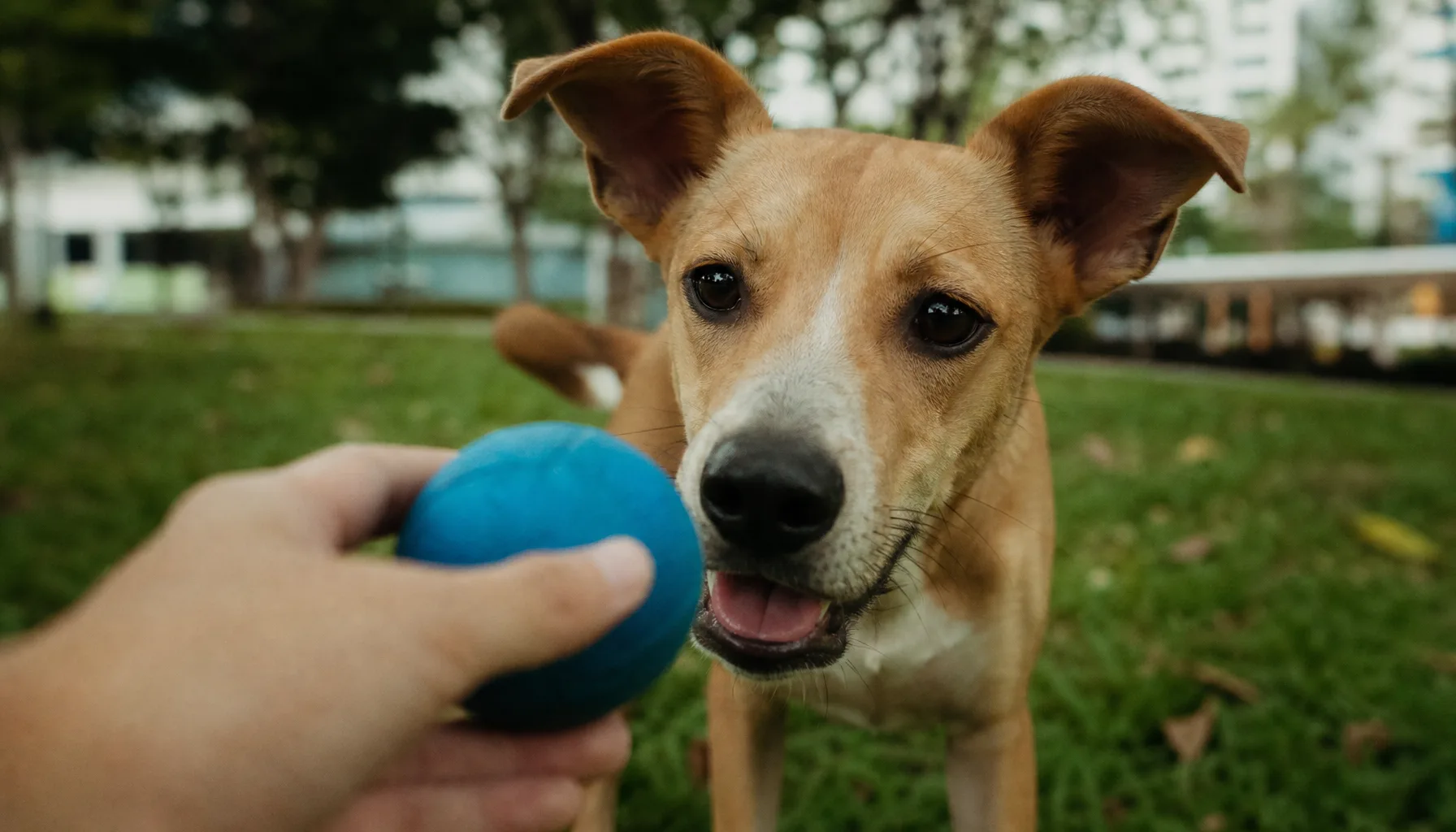

Your dog can share your favourite walking route while noticing different things along the way. Understanding the broad differences in vision can help you choose clearer cues and a more comfortable environment. It does not let us read exactly what a dog sees or explain every behaviour through eyesight alone.
1. Colour is one part of the picture
Dogs have two cone types, with sensitivities in blue-violet and greenish-yellow ranges. Red versus green is harder for them to distinguish than for a person with typical colour vision. This supports trying a blue or yellow toy against a contrasting background. It does not prove that a red toy is invisible: brightness, shape, scent and context still contribute.
For a useful home experiment, offer a familiar toy against two different, uncluttered backgrounds while keeping the game easy and enjoyable. Watch what your own dog chooses. Avoid interpreting a missed retrieve as an eyesight problem or a failed training attempt.
2. Fine detail and an individual dog’s eyes
The American College of Veterinary Ophthalmologists describes estimates around 20/75 from published work. In that notation, detail resolved at 20 feet by the tested observer corresponds to detail a typical 20/20 observer resolves at 75 feet. The nearer distance belongs to the observer with lower acuity. It is not a universal eye-chart result for every dog.
For training, begin where your dog can comfortably notice and respond to a familiar cue. Change distance gradually rather than expecting a precise hand shape to work across a busy park. A clicker is an audible marker, so its usefulness does not depend on seeing the device. If a previously reliable response changes, consider the whole situation rather than simply making gestures larger.
3. Movement is more complicated than “better than humans”
Different experiments test different aspects of motion. A 2017 study of coherent motion detection found dogs performed less well than humans in that particular task. That is a useful correction to the sweeping claim that dogs are better at every kind of motion detection. It does not mean a moving animal cannot be highly noticeable to your dog.
There is no reliable rule here that a dog spots a squirrel at 100 metres but misses a cat at five. During a walk, watch your dog’s actual response and create space if they become uncomfortable. Keep play and training at a level where they can engage willingly; a screen filter cannot prescribe the right distance.
4. Field of view and recognising people
Eye position and head shape affect a dog’s visual field and binocular overlap. A single “250-degree” promise glosses over that variation. You also cannot infer from a dog looking forward that they have failed to notice activity to the side.
Face-processing research has found dogs can distinguish some human and dog face images. Recognition is not an either-or choice between faces and smell. Avoid testing a dog by withholding familiar cues or setting up a frustrating recognition challenge. Approach in a familiar, calm way and let them orient to you.
5. Make the route comfortable for both of you
Dogs have adaptations that help in dim light, including retinal rods and, in most dogs, a reflective tapetum. This does not establish that a particular dark corridor feels like daylight, or that every dog sees best at 5am.
Choose adequate lighting, familiar footing and enough time to move comfortably. Temperature, surfaces, traffic and your dog’s condition all belong in the decision. Use the walking planner and heat-safety guidance alongside what you observe, rather than treating the clock as a guarantee.
6. Try the illustration thoughtfully
The vision tool lets you compare a colour-shifted image and softer detail with the original. Try a photo of a favourite play area, switch the two effects separately and notice what stands out. The picture cannot recreate scent, sound, depth, movement or visual health.
The same page processes a chosen photo in your browser and lets you download the illustration. The separate eight-round game is a puzzle about spotting that filter. Neither result scores your bond with your dog or certifies what they can see.
Sources and review
- ACVO: colour, acuity, dim-light adaptations and visual fields
- Scientific Reports (2017): dogs and coherent motion detection
- Research (2010): discrimination of human and dog face images
The practical suggestions are editorial applications of these limits, not a veterinary examination or a guarantee of training results.