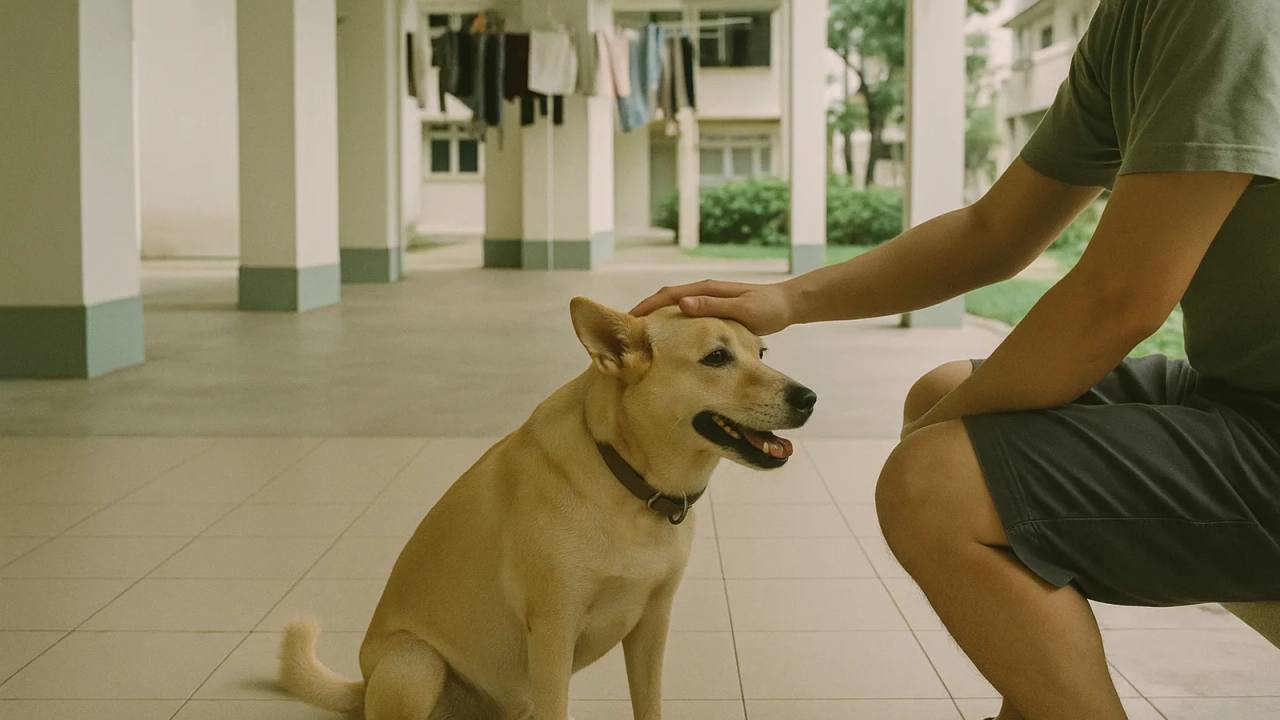

Almost every owner has watched a dog drag its backside across the floor and made a joke about it. It is one of the few dog behaviours that is genuinely funny to witness and genuinely painful for the dog. Anal sac disease is common, it escalates in a predictable way, and the early stage is far easier to deal with than the late one. Here is what is actually going on back there.
By the numbers
- 2 Anal sacs a dog has, one on each side of the anus
- 4 and 8 o'clock Where the sacs sit relative to the anus
The scooting joke has a cost. Because the behaviour looks comic, owners tend to watch it for weeks, try a deworming tablet on a hunch, and only book the vet once something visibly bursts. By then a simple problem has become a painful one. The sequence from mild to serious is well described, and knowing it is most of what you need.
What the anal sacs actually are
VCA Animal Hospitals describes the anal sacs as 2 small pouches sitting on either side of the anus, at roughly the 4 o'clock and 8 o'clock positions. The walls are lined with glands producing a foul-smelling fluid, which collects in the sacs and is released through a small duct that opens just inside the anus. They are present in both males and females.
The fluid is a scent marker. VCA explains that the secretions work as territorial markers, similar in principle to a skunk's, and that they give each dog's faeces a distinctive signature. That is why dogs are so interested in one another's droppings at the void deck, and it is worth knowing that the smell has a purpose, because owners often assume any anal sac odour is a sign of disease. It is not. It is the system working.
How the system fails
Normally the sacs empty themselves. VCA notes that anal sac fluid is squeezed out by muscular contractions whenever the dog passes a bowel movement. Everything downstream of that depends on it happening reliably.
When it does not, you get impaction. VCA states that anal sac disease is common in dogs, and that the sacs frequently become impacted or plugged, usually because of inflammation of the ducts. The secretion in a blocked sac thickens, the sacs swell and distend, and passing a bowel movement becomes painful. That is the point at which most dogs begin to scoot.
Impaction then invites infection. VCA describes the trapped material as an ideal medium for bacterial growth, and notes that bacteria normally present in faeces can travel up the ducts and into the sacs. In a working sac those bacteria are flushed out with each bowel movement. In a blocked one they stay. The fluid turns bloody, then fills with pus, and an abscess forms.
An abscess is the stage owners do notice. VCA describes it as a painful, red, hot swelling on one or both sides of the anus, which may burst and release greenish-yellow or bloody pus through an opening in the skin beside the anus. Left untreated, the infection can spread quickly and cause severe damage to the anal area. That is the whole argument for acting at the scooting stage rather than the swelling stage.
Reading the early signs
VCA lists the first sign as scooting or dragging the rear end along the ground, often accompanied by excessive licking or biting. The detail worth holding on to is that the licking is frequently at the base of the tail rather than at the anus, which is why owners mistake it for a skin or allergy problem and treat the wrong thing for a fortnight.
The other signal is temperament. VCA is direct that anal sac disease is very painful, and that even normally gentle dogs may snap or growl if you touch the tail or anus. If a dog who has always accepted handling suddenly objects to having his back end touched, that is diagnostic information, not a behaviour problem that appeared out of nowhere. Do not correct it. Book the appointment.
What treatment involves
For impaction, VCA describes expressing the sacs and flushing out any solidified material, with anti-inflammatory and antibiotic medication sometimes infused into the affected sac. The procedure can be painful enough to require sedation, which is worth knowing in advance so the cost and the plan do not come as a surprise on the day.
For infection, the approach is to express the sacs and give oral antibiotics to clear the bacteria. VCA notes most dogs respond well to pain relief alongside treatment. The general principle holds across both: the earlier in the sequence you arrive, the shorter and cheaper the intervention.
The groomer question
In Singapore, where most dogs are groomed professionally every few weeks, anal sac expression is often bundled into the standard package without anyone discussing it. That deserves more thought than it usually gets. Routine expression on a dog with no symptoms is not automatically the right call for every dog, and it is a reasonable thing to ask your own vet about rather than leaving as a default on an invoice.
What is clearly useful is information flow. Ask your groomer to tell you whether they expressed the sacs and what came out, because a groomer who does this every few weeks is often the first person to notice that something has changed. That observation is worth passing to your vet. A groomer noticing difficulty, or an unusual smell, or a dog objecting to handling that never objected before, is an early warning you would otherwise not get.
The Singapore angle
For a ruptured or draining anal sac, follow the vet’s specific cleaning, medication and follow-up plan. Singapore’s humid weather may make keeping bedding and the surrounding coat clean more demanding, but a climate statistic does not prove a particular wound-healing outcome. Do not apply unprescribed antiseptics or attempt to express a painful swelling.
The second is stool consistency. The mechanism depends on a firm bowel movement providing the pressure that empties the sacs, so a dog with persistently loose stools loses that mechanism. If your dog scoots and also has chronically soft stools, those are likely to be the same conversation with your vet rather than two separate ones. AVS publishes general guidance on caring for a pet in Singapore, and AVS licensing information is worth keeping current alongside routine health admin.
What to do this week
Repeated scooting, licking, discomfort or a change in handling tolerance deserves a vet check. Anal sac disease is one possibility, but parasites, skin irritation and other problems can look similar. Do not squeeze the sacs or assume deworming will solve it. A painful swelling, bleeding or drainage beside the anus warrants same-day advice; marked illness or severe pain needs urgent assessment.
Common questions
- Why is my dog scooting?
- Anal sac disease is one possible cause, but parasites, skin irritation and other problems can also cause scooting or licking. Repeated signs need a vet examination rather than treatment based on the behaviour alone.
- What are anal glands?
- They are more accurately anal sacs: 2 small pouches sitting on either side of the anus at roughly the 4 o'clock and 8 o'clock positions, per VCA. The walls are lined with glands that produce a foul-smelling fluid.
- Should I get the sacs expressed at every groom?
- Routine expression on a dog with no symptoms is not a given, and it is worth asking your vet whether your particular dog needs it. Ask your groomer to tell you if they are doing it and what came out, because that information belongs in the conversation with your vet.
- How is anal sac disease treated?
- VCA describes expressing the sacs and flushing out solidified material for impaction, sometimes under sedation because the procedure is painful. Infection is treated by expressing the sacs and giving oral antibiotics.
- When is it an emergency?
- A painful, red, hot swelling beside the anus suggests an abscess, and a burst abscess drains greenish-yellow or bloody pus. Both warrant same-day veterinary attention rather than the next available appointment.
Sources
- VCA Animal Hospitalsvcahospitals.com
- 2: Anal sacs a dog has, one on each side of the anus
- 4 and 8 o'clock: Where the sacs sit relative to the anus
- The anal sacs are two small pouches on either side of the anus, at roughly the four o'clock and eight o'clock positions.: Reference
- The sac walls are lined with glands producing a foul-smelling fluid that is released through a small duct just inside the anus.: Reference
- Anal sac fluid is normally squeezed out by muscular contractions when the dog passes a bowel movement.: Reference
- Anal sac disease is common in dogs. The sacs frequently become impacted, usually from inflammation of the ducts.: Reference
- Impacted secretions are an ideal medium for bacterial growth, and faecal bacteria can travel up the ducts into the sacs.: Reference
- An abscess appears as a painful, red, hot swelling beside the anus, and may burst to release greenish-yellow or bloody pus.: Reference
- The first sign is often scooting, dragging the rear along the ground, plus excessive licking or biting, often at the tail base.: Reference
- Anal sac disease is very painful, and even normally gentle dogs may snap or growl when the tail or anus is touched.: Reference
- Treatment for impaction is to express the sacs and flush out solidified material, sometimes requiring sedation. Infection is treated by expressing the sacs and giving oral antibiot: Reference
- Meteorological Service Singaporeweather.gov.sg
- 82%: Mean annual relative humidity in Singapore, which keeps skin and coat problems in play year round
- Singapore's mean annual relative humidity is around 82%, varying from more than 90% just before sunrise to around 60% in the afternoon on dry days.: Reference
- AVS, NParksavs.nparks.gov.sg
- AVS publishes guidance on caring for a pet in Singapore.: Reference
- AVS, NParksavs.nparks.gov.sg
- AVS licenses dogs in Singapore and sets the licensing requirements.: Reference
How we verify content Fact-checking policy How we stay free