
Finding a littermate can be moving for the people involved. For the dogs, recognition is uncertain and a comfortable meeting matters more than the family story.
Can a dog recognise a sibling after years apart?
Possibly, but a family connection does not guarantee recognition, affection or an easy reunion. The research gives a more qualified answer than the familiar story that dogs always remember their littermates through scent. For an owner arranging a meeting, the useful question is whether both dogs feel comfortable together now. You can make room for that lovely possibility without asking the dogs to prove a memory for the camera.
This distinction matters if you have found another adopter from your dog's original litter. There may be photographs to exchange, a shared rescue history to piece together and a real wish to reconnect. Those are good reasons for the people to meet. Whether the dogs join them should depend on the dogs' present needs, rather than the emotional appeal of the family story.
What the early research actually found
In Peter Hepper's 1994 study, scent cues were sufficient for recognition in young puppies. Mother and offspring recognition was also found after a lengthy separation. Adult sibling recognition had an important condition: dogs recognised a sibling when they had continued living with another sibling. Dogs living alone did not show that result. This does not support a blanket promise that separately raised littermates will recognise each other years later.
Later findings complicate the story
Hamilton and Vonk's 2015 research compared responses to scents from closer and more distant relatives. Its experiments included fathers the dogs had not met and siblings separated during puppyhood. Female dogs did not show a statistically significant preference; males preferred the more distant relative's scent in some comparisons. Family scent was not a simple attraction signal.
These are studies of behaviour under particular test conditions. Their findings are useful because they make an easy claim harder to repeat, not because they let us diagnose the memory of a dog in a park. A scent preference, a recognition mechanism and a friendly relationship are different questions. A household reunion does not automatically measure any of them cleanly.
A reunion video cannot tell you what a dog remembers
Imagine filming a greeting without telling the viewer whether the dogs are related. What could they actually observe? They could describe which dog approached, whether either moved away, how their bodies looked and whether they chose to interact again. They could not read a remembered puppyhood from those movements. Adding a caption about siblings changes the human interpretation, but adds no new observation of the dogs themselves.
The same caution works in the other direction. A quiet greeting is not proof of forgetting. Excitement is not proof of recognition. There is no reason to stage repeated greetings until you obtain the reaction you hoped for. You can enjoy the meeting as an experience in its own right, while leaving the memory question unanswered.
Plan around the dogs you have today
Before inviting another adopter, exchange practical information: how each dog usually responds to unfamiliar dogs, whether either has been frightened or injured in previous encounters, and whether anything about their health or routine has changed. Agree that cancelling or ending early will be acceptable. These are planning questions, not a compatibility score or a promise that the encounter will succeed.
For dogs who are worried by other dogs or show aggression towards them, the RSPCA recommends avoiding those situations and seeking veterinary or clinical behaviour advice. Being relatives does not remove that concern. Swapping photographs and updates between the households is still a reunion of sorts, and may be the kinder choice for the animals.
Give a first meeting space
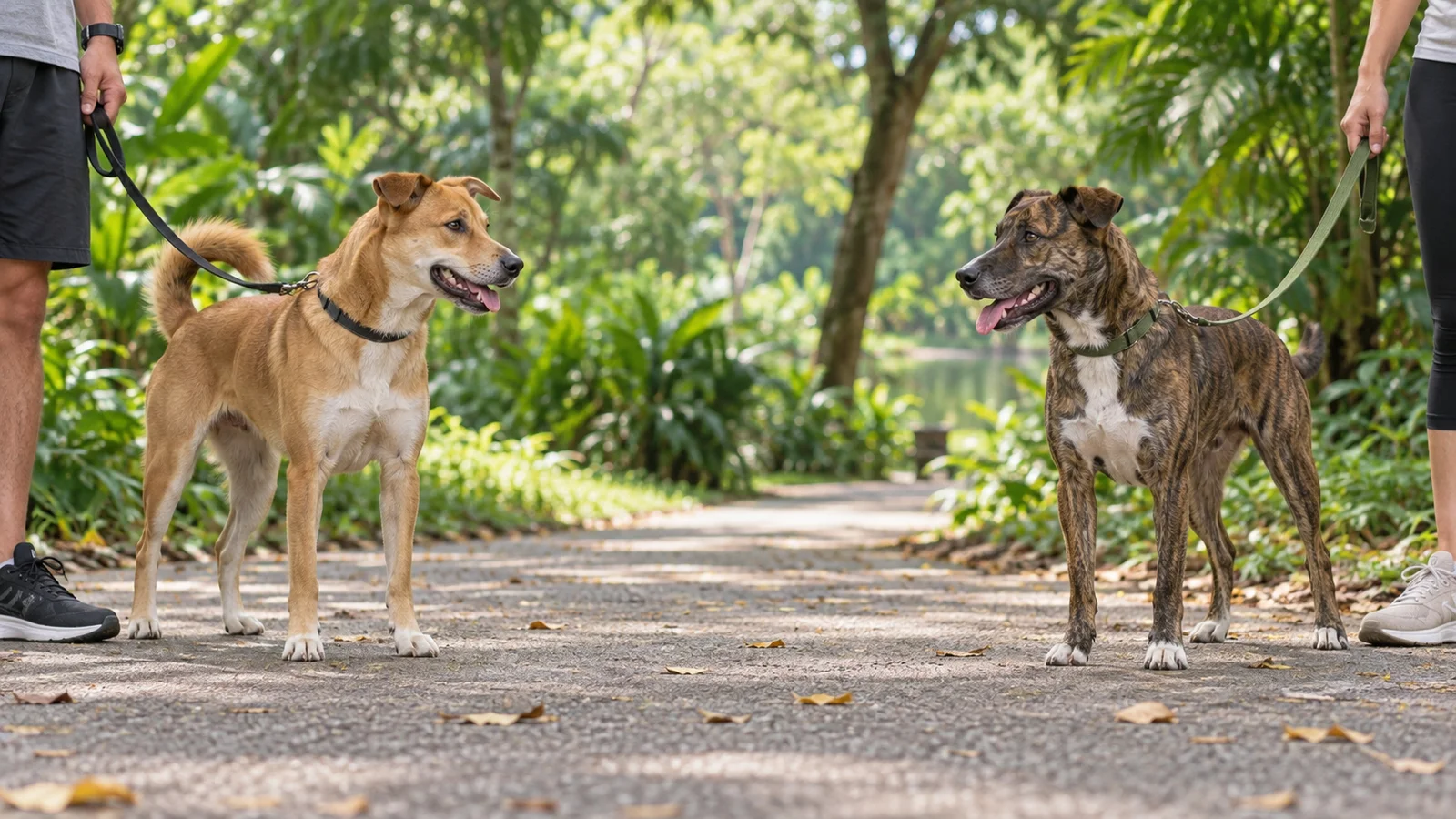
The RSPCA's introduction guidance recommends neutral territory and separate handlers, with a walk helping the dogs get acquainted without making the greeting the entire event. Apply that ordinary introduction approach to relatives too. Neither dog's home doorway needs to become the stage for a surprise face-to-face meeting.
For a Singapore meetup, our practical suggestion is to choose a quiet place with room to change direction and leave independently. Avoid making a crowded lift lobby or a narrow cafe entrance your meeting point. Send each other the location beforehand and agree who will arrive first. Plan where each household can go if the meeting does not work, instead of having to negotiate while holding excited dogs.
Watch the whole dog, then respond
Dogs Trust's body-language guidance describes relaxed dogs as loose through the body, responsive and able to settle. Read the whole situation rather than treating a wagging tail or a single sniff as a verdict. If your dog's usual behaviour changes, a veterinary check may be needed rather than assuming the other dog is the entire explanation.
During introductions, Dogs Trust advises giving space at early signs of discomfort. Significant distress such as lunging or snapping calls for separation, with professional help before trying again. Do not force contact because the dogs are family. A meeting that ends calmly after a brief look at one another can be a better outcome than a longer one nobody enjoyed.
Keep the memory without inventing the meaning
A useful note can be very simple: where you met, how much space each dog chose, what prompted a break, and whether both owners would choose the same setting again. Include anything you would change next time. Keep that note with your own pet-care records rather than posting another owner's details publicly.
Afterwards, write down what happened in ordinary language: both dogs walked nearby, one preferred distance, or they chose to play after a break. That record is more useful for planning another meeting than deciding that they definitely remembered or definitely forgot. Ask the other owner what they noticed too. Different observations can help you see what your own excitement made easy to miss.
UDO's playtime compatibility tool can help organise a conversation about playmates, but it cannot test kin recognition or certify a safe pairing. If you are exploring adoption, use the adoption directory to find the responsible rescue and discuss the individual dog with its carers. A shared litter is part of a dog's history. The relationship you help them build today deserves attention of its own.
A calm sniff and a quiet exit is not indifference. It is often the quietest evidence a dog's nose already knows exactly who it is greeting.
Common questions
- Does being littermates guarantee recognition?
- No. The research does not establish reliable recognition for all separately raised adult siblings.
- Does a calm greeting mean my dog has forgotten?
- No. A greeting alone cannot establish recognition or forgetting. Describe the behaviour you see without assuming the memory behind it.
- Should related dogs meet without a careful introduction?
- No. Treat them as dogs meeting now. Plan around their current behaviour, give them space and end the meeting if either is distressed.
Sources
How we verify content Fact-checking policy How we stay free