
Prepare a private reference for your dog's identifying details, registration information and recent photographs, using AVS's reporting guidance and practical household record keeping.
Why preparation matters before a dog goes missing
Keep one private reference for your dog's identifying details, current contact information and a recent photograph. The aim is to have useful material ready if it is needed, rather than trying to reconstruct it while looking for your dog. AVS's missing-pet guidance lists the information to provide when reporting a lost animal. Use that official list as the basis for your record, then organise it in a way that your household can actually find and maintain.
Permanent identification: microchipping and licensing
A microchip number belongs in that reference, alongside the corresponding registration information. AVS's microchipping page explains that a chip is an identifier read by a scanner, and that microchipping should be performed by a licensed veterinarian. This preparation guide does not describe how to perform that procedure. If you do not know your dog's number or registration status, make that an explicit question for your existing veterinary clinic and the applicable AVS service.
Microchipping on its own is not enough. AVS states clearly that an unregistered chip cannot be traced to an owner. The chip's unique identification number only becomes useful if it is linked, through licensing or registration, to the owner's current contact details. Under the Animals and Birds (Licensing and Control of Cats and Dogs) Rules 2024, pet dogs in Singapore are required to be microchipped and licensed. AVS's missing-pet page says owners should ensure that the animal is microchipped and licensed on PALS or registered with AVS. Treat the registration record and the number itself as separate things to check.
Visible identification on the collar
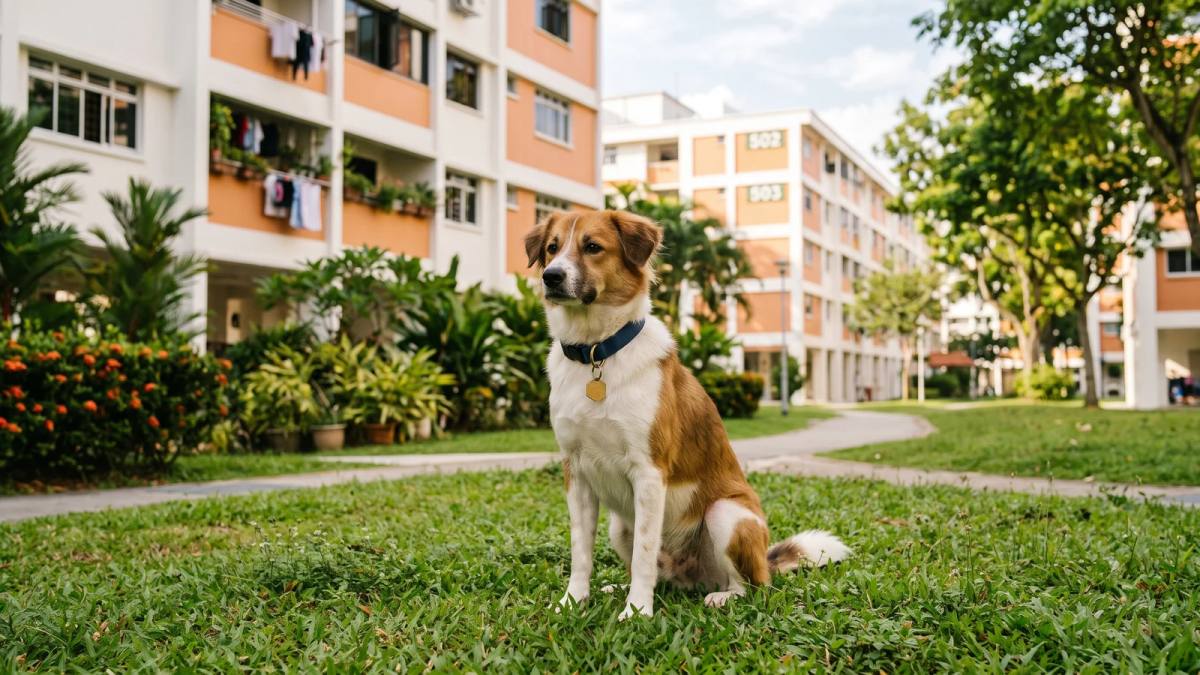
AVS also strongly encourages an identification tag on the animal's collar, carrying the animal's name and your contact number so you can be contacted easily. Keep the tag's purpose separate from registration and reporting. A visible number does not replace the official finder instructions or establish that every other identification step is unnecessary. As a practical preparation task, check that the contact details you intend to use are legible.
Compiling a ready description for authorities
Beyond permanent and visible identification, AVS's guidance on what to do if a pet goes missing lists specific details that officers will request when a report is made. Owners can save time when making a report by having this information written down and easily accessible beforehand, such as in a phone note or printed card. The details AVS asks for include:
- The dog's name, microchip number, breed, age, sex, and colour
- Whether the dog has any accessories, such as a collar or ID tag
- A description of any distinguishable body markings the dog may have
Having the microchip number on hand is particularly useful, since AVS notes that if a microchipped animal is found, officers can quickly trace it through the microchip database, but only if the animal's details are properly registered with AVS. This reinforces why organising registration details ahead of time, rather than after a dog has already gone missing, gives the authorities a registered record to consult.
Preparing materials for a wider search
AVS's guidance also recommends broadening the search beyond official channels if a pet goes missing, and some of this groundwork can be done in advance. The guidance suggests preparing flyers that include a clear photograph of the dog and the owner's contact details, which can be distributed around the neighbourhood, at veterinary clinics, or at pet shops with the permission of those businesses. Keeping a recent, clear photo of the dog on hand, ideally showing any distinctive markings, means a flyer can be produced quickly rather than needing to search for a suitable image under stressful circumstances.
AVS also identifies online communities, social media and newspaper classified advertisements as possible ways to broaden a search. Keep the current links for the channels you would consider using, but check their rules before posting. A group name alone does not establish that its administrators can trace, transport or house a dog. If someone offers help, clarify the specific action rather than assuming every volunteer or organisation performs the same role.
Understanding the role of finders and authorities
It is also useful for owners to understand what happens on the other side, so that their own preparation aligns with the process. The AVS guidance for people who find a missing pet explains that finders are asked to contact the Animal Response Centre, inform other animal groups, and bring the animal to a vet clinic to scan for a microchip number. This underscores again why a registered microchip and a legible collar tag matter: they are the two pieces of information a stranger or officer can act on immediately when a dog is found.
Make the record usable by the people who care for your dog
Choose one main copy and give it an obvious name. You might keep it in a private household folder with a short printed reference stored alongside the dog's usual documents. That is an organisational suggestion, not a requirement to buy an app or create another account. If several people help with care, agree which copy is current and who maintains it.
Separate facts you have checked from questions you have not resolved. For example, record the microchip number from the relevant document rather than entering a number from memory. If registration needs checking, write that down as an outstanding action. A complete-looking form is less useful than a short record that makes its gaps clear.
For photographs, choose clear views rather than only favourite portraits. Consider whether the pictures show the features you would describe in a report, such as coat pattern or a distinctive marking. Keep the original files available. You do not need to publish them now or include other people's faces simply because they were in the frame when the photograph was taken.
Make a separate, minimal version for a temporary caregiver. Decide which contact to use, where the current reference is kept and whom the caregiver should contact if a detail is missing. Ask them to confirm that they can open it before you leave. This checks access to your own information; it does not give a walker or sitter new duties they have not agreed to undertake.
Keep the fuller record private. Before placing information on a flyer or public post, decide what the audience needs for that purpose. A public notice and an official report are different destinations, so do not automatically copy the whole folder into both. Review attachments as well as text, particularly if a photograph shows documents in the background.
Return to the record when a relevant detail changes, rather than treating its creation as the final step. A new contact number, an updated registration document or a different regular caregiver is a reason to check the corresponding information. Remove confusing duplicate working copies where you can do so safely, and make the current version easy to recognise. This is ordinary record keeping, not a fixed timetable or a promise of a particular outcome.
Limitations of this guidance
This is a preparation framework based on the cited AVS guidance, with practical organisational suggestions. It is not a guarantee that a dog will be found or returned. Follow the current official reporting and collection instructions if a dog actually goes missing. This article does not prescribe veterinary procedures, quote service prices, verify a rescue organisation's capacity or replace advice about an individual dog's needs.
Common questions
- Is microchipping alone enough to identify my dog if it goes missing?
- No. AVS states that an unregistered microchip cannot be traced to an owner. The chip must be linked to your current contact details through licensing or registration for it to help reunite you with your dog.
- What information should I keep on hand in case my dog goes missing?
- According to AVS, you should be ready to provide your dog's name, microchip number, breed, age, sex, colour, any accessories like a collar or ID tag, and a description of distinguishing body markings.
- Why does AVS recommend a collar tag if my dog is already microchipped?
- AVS encourages an identification tag carrying the animal's name and your contact number so that you can be contacted easily if the animal is found. Continue to follow the applicable microchip, licensing and finder guidance.
Sources
How we verify content Fact-checking policy How we stay free