
Fostering is the least understood way to help a dog in Singapore, and it is also the one with the shortest queue. Shelters here are full. Action for Singapore Dogs said it had over 100 dogs under its care as of January 1, 2025, split between kennels and foster families around the island. A foster place is not a small favour, it is the difference between a dog waiting in a kennel run and a dog waiting on a sofa. Here is what the shelters actually ask for, and what the weeks look like once a dog arrives.
By the numbers
- 18 Minimum age to foster through SPCA, at the point of application
- 100 dogs Dogs in ASD care as of 1 January 2025, across kennels and foster homes
- 3 weeks Minimum commitment SOSD asked of fosterers during its parvovirus appeal
- 76 dogs Dogs listed for adoption at ASD on 1 September 2026
Fostering sits in an odd blind spot. Most people who want to help a shelter dog in Singapore go straight to adoption, decide they cannot commit to fifteen years, and stop there. Fostering is the option in between, and shelters are short of it in a way they are not short of donations.
What fostering actually is
You take a shelter dog into your home for a defined but open ended stretch, and the shelter keeps ownership, keeps paying for its medical care, and keeps looking for an adopter. You supply the home, the routine and the reporting. That last part matters more than people expect: a fostered dog gets described to potential adopters using what you observe, so your notes on how it handles the lift, the void deck and being alone become the dog's adoption profile.
The scale of the need is easy to check. Action for Singapore Dogs says on its frequently asked questions page that as of January 1, 2025 it had over 100 dogs under its care, spread across 5 kennel units in Sungei Tengah and foster families in different parts of Singapore. On 1 September 2026 its adoption listing showed 76 dogs waiting. Every dog in a foster home is a kennel run freed for the next rescue.
What the shelters ask of you
Requirements vary by organisation and by dog, so read the specific programme rather than a general guide. SPCA states on its fostering page that the fosterer must be 18 years old or older at the point of application, and that anyone under 18 needs an adult to apply instead.
Medical circumstances tighten the rules considerably. When SOSD ran a foster appeal during a parvovirus outbreak, it asked for homes where the fosterer had no dogs of their own and no close contact with other dogs for 3 weeks after the pup was discharged, because the puppies were still shedding virus. It also asked that pups not be left home alone for more than 4 hours, and that fosterers commit to at least 3 weeks or ideally until adoption. Those are conditions for one specific situation, not a universal standard, but they show the shape of what a medical foster can involve.
Who pays for what
Get this in writing before the dog arrives, because it is the most common source of friction. As a rule the shelter carries the veterinary side while the dog is in its care. ASD's adoption package page sets out that it covers all vaccinations up to the point of adoption, and that puppies between the age of 2 to 5 months require 3 vaccinations, 1 month apart in their first year. Sterilisation is mandatory and can be done once the dog turns 6 months old, arranged through a vet on the shelter's panel.
What usually falls to you is food, a crate or pen, bedding, poo bags and your time. None of that is trivial over months, but it is a fraction of what owning the dog outright would cost. The one thing to clarify explicitly is emergency treatment out of hours, and which vet you are authorised to take the dog to at two in the morning.
Fostering in an HDB flat, and why you check first
Do not assume a temporary dog sits outside Singapore's housing rules. AVS states on its limits of ownership page that a maximum of 2 cats and 1 dog of an approved small breed is allowed to be kept in each residential unit under the Housing and Development (Animals) Rules 2024, and that you can face a fine of up to S$4,000 if you fail to comply with HDB's rules. Private, non-HDB premises are allowed a maximum of 3 cats or dogs, or a combination of both.
HDB's own keeping pets page lists 61 named approved breeds, plus a cross of any 2 of them. Project ADORE widens that for local mixed breeds: AVS says the scheme allows a dog up to 55cm in height in HDB flats, with only one dog per residential unit. If the dog you are offered would not be permitted as a resident dog, ask the shelter and AVS how the foster arrangement is treated before you say yes. The AVS Animal Response Centre takes enquiries on 1800 476 1600, listed on its contact page as a 24 hour line.
The first fortnight is not the dog
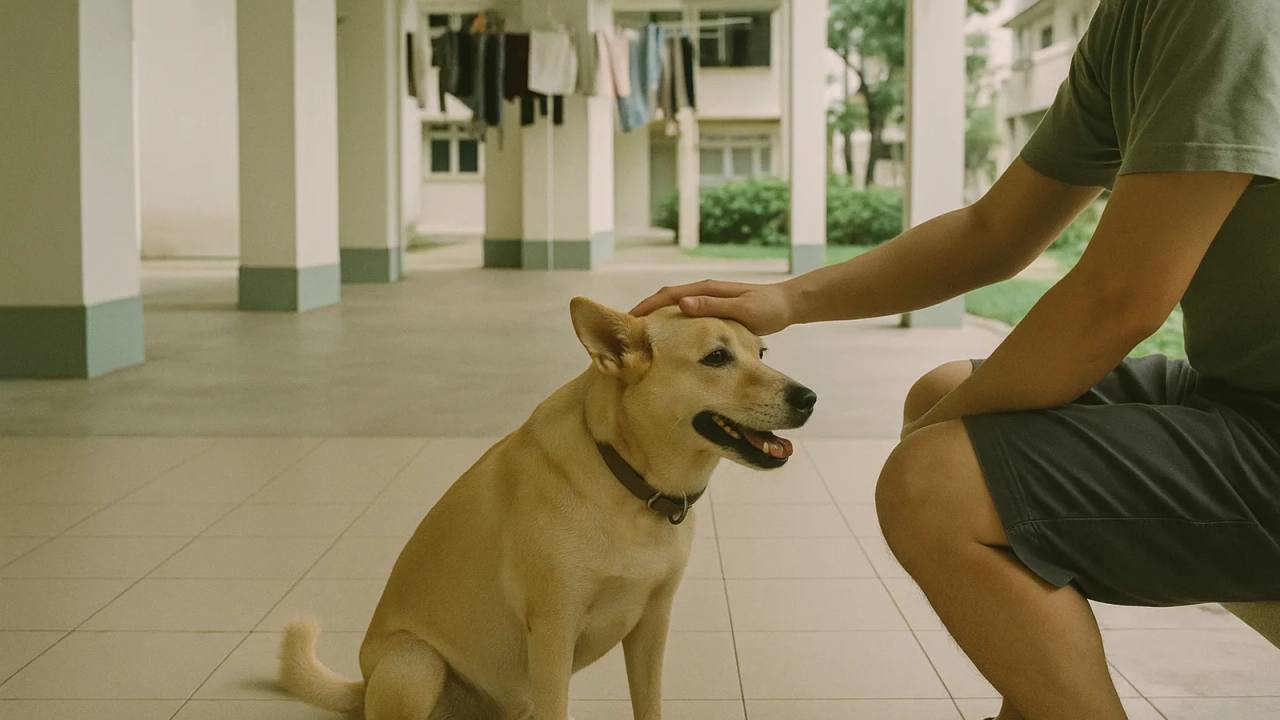
A dog arriving from a kennel is arriving from noise, concrete and a fixed routine into a quiet flat with a lift and a stranger. The dog you meet in week one is a dog managing that. Toileting regresses, appetite drops, and some dogs sleep almost continuously for days. None of that tells you much about the animal underneath.
Singapore's climate adds its own pressure. The Meteorological Service describes the local climate as having daytime maximums that do not usually rise above 31-33 degrees Celsius, overnight minimums that do not usually fall below 23-25, and a mean annual relative humidity of around 82%. A dog that has been kennelled outdoors handles that differently from one coming out of an air conditioned home, and both need their walks pushed to the ends of the day.
The part nobody warns you about
You will get attached, and then the dog will leave. Fosterers describe the handover as genuinely hard, and it does not get much easier with practice. What helps is holding on to the arithmetic: the dog leaving is the outcome you signed up for, and the space it vacates goes to the next one. Foster coordinators are used to this conversation and are usually good at it, so use them.
Some fosterers do adopt the dog. Shelters treat that as a normal application rather than a shortcut, so you go through the same process and pay the same fee as anyone else. Say so early. Once another family has applied, it gets complicated for everybody, including the dog.
What to do next
Work through this before you fill in a form. Confirm your housing type permits the dog you would be offered, using the AVS limits page and HDB's list rather than an assumption. Agree in writing who pays for routine and emergency veterinary care, and which clinic you are authorised to use. Fix a realistic minimum commitment with the coordinator, treating any quoted period as a floor. Ask whether the dog has a medical isolation requirement, because that determines whether your own dogs or your neighbours' dogs matter. Then set up a crate or pen and a quiet corner before the dog arrives, not after.
If all of that still works, apply to one shelter rather than four. SPCA's fostering page takes applications directly, and ASD and SOSD both run their own programmes. Fostering one dog well is worth more to a shelter than being on three waiting lists.
Common questions
- Does fostering cost me anything?
- The shelter normally covers the medical side. ASD, for example, covers all vaccinations up to the point of adoption. Day to day food, and the wear on your flat, tend to sit with you, so agree the split in writing before the dog arrives.
- How long does a foster placement last?
- It runs until the dog is adopted, which nobody can predict. SOSD asked fosterers in its parvovirus appeal to commit to at least 3 weeks, or ideally until adoption. Treat any number you are quoted as a floor, not a ceiling.
- Can I foster if I already have a dog?
- Sometimes, but not always. During its parvovirus appeal SOSD specified that the fosterer must not have dogs of their own, nor have any close contact with other dogs 3 weeks after the pup is discharged, because the puppies were still shedding virus.
- Can I foster in an HDB flat?
- Ask AVS and the shelter first, in that order. AVS states that a maximum of 2 cats and 1 dog of an approved small breed is allowed in each residential unit, and breaching HDB rules carries a fine of up to S$4,000. Do not assume a temporary dog is outside the rule.
- What if I want to keep the dog?
- It happens often enough that shelters have a name for it. You go through the normal adoption process like any other applicant, including the fee. Tell your coordinator early rather than at the point somebody else applies.
Sources
- Minimum age to foster through SPCAspca.org.sg
- 18
- Dogs in ASD care as of 1 January 2025asdsingapore.com
- 100 dogs
- 5 kennel units
- Minimum foster commitment SOSD asked for during its parvovirus appealsosd.org.sg
- 3 weeks
- 4 hours
- Dogs listed for adoption at ASD on 1 September 2026asdsingapore.com
- 76 dogs
- Puppy vaccinations in the first yearasdsingapore.com
- 3 vaccinations
- 6 months old
- Maximum fine for breaching HDB pet rulesavs.nparks.gov.sg
- S$4,000
- 1 dog
- Project ADORE height limitavs.nparks.gov.sg
- 55cm
- AVS Animal Response Centre, 24 hoursavs.nparks.gov.sg
- 1800 476 1600
- Named breeds on the HDB approved listhdb.gov.sg
- 61
- $4,000
- Singapore mean annual relative humidityweather.gov.sg
- 82%
- 31-33
- 23-25
How we verify content Fact-checking policy How we stay free