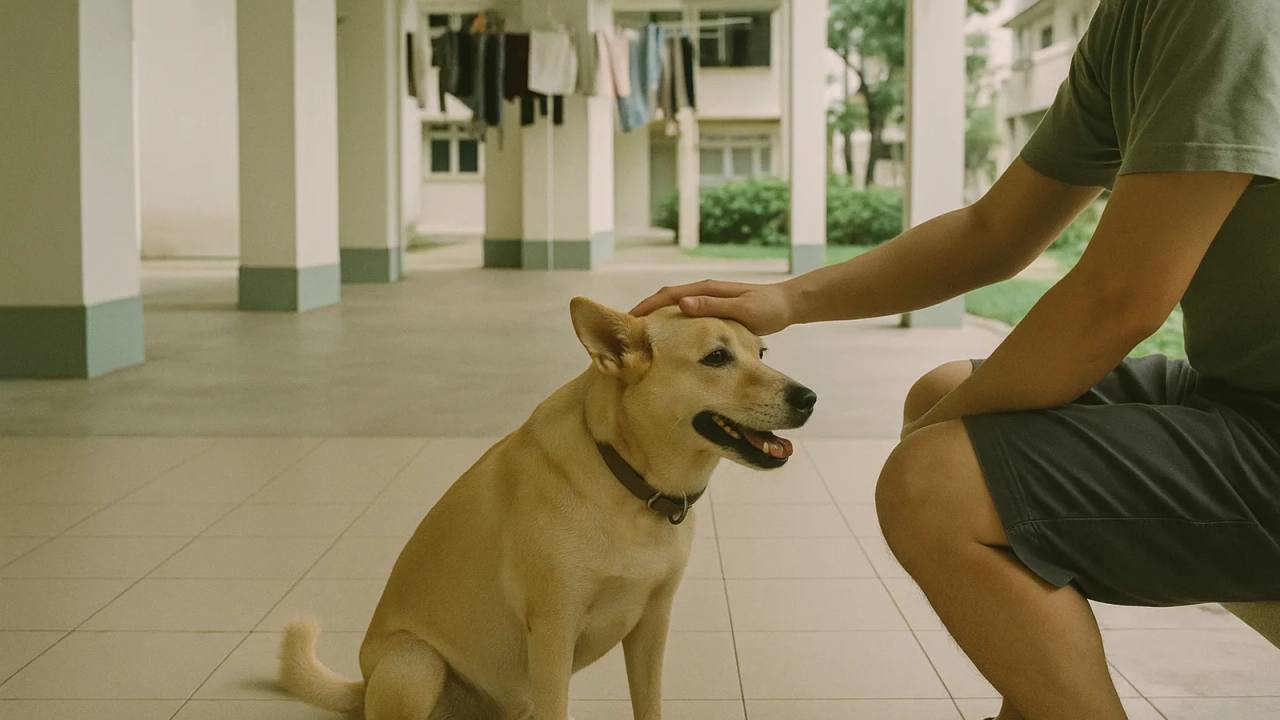

Singapore Specials are the dogs most people here have seen their whole lives without ever being told what to call them: the local mixed breeds, often tan or brindle, that turn up in rescue listings and at adoption drives. They are frequently passed over by first-time owners who assume a flat rules them out. Sometimes it does. Often it does not, and the difference comes down to a route most owners have never had explained.
By the numbers
- 40cm and 10kg Standard HDB toy-breed height and weight ceiling, per SPCA
- 55cm Height limit for a Singapore Special under Project ADORE, with no weight limit
- $150 to $250 SPCA adoption fee for a Singapore Special, licensing not included
Ask a first-time owner in a flat what dog they are considering and you will hear the same short list of small pedigrees. Ask why not a local dog and the answer is almost always some version of "we cannot, we are in HDB". That belief is half right, which is the most expensive kind of half right, because it rules out a whole population of healthy adult dogs on the basis of a rule the owner has not actually read.
What the name covers
Singapore Special is the working name for the local mixed-breed dog. It is a population rather than a breed, which is the first thing to understand about it: there is no standard, no predictable adult size chart and no breed-typical temperament to look up. What you get instead is an individual dog whose adult size and character are already visible if the dog is an adult, which is a genuine advantage over choosing a puppy on paper.
SPCA treats the category as distinct in its own fee schedule, listing local mixed breed puppies and local cross breed adults separately from pedigrees and crosses. SOSD, another local rescue that rehomes these dogs, goes further and marks on each dog's listing whether that dog is HDB eligible. That per-dog flag is the important detail, and it is worth understanding why it exists.
Two routes, and they are not interchangeable
This is the part that gets muddled in every group chat. There are two separate ways a dog can be kept in an HDB flat, and satisfying one has nothing to do with satisfying the other.
The first is the standard allowance. SPCA summarises it as an HDB flat being permitted one dog of a toy breed, standing 40cm or less at the shoulder and weighing 10kg or less. That route runs off HDB's approved-breed list. HDB sets and maintains that list and the rules around it, and the list can change, so treat HDB as the authority and check the current position there rather than relying on a summary, this one included.
The second is Project ADORE, which SPCA describes as a separate route under which HDB residents can adopt selected Singapore Specials up to 55cm tall, with no weight limit, one dog per flat. SPCA notes the route requires sterilisation, vaccination, licensing and microchipping.
Read those two paragraphs again and note what is different. The standard route is about a named breed on a list, with a 40cm and 10kg ceiling. ADORE is about a selected local dog, with a 55cm ceiling and no weight limit at all. A dog that qualifies under ADORE is not on the approved-breed list, and a dog on the approved-breed list is not going through ADORE. Neither status implies the other.
Why "is it HDB approved" is the wrong question
The common failure is to ask, of a mixed-breed dog, whether it is HDB approved, and to accept a yes or a no. Both answers mislead. A yes implies the dog is on the approved breed list, which it is not. A no implies the dog cannot live in a flat, which may be untrue if ADORE applies to it.
Mixed breed is also a very broad label, and being mixed does not by itself put a dog on any route. A cross involving a breed that is not on the list does not become permissible because the dog is small, quiet or well behaved, and unfamiliar or non-local lineage is a different situation again. The variable is the individual dog and the route that applies to it, not the general category.
So the question to ask is narrower and more useful: is this specific dog eligible, and by which route? Put that to the shelter. They deal with it constantly, they know the status of the dog in front of you, and they would far rather answer it before an adoption than after one.
What it costs and what you get
SPCA publishes its dog adoption fees plainly. Singapore Special puppies under 6 months are $250. Local cross breed adults from 6 months to under 7.5 years are $150. Seniors above 7.5 years, or dogs that have been at SPCA over a year, are $70, and dogs with special needs or long-term medical care are $25. SPCA notes that all fees include vaccination, sterilisation, deworming and microchipping, and that the AVS dog licensing fee is not included.
Set that against what those inclusions cost separately and the economics are not close. You are also getting a sterilised, vaccinated, microchipped dog whose adult size you can see, which removes the largest single unknown in choosing a dog for a flat. AVS licenses dogs in Singapore and sets the licensing requirements, so budget for that on top and sort it early.
The process is an interview, not a purchase
Adopters used to buying from a shop are sometimes taken aback by how much is asked of them. SPCA notes that all household members must be present during the visit for interaction with the animal, and that a premises check may be required before an adoption is approved by its counsellors. Thorough interviews are conducted to match each animal.
None of that is an obstacle course. It exists because the dog in front of you has usually already been returned or abandoned once, and the shelter is trying to make sure it does not happen again. Going in expecting a conversation rather than a transaction makes the whole thing easier, and the questions they ask about your hours, your flat and your household are worth answering honestly rather than optimistically.
What to do this week
If you are in a flat and have written off a local dog, reopen the question. Look at the listings on SOSD or SPCA and note that eligibility is flagged per dog. Then ask the shelter directly whether the specific dog you like is eligible and under which route, rather than asking whether Singapore Specials in general are allowed. Check the current rules at HDB yourself rather than trusting a summary. Budget the adoption fee plus AVS licensing. And if the dog is an adult, take the size and temperament you can see as a feature, because that is information a puppy simply cannot give you.
Official Singapore source
Project ADORE, the scheme that lets HDB residents adopt a Singapore Special up to 55cm tall, is administered by the Animal & Veterinary Service (AVS), and the standard HDB dog-breed and size rules are set by the Housing & Development Board.
Common questions
- What is a Singapore Special?
- It is the common name for a local mixed-breed dog, the population that most Singapore rescues work with. SPCA lists them separately from pedigrees and crosses in its adoption fee schedule, distinguishing local mixed breed puppies from local cross breed adults.
- Can a Singapore Special live in an HDB flat?
- Potentially, via Project ADORE, which SPCA describes as covering selected Singapore Specials up to 55cm tall with no weight limit, one dog per flat. This is a different route from the standard approved-breed allowance, and it does not apply automatically to every mixed-breed dog. Ask the shelter about the specific dog.
- What is the standard HDB allowance?
- SPCA summarises it as one dog of a toy breed standing 40cm or less at the shoulder and weighing 10kg or less. HDB sets and maintains the rules and the approved-breed list, so check the current position at HDB.gov.sg before you commit.
- What does adoption cost?
- SPCA's published dog fees are $250 for Singapore Special puppies under 6 months, $150 for local cross breed adults from 6 months to under 7.5 years, and $70 for seniors above 7.5 years. Those fees include vaccination, sterilisation, deworming and microchipping. The AVS dog licensing fee is not included.
- What does the adoption process involve?
- SPCA notes that all household members must be present during the visit for interaction with the animal, and that a premises check may be required before an adoption is approved. Expect an interview rather than a transaction.
Sources
- SPCA Singaporespca.org.sg
- 40cm and 10kg: Standard HDB toy-breed height and weight ceiling, per SPCA
- 55cm: Height limit for a Singapore Special under Project ADORE, with no weight limit
- $150 to $250: SPCA adoption fee for a Singapore Special, licensing not included
- Under the standard HDB allowance, an HDB flat may keep one dog of a toy breed standing 40cm or less at the shoulder and weighing 10kg or less.: Reference
- Project ADORE is a separate route under which HDB residents can adopt selected Singapore Specials up to 55cm tall with no weight limit, one dog per flat.: Reference
- Project ADORE requires sterilisation, vaccination, licensing and microchipping.: Reference
- SPCA adoption fees for dogs: Singapore Special puppies under 6 months are $250, local cross breed adults from 6 months to under 7.5 years are $150, seniors above 7.5 years are $70.: Reference
- SPCA adoption fees include vaccination, sterilisation, deworming and microchipping.: Reference
- SPCA may require a premises check before an adoption is approved, and all household members must be present during the visit.: Reference
- $25
- HDBhdb.gov.sg
- HDB sets and maintains the approved-breed list and the rules for keeping pets in a flat.: Reference
- AVS, NParksavs.nparks.gov.sg
- AVS licenses dogs in Singapore and sets the licensing requirements.: Reference
- SOSDsosd.org.sg
- SOSD is a Singapore rescue that rehomes local dogs and lists whether each dog is HDB eligible.: Reference
Start with a quiet moment together →A small idea to try, with progress kept in your Pack.
How we verify content Fact-checking policy How we stay free