
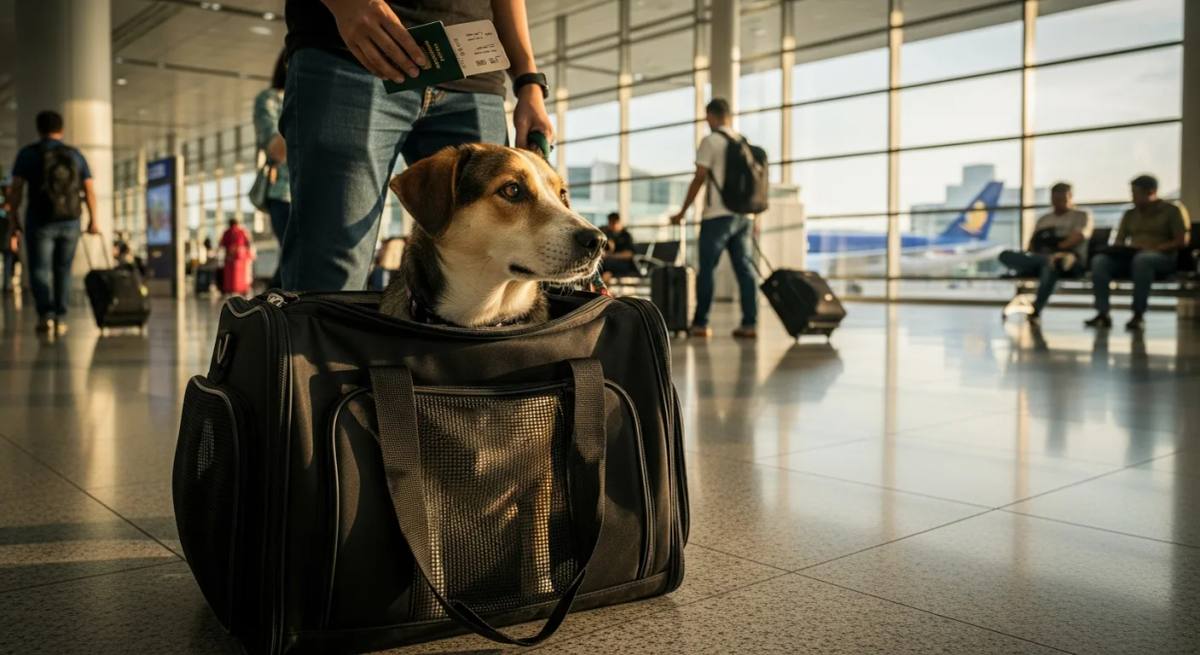

Start with the operating airline and exact route. A pet may travel in the cabin, as checked baggage or through a cargo arrangement depending on the carrier and journey. Confirm acceptance before buying equipment or treating your own flight booking as a pet booking.
3 min read
Cabin, checked baggage and cargo are different
Do not assume that all dogs leaving Singapore must travel as manifest cargo. Singapore Airlines accepts eligible pets as checked baggage on permitted flights; if the combined pet-and-container weight exceeds 32kg, it directs owners to a cargo agent. Its aircraft, route, breed and other restrictions still apply. This is one carrier’s policy, not a rule for every airline.
Ask the operating carrier which arrangement is available for your individual dog and each leg of the trip. Do not infer cabin eligibility from size alone or assume a codeshare booking guarantees acceptance. Assistance-dog arrangements are separate from ordinary pet travel.
Get a specific booking answer
Provide the dog’s age, breed or crossbreed, weight, crate weight and dimensions, proposed dates and route. Singapore Airlines asks owners to contact it at least two weeks before departure; allow longer when documents or another carrier’s rules require it. Keep the acceptance confirmation and ask what happens if the aircraft or itinerary changes.
Make a note of the drop-off location, reporting time, required originals, collection point and emergency contact. If a cargo agent is involved, establish which parts the agent handles and which remain yours. A general customer-service answer is less useful than confirmation for the actual flight.
Match the documents to the journey
Follow the import and export planning guide and the official rules for departure, transit and destination. A health certificate, an import permit and the airline’s forms serve different purposes. Keep the dog’s identity consistent across them.
Work backwards from the travel date and check validity windows before scheduling tests or appointments. If the date changes, recheck the documents instead of assuming everything remains valid. For a holiday, complete the return plan before you commit to going.
Choose the crate with the airline
Use IATA’s container guidance together with the airline’s restrictions. The dog needs room to stand and sit naturally, turn and lie down. Confirm the internal dimensions, ventilation, fastening, bowls and the specific flight’s limits. A generic product badge is not an airline acceptance decision.
Set the crate up well before departure and help your dog become comfortable with it in manageable steps. Ask your vet about difficulties rather than forcing long confinement immediately. Discuss any health condition or concern about travel fitness before the last appointment.
Prepare for the whole travel day
Agree feeding, water, bedding and medication instructions with the vet and carrier. Do not improvise sedation to make travel easier; airline restrictions and the dog’s health matter. Arrange suitable transport to the airport and enough time for the pet’s own check-in process.
Pack a separate document folder and contact sheet that remain accessible. Tell the receiving person or provider about the dog’s normal routine and any medical needs. Clarify how updates will reach you during transit and where you can get help if the arrival is delayed.
Compare the full quote and the alternative
Include the crate, additional pet carriage or cargo charges, documents, veterinary work, transfers and any required quarantine or arrival handling. Get cancellation and itinerary-change terms in writing. There is no useful universal flight price without the dog, route and service details.
If the travel plan is a poor fit for the dog, discuss alternatives early. That might mean a different route or timing, or suitable care at home for a short trip. The objective is a workable welfare and logistics plan, not simply finding a way to attach a dog to an existing holiday booking.
Frequently asked questions
- Can a dog fly from Singapore as checked baggage?
- Some eligible dogs can, including under Singapore Airlines’ published conditions. Confirm the exact dog, aircraft and route.
- Can my small dog always fly in the cabin?
- No. Cabin acceptance depends on the operating carrier and route; small size alone is not permission.
- Is a crate sold as airline approved enough?
- No. Check its dimensions and construction against the actual carrier and current requirements.
- Should every owner use a relocation agent?
- Not necessarily. Compare complexity and the provider’s scope, then make sure every requirement has a responsible person.
Editorial migration review: 17 September 2026. Original publication date preserved. Check current official requirements before travel.
More from The Block
-
 Dog supplements in Singapore: what helps and what to skip Most healthy dogs on a complete diet need no supplements. A few have real evidence; many are marketing. How to tell them apart, and why to ask your vet first.
-
 Raw feeding for dogs in Singapore: a safe, honest guide Raw feeding is not proven to be healthier than an appropriate balanced cooked diet. CDC advises against raw pet food because of risks to animals and people. Nutritional formulation, cold storage and careful cleaning do not remove every infection hazard. A complete cooked diet is a practical starting point for discussing your dog's needs with your vet.
-
 Choosing a dog for an HDB flat: eligibility, adoption and everyday care A dog can become a much-loved part of flat life. Start by checking eligibility for your actual home, then choose for the individual dog’s needs and the daily care you can offer. A small body or a seller’s assurance is not proof of HDB approval.
-
 Tiring out your dog in 800 sq ft: indoor exercise for Singapore HDB dogs When the afternoon heat or a monsoon downpour cancels the walk, a flat-bound dog still needs to burn energy. The good news is that a tired brain tires a dog faster than tired legs, and most of the work fits inside 800 square feet.