
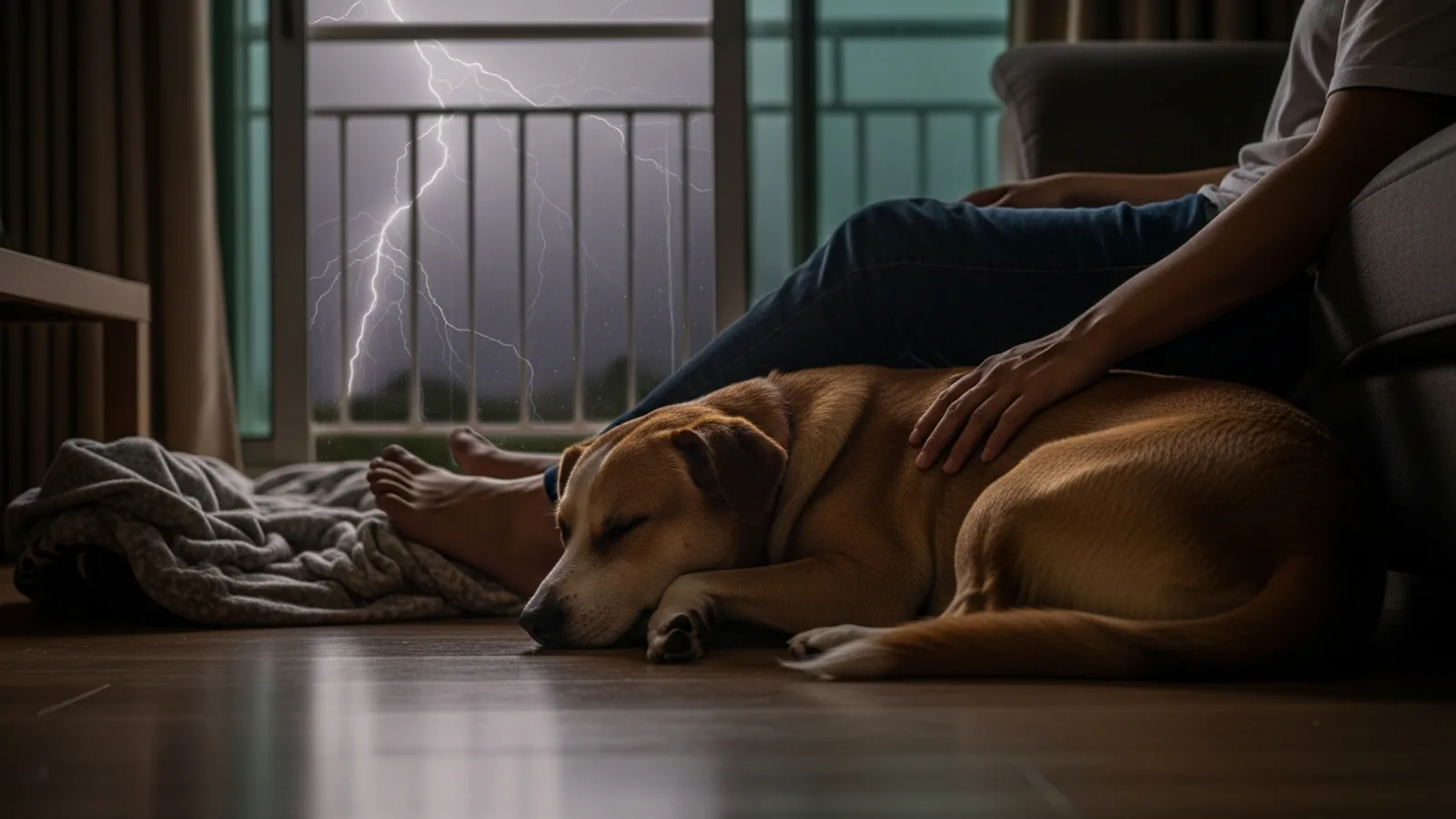

"Dog thunderstorm anxiety" is one of the most searched dog-behaviour questions in Singapore, and for good reason. Between the Southwest Monsoon's afternoon storms and the sharper burst of thunder that arrives with each inter-monsoon, a Singapore dog owner is rarely more than a few weeks from the next bad night. Here is what is actually behind the fear, what an HDB flat does to it, where Singapore sits in the monsoon calendar right now, and what genuinely helps, including where the evidence runs out and practitioner convention takes over.
Everyday dog care in monsoon weather
Storm anxiety is only one part of wet-weather care. Before a toilet trip, check the Meteorological Service Singapore forecast and the conditions outside. Postpone an exposed walk during thunder or lightning. A tree or open shelter is not a safe substitute for a substantial building. Keep an indoor backup for exercise and a short, practical toilet plan for when conditions permit.
Avoid flooded paths, drains and standing water. Do not let your dog drink from puddles. Contaminated water can expose dogs to infection; drying the paws afterwards does not undo an exposure. Discuss leptospirosis vaccination and warning signs with your vet rather than assuming a monsoon calendar alone predicts disease risk.
After a wet outing, gently remove dirt and dry the coat, paws and skin folds, including between the toes. Check harness contact areas and dry wet bedding. A raincoat should fit comfortably and come off indoors; stop using it if your dog becomes uncomfortable or too warm. Do not put products into the ears or apply medicated creams without advice.
Persistent scratching, odour, redness, discharge, painful paws or repeated head-shaking needs assessment, not just more washing. Use the dog’s established skin-care plan if one exists. Avoid prescribing a universal extra bathing schedule simply because it rains.
Keep necessary parasite prevention on its prescribed schedule and check each topical product’s bathing instructions. For days when outdoor plans change, use short reward-based training, appropriate food puzzles and calm sniff games at home. Do not force a frightened dog outside to “get used to” a storm.
By the numbers
- 167 days/yr Singapore's average number of thunderstorm days a year (MSS)
- 176 days/yr Average lightning days a year, among the highest rates worldwide (MSS)
- Over 50% Share of a year's lightning strokes that fall in the two inter-monsoon periods (MSS)
- Up to 65,000 Hz Top of a dog's hearing range, versus about 20,000 Hz for a person (AKC)
- Several weeks Realistic minimum for a counter-conditioning programme to show results (VCA)
- ~77% Share of Singapore resident households living in an HDB flat (SingStat, 2025)
Why storms actually frighten a dog, and what we don't fully know
There is no single, fully agreed mechanism. What exists is a handful of contributing factors, some well documented and some still clinical hypothesis rather than proven fact. It is worth knowing which is which, because the confident-sounding "it's the static electricity" explanation you'll see everywhere is not as settled as it sounds.
- Sound, well documented. A dog's hearing genuinely outperforms a person's. The American Kennel Club notes dogs can hear frequencies as high as roughly 47,000 to 65,000 Hz against a human ceiling near 20,000 Hz, and in the 3,000 to 12,000 Hz range they can pick out sounds quieter than a person could ever notice. The University of Pennsylvania's veterinary Behavior Medicine service adds that many storm-fearful dogs are simply noise-sensitive dogs in general, reacting to any loud, sudden, unpredictable sound, thunder included.
- Barometric pressure and environmental cues, observed but not fully explained. Both Penn's behaviour service and Today's Veterinary Practice describe dogs reacting to falling pressure, darkening skies, gusting wind and even the smell of ozone before a storm visibly arrives. That is a genuine, widely reported pattern. What is less settled is exactly how a dog senses the pressure change itself; the sources describe the association, not a confirmed physiological mechanism.
- Static electricity build-up, a named clinical hypothesis, not settled science. Veterinary behaviourist Dr Nicholas Dodman proposed that static charge building up in a dog's coat during a storm, and the shocks that follow, contribute to the fear, based on owner reports of getting shocked touching their dog mid-storm. He has been open that this does not explain the whole picture (his own words, in a Psychology Today piece: "I do not believe that static shocks account for all the terrors of storm phobic dogs, but they do contribute"). Penn's behaviour service specifically pushes back on the popular extension of this idea, that dogs seek out bathtubs because the plumbing grounds them: humid, water-saturated air actually prevents static build-up rather than causing it, which is the opposite of what the grounding story requires.
The honest summary: sound sensitivity is real and measurable, pressure and environmental cues are a genuine and widely observed pattern, and static electricity is a plausible contributing factor from a named researcher, not an established mechanism. Most working vets treat all three as inputs worth managing for, without claiming to have fully solved which one matters most for any individual dog.
What an HDB flat does to the noise
About 77% of Singapore's resident households live in an HDB flat, per the Singapore Department of Statistics' 2025 General Household Survey, so this is the reality most local dog owners are actually working with. We have not found a Singapore-specific acoustic study on dogs and HDB flats, so the following is our own reasoning from basic acoustic principles, not a cited finding, and it should be read that way.
Hard tile and bare concrete reflect sound rather than absorbing it the way carpet, curtains and soft furniture would, so a sparsely furnished flat can let a thunderclap's rumble linger a beat longer than a softer-furnished room would. A long internal corridor can behave a little like a channel, carrying sound down its length. Height cuts both ways: a high floor often gives a dog an unobstructed view of the lightning itself, adding a visual trigger to the noise, while facing blocks across a courtyard can bounce a clap of thunder between them for a moment after the source sound has already faded outdoors. None of this changes the fundamentals of what helps, but it is worth factoring in when you decide which room in the flat becomes your dog's safe space.
Where Singapore sits in the monsoon cycle right now
Rather than naming a fixed date from memory, here is what Singapore's Meteorological Service (MSS) itself says, checked live rather than assumed. MSS's own monsoon update, last issued 3 June 2026, states that the Southwest Monsoon "set in during early June 2026 and is expected to persist until late September or early October." MSS's climate reference page defines the second inter-monsoon period as October and November, the transition window that typically follows the Southwest Monsoon each year. Check the monsoon update yourself for the latest position before you plan around it, since a transition date can move by a week or two either way.
Whichever week it lands in, the inter-monsoon shift matters more than the calendar date. MSS's own weather systems reference puts Singapore's annual average at about 167 thunderstorm days and 176 lightning days, among the highest lightning rates in the world, and states plainly that "the Inter-Monsoon months account for more than 50% of the lightning strokes in a year," with the highest incidence typically in November, followed by April and May. In practice, that means the run-up to and through the second inter-monsoon is when a storm-anxious dog is likely to have its worst run of nights, which is exactly the window to have a plan ready for rather than improvising on the night.
Desensitisation and counter-conditioning that actually helps
The good news is there is a real, workable protocol, not just good intentions. VCA Animal Hospitals and Today's Veterinary Practice both describe the same basic shape:
- Start with your dog settled and relaxed on a mat or bed, rewarded with food for staying calm there, well before storm season rather than mid-crisis.
- Play a recording of storm sounds at a volume low enough that your dog does not react at all, then reward the calm settling behaviour.
- Raise the volume by a small step only once your dog consistently stays relaxed at the current level, over sessions of roughly 5 to 10 minutes according to Today's Veterinary Practice's protocol.
- If your dog stops taking treats, breaks its settle cue, or shows any sign of fear, that is the signal to stop and drop the volume back several steps, not push through.
- Expect the full programme to take several weeks, per VCA, with ongoing maintenance sessions at full volume roughly weekly to hold the progress.
Here is the part that gets left out of most owner-facing advice: the University of Pennsylvania's veterinary behaviour service is genuinely more sceptical about how far this goes for real storms specifically, because a recording cannot reproduce the barometric pressure drop, the humidity or the smell of ozone a real storm brings, and pushing a dog through a poorly run recording session can sensitise rather than desensitise it. That is not a reason to skip the protocol. It is a reason to treat recorded-sound work as a genuinely useful foundation, especially since the same skill carries over well to predictable events like fireworks, rather than a guarantee that a real storm will feel the same as the recording once it arrives. Pair it with active, calm support during actual storms, and do not force your dog into a crate or behind a closed door if it is inclined to panic there.
Setting up a safe space in a flat
Both VCA and Penn's behaviour service converge on the same basics for a home "safe haven," and they translate reasonably well to a Singapore flat:
- Pick an interior room with no exterior windows if you can, or one where you can draw heavy curtains or blinds to cut the visual impact of lightning.
- Choose a naturally quieter room where hard surfaces are less dominant. A carpeted bedroom or a room with soft furnishings will hold onto less echo than a bare-tiled hall.
- Leave a light on. It reduces the visual jolt of a lightning flash reflecting through a gap in the curtains.
- Make the space available and familiar before a storm ever starts, not only introduced once your dog is already anxious, and teach your dog to go there on a cue.
- Do not force a crate or a closed door on a dog that is inclined to panic there. Penn's guidance is explicit that a panicking dog can injure itself trying to escape a space it cannot leave.
If your dog is also anxious about being left alone, the safe-space groundwork overlaps a lot with what already helps separation anxiety in an HDB flat: a dog that already has a reliable, comfortable spot to settle in tends to cope with a storm arriving while it is home alone a little better than one improvising for the first time mid-panic.
When it warrants a vet conversation
Fear during a storm is not abnormal behaviour on its own; Penn's behaviour service is clear that a fear response is not something a dog chooses, and punishing it for pacing, whining or trying to hide only adds stress without changing the underlying feeling. A few signs, though, are a genuine cue to bring in your vet rather than keep managing it alone:
- Your dog tries to escape, breaks through a screen, or has hurt itself during a storm.
- The fear has generalised beyond thunder to ordinary rain, wind, or even a clear windy day.
- A multi-dog household sees redirected aggression toward another dog during a storm.
- A genuine counter-conditioning effort, done consistently over several weeks, has not moved the needle.
At that point, medication becomes a real option, and it is entirely a vet's decision, not something to self-select. Penn's service states plainly that for most dogs with moderate or severe storm phobia, some form of anti-anxiety medication is what makes it possible to manage the dog safely, that only a vet can legally prescribe it, and that a veterinary behaviourist can help your own vet fine-tune the plan if progress stalls. This guide will not name a specific drug or a dose. That conversation belongs with your vet, who knows your dog's health history.