
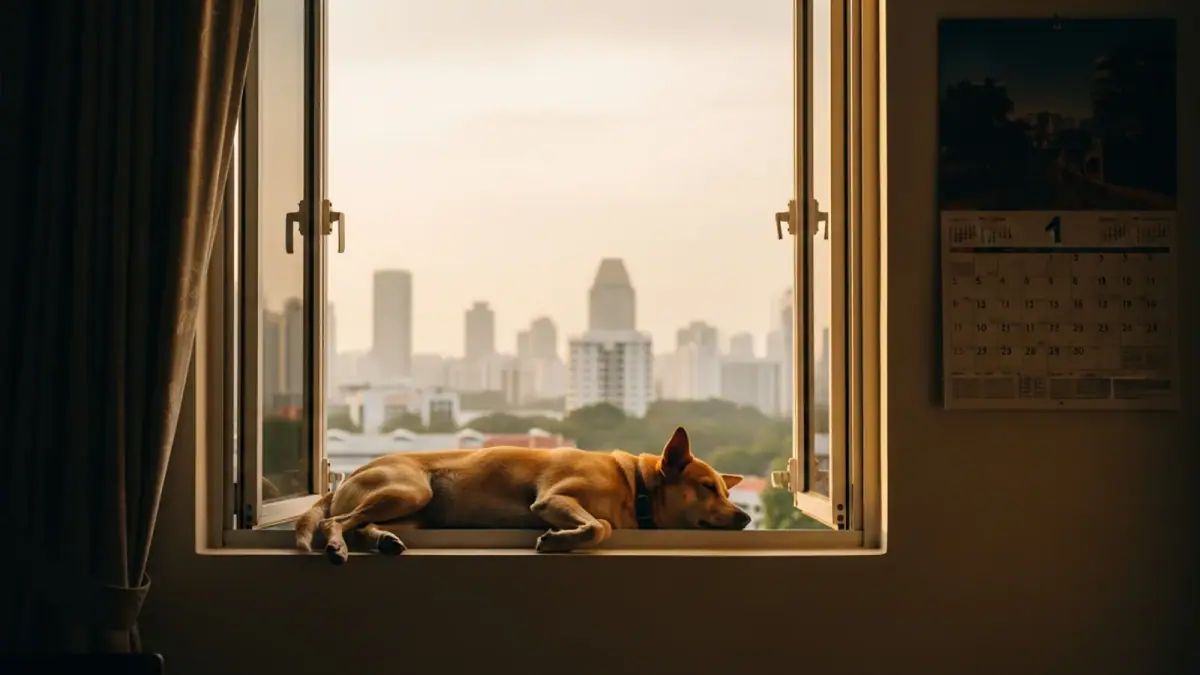

Singapore has no four seasons, but it has a real calendar of heat, haze, monsoons and festival fireworks that shapes life with a dog. Here is the year, month by month, and how to stay ahead of it.
6 min read
Singapore has no spring, summer, autumn or winter, so it is easy to assume the year is one long flat stretch of heat. It is not. There is a real calendar here that shapes life with a dog: the constant heat, the haze that drifts in on a dry spell, two monsoons, and a run of festivals whose fireworks and firecrackers undo a nervous dog in seconds. Knowing what is coming, and when, is the difference between managing a season and being caught out by it.
Official Singapore source
Animal and Veterinary Service: microchipping
The one constant: heat, every month
Temperatures sit at roughly 25 to 33 degrees with high humidity all year, so heat is not a season here, it is the baseline. Walk in the cool hours, early morning and after dark, and press the back of your hand to the pavement first: if you cannot hold it there for five seconds, it will burn paw pads. Flat-faced breeds, puppies and senior dogs overheat fastest. Learn the signs of heatstroke and the first-aid holding steps in our heatstroke first aid guide, and time training around the heat with heat-safe training windows.
Chinese New Year (January or February): noise, open doors and rich food
The festive weeks bring lion dance troupes with drums and cymbals, fireworks at some sanctioned events, and a steady stream of visitors through the front door. Two risks stack up: the noise unsettles sound-sensitive dogs, and the constant coming and going is exactly when a startled dog bolts out an open door, so keep a collar tag and microchip details current. The reunion table is a minefield too. Bak kwa is heavily seasoned, and chocolate, grapes and raisins, onions and garlic, and anything containing xylitol are all toxic to dogs. Build a quiet retreat away from the front of the home, and if noise fear is severe, read our guide to thunderstorm and firework fear in dogs well before the season, not during it.
National Day (9 August) and the fireworks build-up
National Day is fixed on 9 August, but the fireworks do not arrive on the night alone. Preview rehearsals run on the Saturdays through July and early August, each with an evening fireworks segment, so a dog in the central and bayfront areas may face several loud nights over a month. Prepare early: a den or covered crate in the most interior room, background sound to mask the booms, blackout where you can, and a long chew or stuffed toy to work on. Counter-conditioning with low-volume recordings started weeks ahead is far more effective than anything attempted on the night. For a settled dog, this is also a good week to check what is on for owners in our dog-friendly events listings and plan around the busy evenings.
The haze season (roughly August to October)
Transboundary haze drifts in during dry spells, most often between August and October, and it is measured by the Pollutant Standards Index. When the PSI climbs into the unhealthy band, cut outdoor time hard, especially for flat-faced dogs, puppies and seniors whose airways cope least well, and swap the long walk for indoor enrichment. Check the current reading on the NEA haze portal before you head out, and keep the day's exercise to short, low-effort outings when the air is poor. Our indoor games and tools help tire a dog out on a day the walk is off.
Deepavali and the year-end fireworks (October to December)
Deepavali brings lights, crowds and fireworks around Little India, and the year closes with the Marina Bay countdown fireworks on New Year's Eve. Same playbook as National Day: the retreat, the masking sound, the early counter-conditioning, and a walk finished well before the evening displays start. Dogs do not habituate to fireworks on their own, so each season is a chance to make the next one easier rather than assuming it will pass.
The monsoons and thunderstorm months (November to January, and the inter-monsoon storms)
The Northeast monsoon runs from around December into early March and brings the heaviest rain and the most thunder, while the inter-monsoon months of April and October carry sharp afternoon storms of their own. Thunder is a noise problem as much as fireworks are, and the wet months also raise the parasite load and the risk of leptospirosis from puddles and drains. Keep monthly flea, tick and heartworm prevention going without a gap, and see the Singapore dog health calendar for the month-by-month medical picture and the walking hazards guide for storms, flash floods and slippery ground.
The year at a glance
- All year: heat and humidity. Walk in the cool hours, watch the pavement, know the heatstroke signs.
- January to February: Chinese New Year noise, open-door escapes and toxic festive food.
- April to May: hot inter-monsoon, sharp afternoon thunderstorms.
- June to September: Southwest monsoon; haze more likely; National Day fireworks and rehearsals in August.
- October to November: Deepavali fireworks; inter-monsoon storms return.
- December to January: Northeast monsoon, heaviest rain and thunder; New Year's Eve fireworks.
Frequently asked questions
How do I prepare my dog for National Day fireworks in Singapore?
Start early. Build a den in the most interior room with a covered crate, blackout and background sound to mask the booms, and give a long-lasting chew during the display. Because rehearsals run on the Saturdays through July and early August, treat the whole period as fireworks season, not just 9 August. Low-volume sound counter-conditioning started weeks ahead helps most; for severe fear, speak to your vet before the season.
Are fireworks and firecrackers common during Chinese New Year in Singapore?
Private firecrackers are restricted, but you will still meet lion dance drums and cymbals and fireworks at some sanctioned events, plus a busy front door as visitors come and go. The noise and the escape risk are the two things to manage; a quiet retreat away from the entrance handles both.
When is the haze season in Singapore and how does it affect dogs?
Haze is most likely in dry spells between roughly August and October. When the Pollutant Standards Index reaches the unhealthy band, cut outdoor time and switch to indoor enrichment, especially for flat-faced breeds, puppies and senior dogs. Check the current PSI before walks.
When is monsoon season in Singapore?
The Northeast monsoon, the wetter of the two, runs from about December to early March, with the heaviest rain and thunder from November to January. The Southwest monsoon runs June to September. The inter-monsoon months of April and October bring sudden afternoon thunderstorms.
What is the best time of day to walk a dog in Singapore?
Early morning and after dark, when the pavement has cooled and the sun is off it. Midday walks in full sun risk both heatstroke and burnt paw pads. On poor-air-quality or stormy days, keep outings short and tire the dog out indoors instead.
Which festive foods are dangerous for dogs?
Chocolate, grapes and raisins, onions and garlic, alcohol, and anything containing the sweetener xylitol are all toxic to dogs. Rich, heavily seasoned food such as bak kwa can trigger stomach upset or pancreatitis. Keep the reunion table and festive snacks out of reach.
Sources: National Environment Agency, Animal & Veterinary Service, AVSAB: fear and anxiety.
More from The Block
-
 Dog supplements in Singapore: what helps and what to skip Most healthy dogs on a complete diet need no supplements. A few have real evidence; many are marketing. How to tell them apart, and why to ask your vet first.
-
 Flying with your dog from Singapore: cabin, cargo and relocation (2026) Start with the operating airline and exact route. A pet may travel in the cabin, as checked baggage or through a cargo arrangement depending on the carrier and journey. Confirm acceptance before buying equipment or treating your own flight booking as a pet booking.
-
 Raw feeding for dogs in Singapore: a safe, honest guide Raw feeding is not proven to be healthier than an appropriate balanced cooked diet. CDC advises against raw pet food because of risks to animals and people. Nutritional formulation, cold storage and careful cleaning do not remove every infection hazard. A complete cooked diet is a practical starting point for discussing your dog's needs with your vet.
-
 Choosing a dog for an HDB flat: eligibility, adoption and everyday care A dog can become a much-loved part of flat life. Start by checking eligibility for your actual home, then choose for the individual dog’s needs and the daily care you can offer. A small body or a seller’s assurance is not proof of HDB approval.