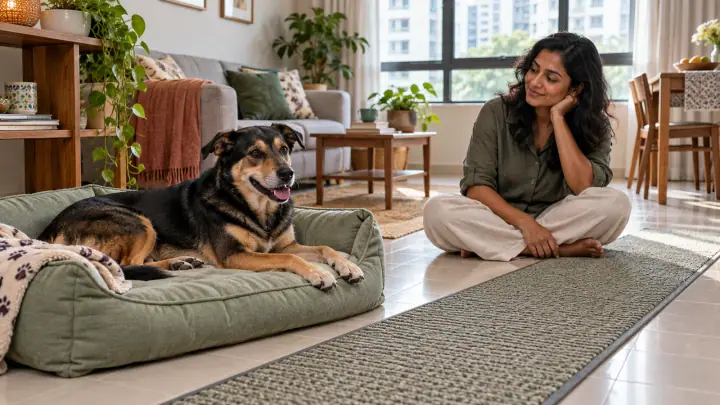

Boredom is one of the most common and least discussed welfare problems in Singapore's flat-dwelling dogs. Interactive toys are often marketed as an easy fix, but not every product on the shelf delivers the mental workout it promises. This guide breaks down which categories of toy actually earn their space in a small home, and how to use them well.
Most interactive toys sold in Singapore promise to cure boredom, but the honest answer is that only some categories consistently deliver on that promise, and even the good ones stop working once a dog has solved them a dozen times. For an owner in a small flat, where a dog cannot simply be let into a garden to self-entertain, choosing the right categories and using them properly matters more than the brand on the box.
This guide sits alongside two other UDO resources worth reading first. If it is unclear whether a dog is actually under-stimulated, the signs of under-stimulation guide lays out what to look for. And because toys are only one part of an indoor routine, the indoor exercise guide covers the physical side that pairs with the mental work described here.
What Makes a Toy Actually Mentally Stimulating for a Dog?
A toy earns the label interactive when it forces a dog to work for an outcome, usually food, through some combination of scent tracking, manipulation or problem-solving. A ball a dog chases and drops is play. A container a dog has to nose, paw and tip in a specific sequence to release kibble is cognitive work, and that distinction is the entire point.
The American Kennel Club notes that mental exercise can tire a dog out as effectively as physical exercise, sometimes more so for breeds bred to work. That matters in a Singapore flat context, where a twenty-minute walk in the heat may be all that is practical on a weekday, but a ten-minute puzzle session before that walk changes how settled a dog is for the rest of the evening.
Not every toy sold as interactive meets this bar. A soft toy with a squeaker inside gives momentary excitement but no ongoing problem to solve. The useful test is simple: does the toy require the dog to think through a sequence of actions to get the reward, and does that sequence change or stay challenging over repeated use. If the answer to either is no, it belongs in the physical play basket, not the mental stimulation rotation.
Which Toy Categories Are Worth Buying for a Small Flat?
Four categories consistently earn their space, and none of them require much floor room, which matters when a living room doubles as a dog's entire indoor world.
- Puzzle feeders slow down eating and force problem-solving. The best ones for a small flat have adjustable difficulty, so the same object can stay challenging as a dog improves. They are particularly useful for dogs that eat too fast or that show anxious behaviour around mealtimes.
- Scent-work toys and snuffle mats tap into a dog's nose rather than its eyes or paws, and scent work is mentally tiring in a way that is easy to underestimate. A folded towel with treats tucked inside works almost as well as a purpose-made mat for a first attempt.
- Treat-dispensing toys that roll or wobble add a physical coordination element on top of the food reward, which suits dogs with more energy to burn in a confined space.
- Chew toys sized appropriately for the dog's jaw and the flat's furniture give an outlet for the natural urge to chew, which is a stress reliever in its own right and not simply a puppy phase to be endured.
The category that gets overlooked most often is scent work, largely because it looks unimpressive compared to a dog visibly solving a mechanical puzzle. But a dog's sense of smell is its primary way of experiencing the world, and a few minutes of nose work can be more mentally exhausting than ten minutes of a paw-operated feeder. For flats without much floor space, scent games scale down easily onto a single mat or even a muffin tray with treats hidden under balls.
How Does Toy Rotation Keep a Dog Interested?
The single biggest reason interactive toys stop working is not that the design was wrong, it is that the toy stayed in circulation too long. Dogs habituate to objects the same way people stop noticing a picture on the wall after the first week. A toy that was genuinely engaging on day one becomes background furniture by day ten if it never leaves the floor.
Rotation solves this without requiring a large collection. Keeping two to four toys out at a time, and swapping one or two out every few days for something that has been resting in a cupboard, resets the novelty each time. The toy itself has not changed, but its absence and reappearance is enough to renew a dog's interest in solving it again. This is a far cheaper strategy than continually buying new products, and it works because the mechanism behind mental stimulation is novelty, not complexity.
A practical routine for a small flat looks like this: one puzzle feeder used at a main meal, one scent-work session in the evening using a mat or hidden treats, and one chew toy left out as a default option, with the specific items in each category swapped weekly. Pairing this with a short daily plan, such as the one in UDO's training plan tool, gives structure to what could otherwise become a haphazard toy basket that nobody actually rotates.
How Should Owners Introduce and Supervise Interactive Toys?
Introducing a new toy category works best gradually. Starting a food-motivated dog on the easiest setting of a puzzle feeder, then increasing difficulty once the dog reliably solves it, prevents the frustration that causes some dogs to give up on puzzle feeders altogether. The same logic applies to scent work: hiding treats in plain sight for the first session, then making the hiding spots progressively less obvious, builds confidence rather than confusion.
Supervision in the early sessions is not optional. New chew toys, in particular, should be watched closely until an owner understands how a dog chews, since some dogs are aggressive enough chewers to break off pieces that a different dog would never manage to dislodge. The ASPCA recommends matching toy durability to a dog's individual chewing style rather than assuming size alone is a safe guide, and that advice holds particularly well in Singapore, where the range of dog sizes in a single condo block can be wide.
A toy that a dog solves once and ignores forever was never doing the job of mental stimulation in the first place.
Common questions
- Are interactive toys really better than a normal walk for tiring a dog out?
- They are not a replacement for a walk, but they work a different kind of tired. Problem-solving and scent work draw on mental energy that a straightforward walk around the block does not touch, which is why the two work best combined.
- How do owners know if a puzzle feeder is too easy or too hard?
- If a dog empties it in under a minute and walks off, it is too easy and no longer doing its job. If a dog gives up frustrated within the first try, it is too hard, and it helps to start on the easiest setting before building difficulty.
- Is it safe to leave a dog alone with an interactive toy in a small flat?
- Supervision matters most in the first few sessions with any new toy, particularly chew toys and puzzle feeders with small removable parts. Once a dog's chewing style and habits are known, low-risk toys can usually be left out unsupervised.
- Do snuffle mats need to be washed often in a humid climate?
- Yes. Singapore's humidity means fabric mats hold moisture and food residue longer than they would elsewhere, so a wash every one to two weeks, or sooner if it smells, keeps mould and bacteria from building up in the fleece strips.
- Can puppies use the same interactive toys as adult dogs?
- Puppies can start with softer, simpler versions of the same categories, particularly gentle scent-work mats and easy-mode treat balls. Firmer chew toys and multi-step puzzle feeders are usually better introduced once adult teeth are in and jaw strength has developed.
- What is the single biggest mistake owners make with interactive toys?
- Buying one toy and expecting it to work indefinitely. Novelty is the entire mechanism behind these toys, so a static toy basket stops delivering mental stimulation within days, no matter how well designed the toy is.
Try a little play, then save the moment →A small idea to try, with progress kept in your Pack.
How we verify content Fact-checking policy How we stay free