
GDV (Gastric Dilatation-Volvulus, or bloat)
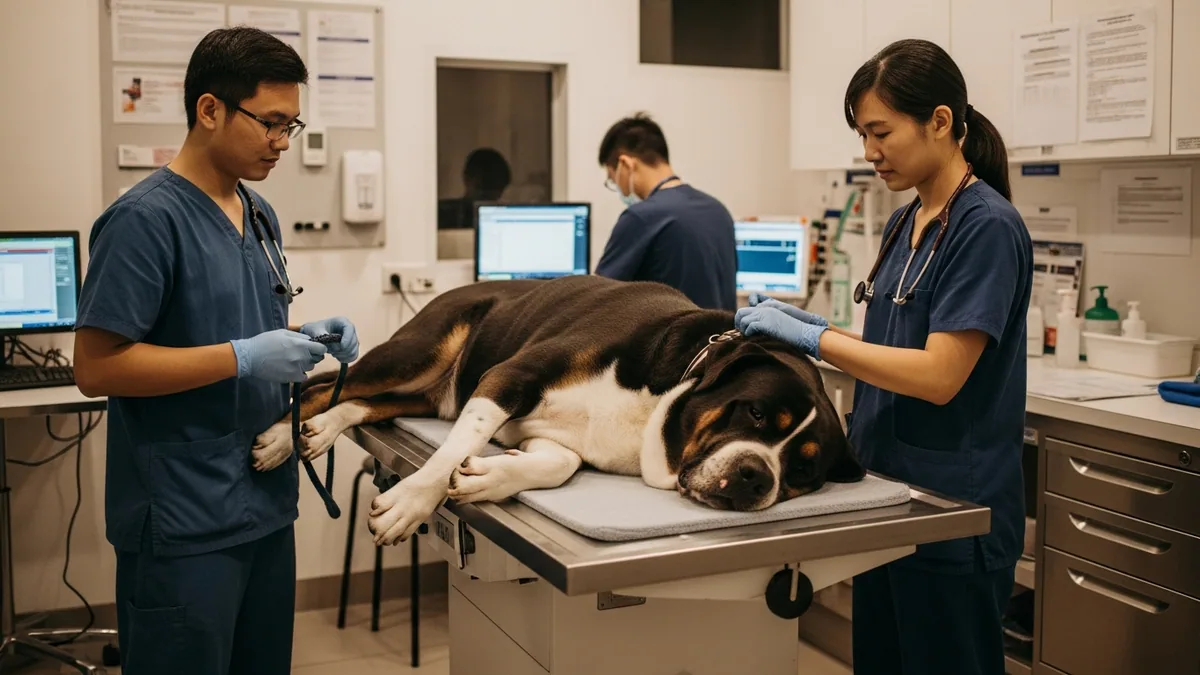
A rapidly progressive, life-threatening condition in which a dog’s stomach distends with food and gas and can rotate on itself, cutting off blood supply. It requires immediate veterinary attention, and reported mortality is approximately 15%.
What it means for you
This is the one to know by sight, because the window is measured in hours and the early signs look like a dog who is merely uncomfortable. A dog retching without bringing anything up, standing and stretching, drooling, looking anxiously at its own belly. That picture, in a deep-chested dog, is a drive-to-the-vet-now picture.
The ACVS is unambiguous that stabilisation and surgery are best performed early, because mortality rises with the severity of disease, and lists clinical signs present for more than six hours as a factor that increases mortality. So the cost of waiting to see whether it settles is measurable.
If you have a deep-chested dog in Singapore, knowing which clinic near you takes emergencies overnight is not paranoia, it is preparation. Our vet directory and emergency triage guide exist for this.
How it works
Food and gas distend the stomach, which prevents adequate blood return to the heart from the abdomen, cuts blood flow to the stomach lining, risks rupture of the stomach wall, and presses on the diaphragm so the lungs cannot expand properly. The stomach can then rotate on itself, which is the volvulus part, blocking blood supply to the stomach and spleen.
Secondary effects follow quickly: poor oxygen delivery causing cell death in the liver and kidneys, cardiac arrhythmias, sloughing of the gastrointestinal lining, and bacteria entering the bloodstream leading to sepsis.
Associations the ACVS reports in dogs that develop it: a deep chest with an increased thoracic height to width ratio, being fed a single large meal once daily, older age, and being related to other dogs that have had the condition. Elevated feeding, previous splenectomy, large or giant breeds and stress have also been suggested as increasing incidence. A 2006 study found that dogs fed dry foods listing oils such as sunflower oil or animal fat among the first four ingredients were at higher risk where the dog was already high risk.
Nearly all breeds have been reported with it, and commonly seen breeds include Great Danes, Weimaraners, St Bernards, Irish Setters and Gordon Setters.
Treatment is stabilisation, gastric decompression, then surgery to explore the abdomen and de-rotate the stomach, with removal of part of the stomach wall or the spleen where needed. The stomach is then permanently attached to the abdominal wall, a gastropexy, which prevents rotation if distension happens again. Many surgeons recommend a prophylactic gastropexy for at-risk breeds, often done at the same time as sterilisation.
Long-term management includes feeding two or three smaller meals a day rather than one large one.
Common misconceptions
- Bloat means a full stomach and it will pass.
- The ACVS describes GDV as rapidly progressive and life-threatening, requiring immediate medical attention. Clinical signs present for more than six hours is listed among the factors that increase mortality.
- A gastropexy means my dog can never bloat again.
- A gastropexy does not stop the stomach expanding. It is there to prevent the life-threatening rotation, and some dogs still experience dilatation without volvulus, typically after a very large meal.
- Only giant breeds get it.
- Nearly all breeds have been reported to have had gastric dilatation with or without volvulus. The strongest association is chest shape, specifically an increased thoracic height to width ratio, rather than size alone.
Sources and last checked
- Gastric Dilatation-Volvulus American College of Veterinary Surgeons (ACVS) Accessed 15 Aug 2026
This entry describes published rules and veterinary guidance. It is a reference, not a substitute for your vet or for the agency handling your application, and where a decision turns on a fee or a deadline the source links above are the ones to confirm against. If something here has gone out of date, tell us and we’ll correct it and say what changed.