

For thin walls and close neighbours, a naturally quieter dog helps. This guide lists genuinely lower-barking breeds from the HDB approved list, while being honest that no dog is silent and training matters more than breed.
6 min read
Why a quieter breed helps in a flat
HDB living means shared walls, corridors and lifts, so a dog that barks less is easier on you and your neighbours alike. Any dog you keep must be on the HDB approved list of 62 breeds and counted as your one permitted dog, as set out on the HDB keeping pets page. The good news is that several approved breeds tend towards the quieter end, so you can prioritise calm without leaving the list.
There is a practical stake in this beyond politeness. Persistent barking is one of the more common triggers for neighbour complaints, and complaints are what tend to bring a flat's dog to official attention. Keeping the peace is therefore part of keeping your dog's home secure, which is one more reason to think about noise before you choose. Before the list, though, one honest caveat. No breed is silent, and barking is normal dog behaviour, an alert, a greeting, a request. A quieter breed lowers the baseline, but a bored, anxious or under-exercised dog of any breed will make noise. Separation anxiety in particular can turn a naturally placid dog into a persistent barker the moment it is left alone, which is exactly when neighbours notice. Temperament varies between individual dogs too, and how a dog was raised and socialised counts for a great deal, so treat the following as tendencies rather than guarantees.
Quieter breeds on the approved list
These HDB-approved breeds are widely considered gentler on the noise front:
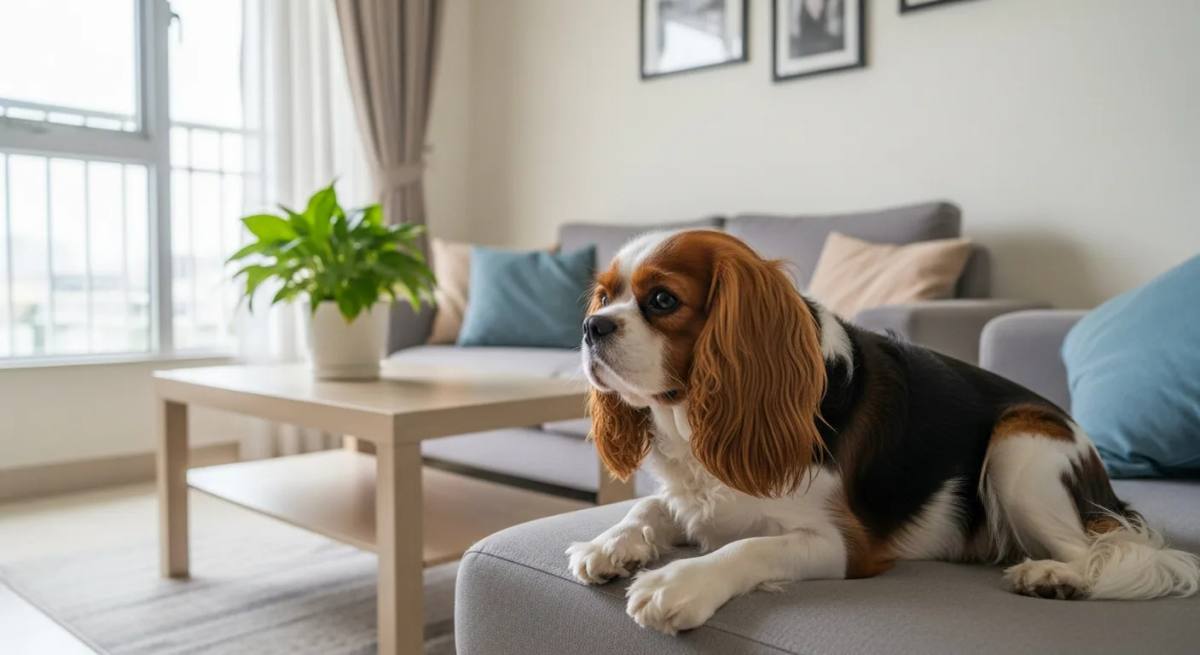
- Cavalier King Charles Spaniel. A calm, affectionate lapdog that is often content and quiet when it has company. It was bred purely for companionship, which shows in its easy, settled temperament.
- Bichon Frise. Cheerful and people-oriented, and not typically a persistent barker when its needs are met. Its low-shedding coat is a bonus in a small home, though it needs regular grooming.
- Italian Greyhound. A quiet, sensitive companion that tends to be reserved rather than vocal. It is happy to curl up for long stretches and asks for less exercise than its racy shape suggests.
- Coton de Tulear. An easy-going small breed with a soft temperament and a modest voice, well suited to close quarters.
- Havanese. Sociable and adaptable, and generally undemanding on the noise front when kept company. It bonds closely and dislikes being left alone for long.
- Shih Tzu. A sturdy companion breed bred for closeness to people, usually more placid than yappy, and content with modest walks.
You can read fuller profiles for these and the rest of the approved breeds on our breeds pages, browse the full roster on our HDB-approved breeds list, and check any breed against the rules with the HDB checker.
Which approved breeds bark more
It is just as useful to know the noisier end of the list, so you can weigh the trade-off with open eyes. Several popular approved breeds are alert, vocal little dogs. Terriers such as the Jack Russell were bred to work and to sound off, and toy breeds like the Pomeranian and Chihuahua are quick to announce every visitor and passing sound. None of this rules them out; plenty of them live happily in flats. It simply means their owners lean harder on training and on meeting the dog's needs. If quiet is high on your list, go in knowing which breeds will ask more of you on that front, and be honest about whether your routine can supply it.
Training and routine matter more than breed
Choosing a quieter breed is a sensible head start, but it is only that. The dogs that live happily and quietly in flats are, above all, the ones whose needs are met. A dog with enough exercise, mental stimulation and company has far less reason to bark than one left alone and under-occupied. Early, kind training that teaches a dog when to settle, and that does not reward barking with attention, does more for household peace than any breed choice. Leaving a dog alone for long, dull days is the surest way to manufacture a barker out of even a naturally quiet breed.
So think of the list as a shortlist rather than a solution. Pick a breed that suits your energy and your home, then put the work in on routine and training. If you would like the wider picture, our HDB dog rules guide covers the one-dog limit, the approved-list concept and Project ADORE for local mixed-breeds.
Why the rules favour smaller, calmer dogs
It is worth understanding why the approved list looks the way it does, because it explains the whole noise question. HDB allows one dog per flat, and only from the approved list, and that list is dominated by small companion breeds. The reasoning is that compact, people-oriented dogs cope with the realities of dense living: lifts full of strangers, narrow corridors, thin walls and neighbours a metre away. Larger, higher-drive breeds are not on the list precisely because their size and needs create friction in that setting, and noise is a large part of that friction. Choosing a quieter approved breed is, in a sense, choosing further along the same logic the list already follows.
Private housing gives you more room to manoeuvre, but it does not remove the issue. A condominium sets its own pet rules through its management corporation, and those rules, along with the proximity of neighbours, mean a barky dog can still cause trouble in a condo. Landed housing is the most forgiving on noise simply because there is more distance between homes. Wherever you live, a considered breed choice and steady training remain the real answer, not the walls around you.
Do not forget the licence
Whichever quieter breed you choose, it must be licensed with AVS, as must every dog in Singapore, and microchipping is part of responsible ownership. The licence is mandatory and renewable, and a sterilised dog attracts a lower fee. The requirements are on the AVS licensing requirements page, with costs under licence fees. A local vet can handle the licence, microchip and sterilisation together. Sort it out early, since it is a legal requirement whatever the breed.
Notice one little habit together →A small idea to try, with progress kept in your Pack.
More HDB guides
-
 HDB-approved cross-breeds and Project ADORE Local mixed-breed dogs, the Singapore Specials, are not on the standard HDB breed list, but Project ADORE lets many of them live in HDB flats under set conditions. This guide explains how the scheme works and who qualifies.
-
 Is a Border Collie HDB approved in Singapore? The short answer is no. The Border Collie is not on the HDB approved breed list, so it cannot be kept in an HDB flat. This guide explains the rule, why the breed sits outside it, and the realistic options for owners set on one.
-
 Is a Shiba Inu HDB approved in Singapore? No, the Shiba Inu is not on the HDB approved breed list, so it cannot be kept in an HDB flat. This guide explains the rule and points to an approved spitz, the Japanese Spitz, for owners who love the fluffy fox-like look.
-
 Are Golden Retrievers allowed in HDB flats? No. The Golden Retriever is a large breed and is not on the HDB approved list, so it cannot be kept in an HDB flat. This guide explains the rule, the reason, and the housing that does suit the breed.