Walking your dog in Singapore heat: timing, pavement, and gear
By UrbanDogOwner Editorial . Last reviewed 2026-07-06
The daily walk is where heat safety is won or lost, because it is the routine thing you do without thinking, in a climate that punishes not thinking. The good news is that it comes down to three habits you can build in a week: walk at the right time, check the ground before you commit, and carry what you need. Get those right and the walk stays a pleasure. This guide covers each in turn, plus the gear worth buying, and the signs that mean turn back now.
By the numbers
Before 8amThe cooler morning window for the main walk
After sundownThe second safe window, once the pavement has released its heat
10am to 6pmDirect-sun hours to avoid for anything more than a quick toilet trip
7 secondsPavement test: hand on the ground; if you cannot hold it, nor can paws
500 mlWater plus a collapsible bowl for a roughly 45-minute walk
Turn backThe rule when panting stays heavy at rest, gums redden, or the gait wobbles
Timing: the cool bookends of the day
In a climate that runs warm all day and all year, the safest exercise windows are the cool bookends: before about 8am, and after sundown once the ground has released the day heat. The stretch from roughly 10am to 6pm in direct sun is for rest, water and shade, not for a proper walk. Even inside the safe windows, the ground matters more than the clock, because a west-facing pavement or a stretch of dark tarmac can stay hot well into the evening. So treat the timing as the first filter and the pavement test as the second, every time.
The pavement test that protects paws
Paw pads are tough, but they are not heatproof, and hot ground causes real burns. The test is simple and takes seven seconds: press the back of your hand flat against the pavement and hold it there. If you cannot keep it comfortably in place for seven seconds, the surface is too hot for your dog, so wait for it to cool, switch to grass or shade, or turn back. The reason it catches people out is that asphalt in direct sun sits far above the air temperature, so a pleasant-feeling 32-degree evening can still hide a pavement that scorches. Grass, void decks and shaded park connectors are almost always cooler than open tarmac, which is worth remembering when you plan the route.
Planning a shade-to-shade route
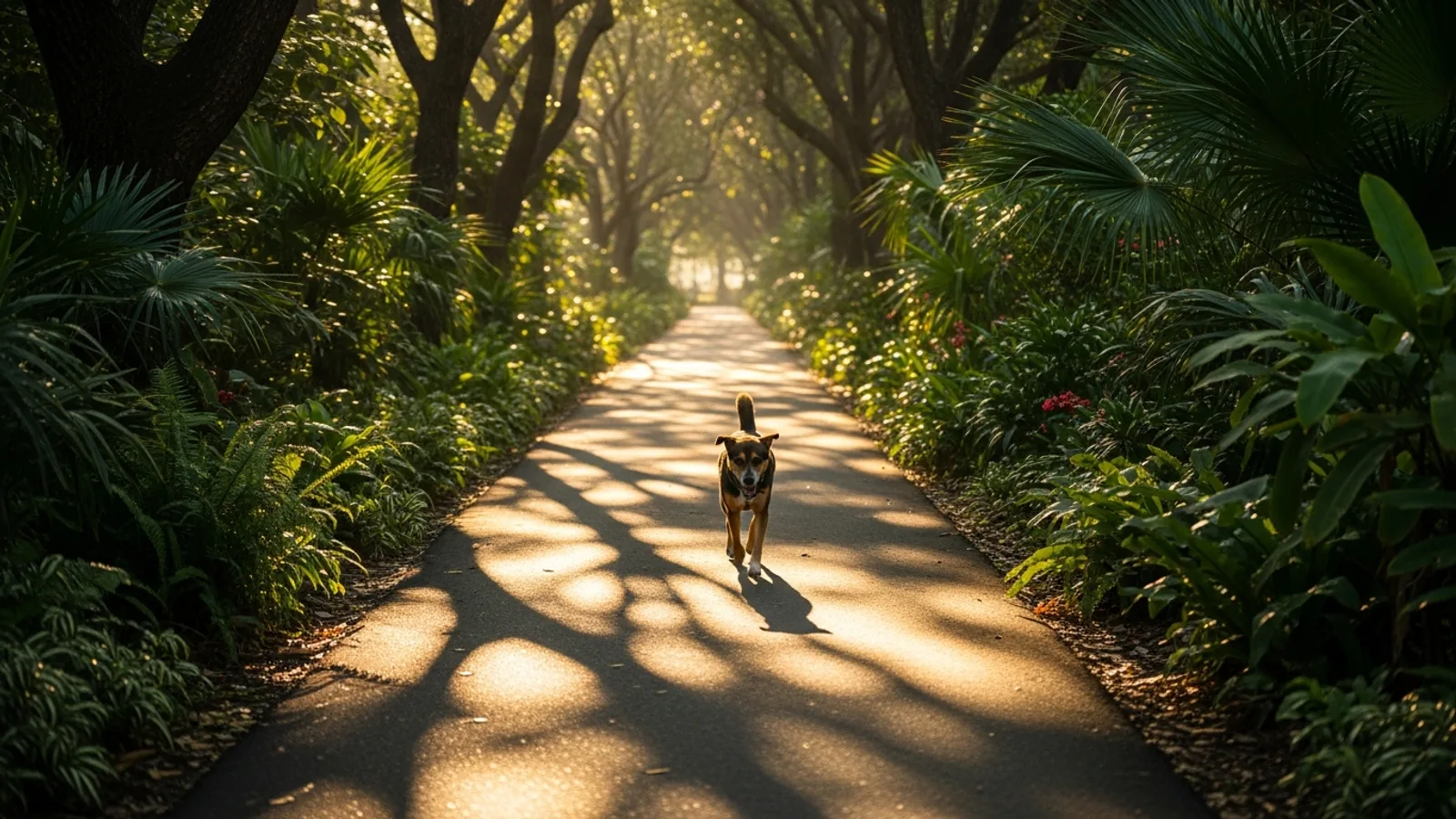
Think of a hot-weather route as a chain of shade and water, not a distance. Favour tree-lined paths, void decks and canopy-covered park connectors over open ground, and know where the taps and water points are so you can refill. Keep the loop short enough that you are never far from shade if the dog starts to flag, and be ready to cut it in half. On the borderline days, our places directory tags canopy-shaded routes and spots with water, which is exactly when a well-chosen route makes the difference between a gentle outing and a risky one.
The gear that earns its place
Most of what helps is unglamorous, and a little of what is sold is theatre. The essentials:
Water and a collapsible bowl, every walk. A 500ml bottle covers about 45 minutes. Offer it before the dog looks thirsty.
A cooling mat at home. For the middle of the day, when the walk is off the table anyway.
A light-coloured, breathable harness. A dark one soaks up sun; a light one does not.
A cooling vest, if you keep it damp. It works by evaporation, so a wet one genuinely helps a larger or double-coated dog, and a dry one does little.
Booties, introduced early. They protect paws on hot ground, but many dogs need time to accept them, so practise before you depend on them.
Skip anything that promises cooling without moisture or airflow, because evaporation is the mechanism that actually moves heat.
Reading the signs to turn back
The last habit is knowing when the walk is over. Turn back at the first heavy panting that will not settle when you pause in shade, at brick-red gums, thick drool, an unsteady gait, or a plain reluctance to carry on. None of these is a signal to push through. Head for shade, offer water, and cool the dog if it needs it. If any of that sounds alarming in the moment, the full recognition-and-response steps are on the heatstroke first-aid page, and the flat-faced breeds guide explains why some dogs hit that wall much sooner.
Frequently asked questions
What is the best time to walk a dog in Singapore?
The cool bookends of the day: before about 8am in the morning, and after sundown in the evening, once the pavement has released the day heat. The middle of the day, roughly 10am to 6pm in direct sun, is for rest, water and shade rather than exercise. Even in the safe windows, check the ground with the pavement test, because west-facing pavements and dark tarmac hold heat well into the evening.
How does the seven-second pavement test work?
Before you set off, press the back of your hand flat against the pavement and hold it there for seven seconds. If you cannot keep it there comfortably, the surface is too hot for your dog paws and can cause burns, so wait for it to cool, find a grassed or shaded route, or turn back. Asphalt in direct sun can sit far above the air temperature, which is why a 32-degree day can still mean a dangerously hot pavement. Paw pads are tough but not heatproof.
How do I plan a route in the heat?
Think shade-to-shade and water-to-water. Favour tree-lined paths, void decks, park connectors with canopy, and grass over open tarmac, and know where you can refill water or find a tap. Keep the route short enough that you are never far from shade if the dog starts to struggle, and be willing to cut it short. Our places directory tags canopy-shaded routes and spots with water, which helps on the borderline days when a gentle outing is still fine.
What gear actually helps a dog in the heat?
The essentials are unglamorous: a collapsible water bowl and a bottle on every walk, and a cooling mat at home for the middle of the day. A light-coloured, breathable harness beats a dark one that soaks up sun. A cooling vest can genuinely help larger or double-coated dogs if you keep it damp, since it works by evaporation, but a dry one does little. Booties protect paws on hot ground but many dogs need time to accept them, so introduce them before you rely on them. Skip gimmicks that promise cooling without evaporation.
When should I cut a walk short or turn back?
Turn back at the first sign the dog is not coping: heavy panting that does not settle when you pause in shade, brick-red gums, thick drool, an unsteady gait, or a reluctance to keep going. Do not push through any of these. Head for shade, offer water, and cool the dog if needed. Learning to read these signs early, covered in full on our heatstroke first-aid page, is what keeps a hot walk from becoming an emergency.
Is it okay to skip walks when it is too hot?
Yes, and sometimes it is the right call. On the hottest, most humid days, an at-risk dog is better off with indoor play, a food puzzle or a lick mat than a walk in the heat. A skipped walk is not neglect; a heatstroke case is the harm. Save the real exercise for the cool of the evening, and give a brachycephalic or senior dog the benefit of the doubt every time.