
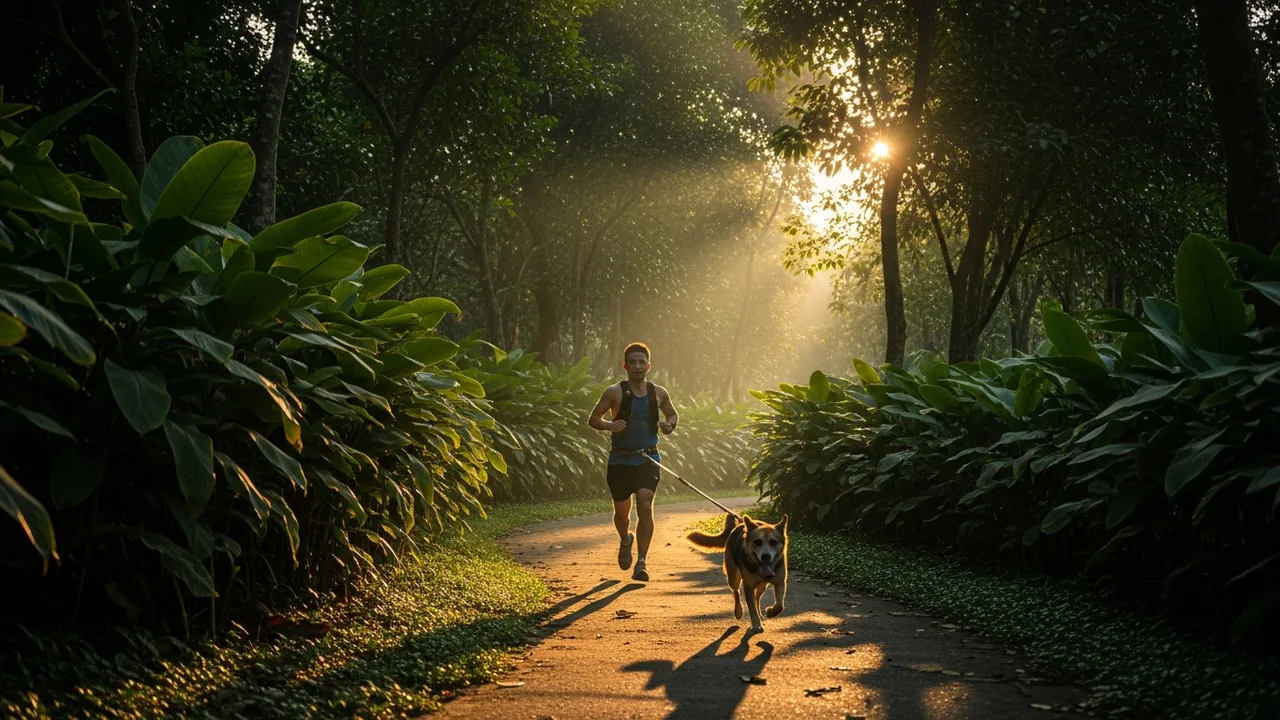

If your dog simply wants to move, and you do too, canicross is the most natural fit of any dog sport. It is cross-country running with your dog attached to your waist by a bungee line, the two of you working as a team, and it needs almost no facility, just a harness, a trail and an early start. The catch in Singapore is the heat, which turns a temperate-climate sport into one that lives and dies by timing. This guide covers the gear, the routes, the heat management and the local running communities you can join.
What canicross is, and why it fits a busy dog
Canicross is the simplest of the dog sports to describe and one of the most rewarding to do: you run, your dog runs out in front, and a bungee line between your waist and the dog’s harness turns the two of you into a single team. The dog is encouraged to pull, which taps into a natural, joyful drive to move forward, and the elastic line smooths out the jerks so neither of you gets jarred. It grew out of off-season training for sled dogs and has become a popular sport in its own right, precisely because it asks so little in the way of equipment or venue.
For a dog with energy to burn, canicross is transformative. A hard run in harness satisfies both the body and the instinct to move with purpose in a way that a sniffy amble on a loose lead never quite does, and a dog that runs regularly is usually a calmer, more settled dog at home. It also happens to be one of the few dog activities that directly benefits the human’s fitness too, which makes it easy to keep up. If your dog’s core problem is simply that it needs to move more, this is very often the answer.
The gear that makes it work
Canicross runs on three pieces of kit, and getting them right is the difference between a comfortable run and an injury. The first is the dog’s harness, which must be a proper pulling harness designed to spread the load across the chest and shoulders while leaving the throat, shoulders and legs free to move; an everyday walking harness is not built for sustained pulling and can rub or restrict over distance. The second is a padded waist belt for you, so that the dog’s pull comes through your hips and core rather than your arms and shoulders. The third is the bungee line that connects the two, whose stretch absorbs the shock each time the dog surges.
The reason the setup is hands-free is not just comfort; it is control and safety. With the line anchored to your waist, your hands are free to balance and you are far less likely to be pulled off your feet, while the dog has a consistent, predictable connection to follow. Take the time to have the harness fitted properly, ideally with someone who knows canicross gear, because a harness that fits badly will cause problems that only show up once you are running regularly. Beyond those three items you need very little: water, suitable shoes for you, and a route.
Where and when to run
Singapore’s network of park connectors and nature trails is genuinely well suited to canicross, offering long, traffic-free stretches where a dog can settle into a rhythm. Our trails and parks directories are a starting point, but always check that dogs are allowed on a particular route before you set out, because certain nature reserves and catchment areas prohibit them entirely. Your dog must be leashed in public by law except inside a fenced dog run, and the canicross line satisfies that requirement, so you are running legally as long as the dog is connected to you.
When you run matters even more than where. In this climate the cool hours are not a preference but a safety measure: run before roughly 9am or after 7pm, and keep off the trails in the heat of the day. Early morning on a quiet connector, before the sun is high and before the paths fill up, is the ideal window, giving you cool air, shade and space. Build your distance gradually, both for your dog’s conditioning and to learn how it copes with the heat, and always carry water. A shaded, early route run at an easy pace beats an ambitious one attempted in the sun every single time.
Managing the heat, honestly
The heat deserves its own section because it is the one thing most likely to hurt your dog in this sport. A running dog produces a great deal of internal heat and can only shed it by panting, which becomes far less effective in high humidity, so a dog can move from comfortable to dangerously overheated quickly on a warm, sticky morning. Veterinary bodies are consistent on this: Cornell’s canine heat-safety guidance advises exercising in the early morning or evening and avoiding strenuous activity during the hottest, most humid parts of the day, which describes Singapore’s afternoons exactly.
Put that into practice with a few firm habits. Run only in the cool hours, start shorter and slower than you think you need to, carry water and offer it often, and check that the tarmac is not too hot for paws with the back of your hand. Watch your dog constantly for the early signs of trouble, heavy relentless panting, dropping behind, a glazed look or an unsteady gait, and stop and cool the dog the moment you see them. Some dogs simply are not built for running here: flat-faced breeds and dogs that overheat easily are better served by swimming or gentle walking. Know the emergency response from our heatstroke first aid guide before your first run, not after.
Joining a community
You can absolutely run with your dog alone, but there is a real dog-running community here, and joining it makes the whole thing easier and more fun. Canicross Singapore runs sessions and beginner-friendly courses that teach the technique and the directional cues from the ground up, which is worth doing because good form protects both you and the dog. Canirox (CNRX) runs a regular club and organises dog-and-human events, including the CANIROX Challenge, an obstacle race billed as Singapore’s first for dogs and their people and featured by local media in late 2025.
Running with a group has practical advantages beyond company. You can learn the technique properly, often try or borrow gear before committing to your own, and pick up the local knowledge about which routes work and when. It keeps your dog social and it keeps you accountable, which is the quiet secret to actually sticking with any exercise habit. Because these are independent communities whose schedules change, check their current sessions directly, and turn up ready to learn. Canicross rewards good technique and heat sense far more than raw fitness, and both are easiest to pick up alongside people who already run.