

9 min read
Last updated First published 2 June 2026
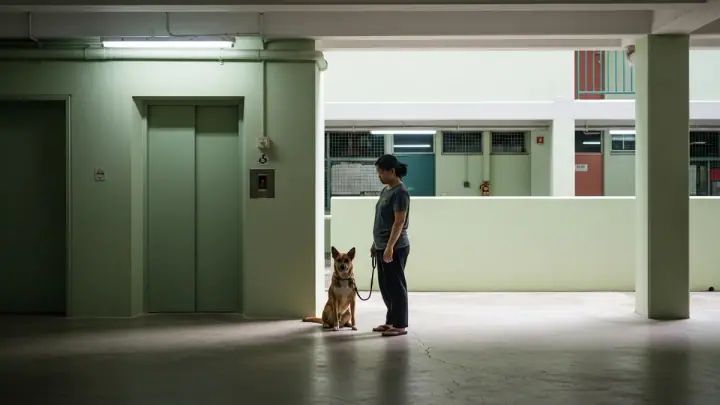
The HDB lift lobby is an almost perfectly designed trigger: a tiny space, zero retreat options, and doors that open without warning onto whatever is waiting on the other side. Here is how to work with that, specifically.
Why the lift and lobby are the worst combination in Singapore dog life
Distance can matter greatly in reactive behaviour, but pain, fear, frustration and other factors may also contribute. When a dog sees something alarming and has enough space to process it, many dogs manage. The HDB lift lobby removes that option entirely. You step out of your flat into a corridor roughly two metres wide, wait beside a metal door, and when it opens, you are already inside another dog's personal space before either of you had a second to negotiate. There is no buffer, no escape route, and nowhere to move that does not feel like a confrontation.
The lift itself compounds this. It is a small, sealed box that smells of every dog that has ridden in it that week. Your dog enters, the doors close, and for the duration of the ride it is committed. Then the doors open onto a stranger or another dog at point-blank range. From a dog's perspective, that moment has every hallmark of an ambush. The startle, the proximity, the inability to retreat, the smell already priming the nervous system before the doors part. That is a very reliable recipe for a lunge, a bark, or a prolonged display that embarrasses you and frightens your neighbours.
None of this means your dog is aggressive or beyond help. It means the environment is genuinely difficult, and that your training has to be specifically designed for this environment, not imported wholesale from a class held in a park with ten metres of grass on every side.
Understanding threshold distance in a confined space
Threshold distance is the point at which a dog shifts from noticing something to reacting to it. In a large open space, that might be fifteen metres for a nervous dog. In the average HDB lift lobby, you have perhaps three metres of usable corridor before the wall, the lift door, or the stairwell ends your options. You will almost never be working within comfortable threshold distance at the lobby level.
The practical consequence of this is that you need to change the environment rather than wait for a comfortable distance that the architecture will never give you. That means:
- Knowing which floors in your block are usually quiet and using them as training ground when neighbours are at work.
- Learning your block's lift pattern. Most HDB blocks have two lifts. If one arrives full and noisy, you can let it go and wait for the second.
- Using off-peak hours, particularly after 9am on weekdays when the school and office rush has cleared, for your dog's first solo lobby-training sessions before you add the variable of actual lift riding.
Threshold work in a lobby is not about desensitisation alone. It is about buying yourself enough time and distance for your dog to see the trigger, look at you, and get a reward before the emotional escalation begins. That sequence, see it, turn to you, treat, is the foundation of everything.
The mat-and-treat routine at the front door
The single most useful thing you can do does not happen in the lobby at all. It happens inside your flat, at your front door, before you leave.
Place a small mat or folded towel at your front door, close enough to the door that your dog can stand on it while you open the door, but not so close that the door swings into the dog. Teach your dog that mat means sit or stand still and look at you. Start without the door open, treating generously for calm attention. Work up to opening the door a crack while the dog holds position on the mat. Then a wider crack. Then fully open, with the corridor empty.
The goal is a dog that pauses at the threshold, checks in with you, and waits for permission before stepping into the corridor. This gives you two or three seconds to scan the lobby before your dog is already out there and committed. Those seconds are disproportionately valuable. A calm scan left and right costs you nothing. Discovering at nose-distance that your neighbour's Shiba is in the lobby costs you a great deal of goodwill and adrenaline.
Practise this daily, even on trips that turn out uneventful. The behaviour needs to be so well rehearsed that it holds when your dog is already excited about the walk ahead. Over-rehearse it on boring days so it is available on difficult ones.
Counter-conditioning the ding of the lift
The lift chime is one of those sounds that dogs learn to associate with high arousal faster than most owners realise. The sequence they experience, repeatedly, is: ding, doors open, possibly something alarming appears. The ding becomes a predictor of the scary event, which means some dogs begin displaying stress before the doors even open.
You can work on this directly, but it requires a little preparation. On a quiet weekday morning, go to your floor's lobby without your dog first and record the lift chime on your phone. Play that recording back at very low volume while your dog is in a calm, settled state at home, and pair each playback with a small, high-value treat. A piece of chicken, a sliver of cheese, something that earns genuine attention. Repeat in short sessions of two to three minutes over several days.
Increase difficulty only while your dog remains comfortable. If they startle, stop or reduce it. A recording may sound different from the real lift; do not use a one-week timetable to decide readiness.
Once the sound alone is well conditioned, move the sessions to the lobby at quiet times. Stand with your dog away from the lift door, play the recording or simply wait for a real lift to arrive on another floor, and treat calmly when your dog orients to you at the sound. Only then start asking your dog to ride in an empty lift, treating throughout the ride, and treating again at the ding before the doors open at your destination floor.
Waiting for an empty lift, and how to do it gracefully
In Singapore, especially in blocks with elderly residents or families with young children, you will sometimes need to let a lift go because it contains a dog, a child, or a person who looks uncomfortable. This is not failure. This is management, and management is a legitimate, permanent part of owning a reactive dog in a dense urban environment.
The practical mechanics of waiting well:
- Stand back from the lift door, at the far end of the lobby or against the wall furthest from the lift. This puts a metre or so between your dog and whoever exits.
- Keep your dog beside you in a sit or stand-stay, not in front of you where the leash becomes a taut line pointing at the trigger.
- If the doors open and you see a dog or a person who seems uncertain, simply say clearly and without drama, "I'll wait for the next one," and step back. Most residents will appreciate the clarity. The ones who do not will forget about it before they reach their floor.
- If you are on a high floor and waiting becomes impractical, use the time to practise that see-it-look-at-me sequence from a distance. The lift lobby becomes a training venue rather than a gauntlet.
Observe your own building to find quieter opportunities. There is no universal quiet slot. If the lobby is busy or your dog cannot cope, retreat to a safe space rather than persisting to complete an exercise.
Using the stairs as a serious training tool
If you live on the second, third, or fourth floor, the stairwell is genuinely useful and underused. The stairwell is quieter, predictable in its layout, and gives you a second or two of auditory warning when someone is approaching from below. It also removes the ambush dynamic of the lift doors entirely.
Use stairs only when they are suitable for the dog and handler, with secure footing and room to pass. Pain, age, mobility, heat and the building layout may make them inappropriate. Do not substitute a demanding stair climb for a safer management plan.
Even for residents on higher floors, occasional stair use for the last two or three floors can be useful. Ride the lift to the third floor, walk down two flights, and exit through the void deck. The void deck is generally more open than the lobby, giving your dog a moment to decompress before hitting the pavement. This is particularly helpful in the evenings when the lifts are busy with returning residents.
Managing other residents without making it awkward
Your neighbours did not sign up to be part of your dog's behaviour programme, and it is worth keeping that perspective. Most people in an HDB block are navigating their own rushed mornings and tired evenings. A dog that lunges and barks is alarming to them regardless of the reason, and the best neighbourly strategy is a combination of honest communication and consistent management.
A few things that help in practice:
- If you have a neighbour on the same floor with a dog, consider knocking and having a brief conversation about coordinating walk times. Many HDB dog owners are navigating the same problem and will welcome the discussion.
- If your dog has a bad moment in the lobby, a brief, calm acknowledgement to the other resident goes a long way. Something like, "Sorry about that, we will give you space," is sufficient. You do not need to over-explain or apologise repeatedly, which tends to make encounters feel more fraught for everyone.
- Avoid the temptation to let dogs greet in the lift lobby during training. However sociable your dog is on neutral ground, the lobby is not neutral ground, and a forced face-to-face greeting in a two-metre corridor frequently ends badly even between dogs that are otherwise fine with each other.
If you live in a condo rather than an HDB block, some of the lobby dynamics differ slightly. Condo lift lobbies tend to be larger, and you may have a dedicated pet lift in some developments. Check your MCST rules on this. Under AVS regulations, dogs in common areas must be on a leash and under control at all times, which applies regardless of HDB or private housing. That leash must be short enough to give you genuine control in a confined space. A fully extended flexi-lead in an HDB lobby is dangerous and unfair to everyone else in it.
What progress actually looks like
Progress and recovery vary. Seek a vet assessment for sudden changes or possible pain, and qualified reward-based behaviour help for repeated distress, lunging or bite risk. There is no reliable three-to-six-month recovery promise.
Track your progress not by whether a bad moment happens, but by how quickly your dog recovers from it and returns to neutral. Recovery time shortening from ten minutes to two minutes is real progress, even if the initial reaction looks similar. The lobby will always be a challenging environment. Your job is to make it manageable, not invisible.
Editorial check, 14 September 2026: Primary guidance used for this correction. Individual needs and current local rules still apply.
More training guides
-
 Toilet training the apartment way No garden, no driveway, just a tiled floor and a lift that takes two minutes to arrive. Here is how to toilet train a puppy in a Singapore flat without losing your mind.
-
 Clicker basics A clicker is a timing tool, nothing more and nothing less. Learn to use it well in a small Singapore flat and you will have the clearest, most efficient communication method available for teaching your dog almost anything.
-
 Loose-leash walking in Singapore’s shared spaces Start with room, reward a slack lead and make the task easier when your dog struggles. Lift lobbies, narrow pavements and crossings need practical choices, not a perfect heel or a fixed timetable.
-
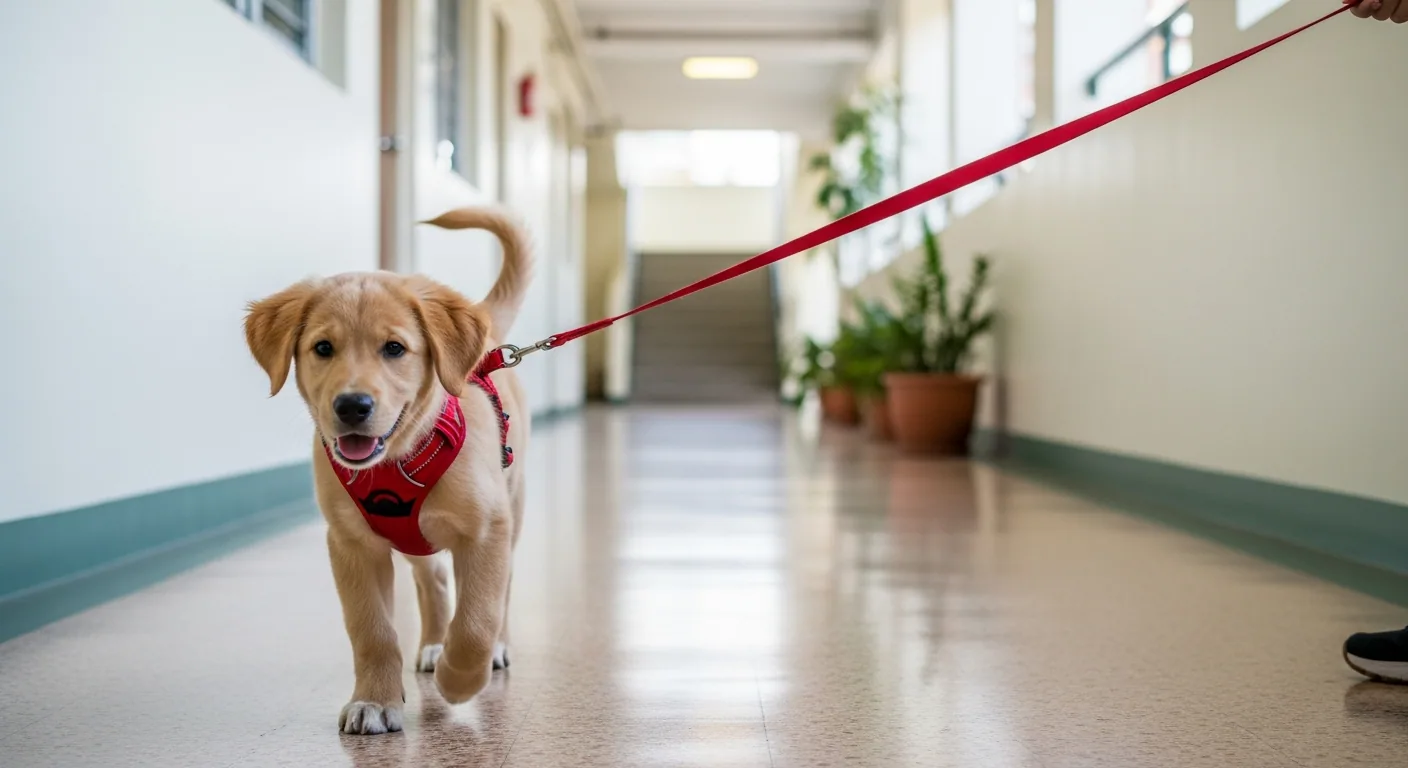 Leash Training a New Dog or Puppy in Singapore Getting a brand-new dog or puppy happy on a leash is a gentle, gradual job, not a one-session fix. Start indoors, reward the position you want, and let your dog set the pace through HDB corridors, lifts and the Singapore heat. This starter guide covers collar and harness choice, first steps, and how to handle pulling and lunging kindly.