
9 min read
Last updated First published 2 June 2026
No garden, no driveway, just a tiled floor and a lift that takes two minutes to arrive. Here is how to toilet train a puppy in a Singapore flat without losing your mind.
The honest starting point
There is no garden. That single fact changes everything about toilet training a puppy in Singapore, and pretending otherwise only leads to frustration on week two when you are mopping urine off your vinyl flooring at midnight and wondering what went wrong.
Most Singapore dog owners are working with one of three options: pee pads laid on the floor indoors, a service yard or balcony designated as the toilet spot, or taking the dog downstairs via lift to a grass verge or void deck garden. Each approach works. Each has a real cost in time, consistency, and setup. The goal of this guide is to help you pick the right one for your flat and your schedule, then execute it without burning out in the first month.
Learning and bladder control vary. Track your own puppy, offer frequent opportunities and ask for help if progress stalls. Pain, straining or sudden changes warrant veterinary advice rather than a longer training deadline.
The lift-wait problem
Living several floors above the street can make a quick toilet trip difficult. Young puppies need frequent opportunities, especially after waking, eating, drinking and play. Prepare the lead and your route in advance, or use a safe consistent indoor option when necessary. Neither an exact two-to-five-minute window nor an assumed average lift wait predicts what your puppy can manage.
Plan a practical route or a safe indoor option that meets the individual puppy's needs. There is no universal age below which outdoor toileting is physically impossible; discuss infection risk and suitable locations with your vet.
Bladder control and signalling develop at different rates. Use a record of your puppy’s actual routine, frequent opportunities and prompt rewards instead of treating age as a guaranteed holding capacity.
- Offer a toilet opportunity after waking, meals and play.
- Shorten the interval when accidents occur; do not punish the puppy.
- Ask your vet about straining, frequent small amounts, pain or a sudden change.
Some puppies sleep longer between toilet trips, but overnight needs still vary. Watch for waking and restlessness and make calm, brief trips when needed. Do not delay because an age chart says the puppy should be able to wait, or assume there is always a thirty-second warning.
Choosing your method: pads, service yard, or outdoor grass
Pee pads indoors
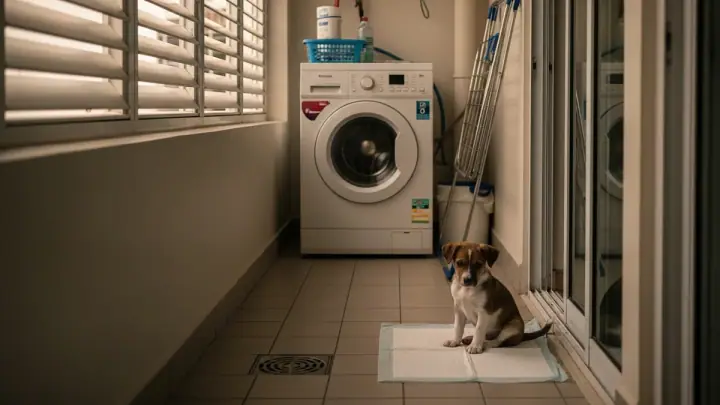
Pee pads are the most common starting point in Singapore HDB flats, and there is nothing wrong with that. They give the puppy a clear, consistent target in a home where every surface is otherwise tiled or laminated. The practical approach is to start with a large pad area, perhaps four pads arranged together near the service yard door or in a corner of the kitchen, and gradually reduce the size over weeks as the puppy becomes more accurate.
The main risk with pads is that you create a dog who believes the entire flat is a reasonable toilet, and the pad is just the preferred one. Contain the puppy to a playpen or gated area that includes the pad zone. When the puppy is loose in the flat, supervise directly. An unattended puppy in a HDB bedroom will find the tiled bathroom floor a perfectly logical toilet, and on some level, they are not wrong.
Choose pads for fit, absorbency and your cleaning routine. We have not established that a particular pad technology reliably outperforms alternatives for every flat.
Service yard or balcony
This is a genuinely good middle option for HDB flats with a service yard. The dog learns that toileting happens outside the living area, there is a hard boundary between the home and the toilet zone, and you avoid the indoor-pad confusion. You need a surface the dog finds acceptable: many owners use a patch of artificial grass mat over a tray, which also makes cleanup far easier than bare tile.
The downsides are real. Service yards in HDB flats are small, often used for laundry, and the smell of urine in an enclosed tiled space with limited ventilation is significant. A drain-connected tray system, which you can buy from pet shops along Serangoon or online, makes this much more manageable. Clean it once daily at minimum.
Note that if you live in a condo, your balcony situation is different. Many condo by-laws restrict what you can place on balconies, and some management corporations have specific rules about pet toilet setups that face common areas. Check before you install anything permanent.
Outdoor grass toileting
Full outdoor toileting is the cleanest long-term solution for smell management in a flat. Choose a permitted outdoor spot after checking local signs and estate rules, and bag and bin faeces immediately. Your lift lobby and void deck are not toilet zones; move to a proper grass patch.
Move towards outdoor toileting gradually when it is appropriate for your puppy’s health and circumstances. Use consistent cues, familiar surfaces where helpful and immediate rewards. There is no universal eight-to-twelve-week indoor requirement or two-to-three-week transition deadline. Continue providing timely toilet opportunities during the change.
Building a schedule around meals and naps
The schedule is not optional. It is the entire mechanism. Without a predictable meal and sleep routine, you cannot predict when the puppy needs to go, and without prediction, you are just reacting to accidents.
Use a feeding routine appropriate for your puppy, agreed with your vet or the food guidance. Offer frequent toilet opportunities based on the individual puppy, including:
- Immediately on waking, before anything else
- After meals or drinking, sooner when your puppy signals a need
- After play or excitement
- Before confinement or sleep
- Frequently while awake, with earlier opportunities whenever your puppy shows signs of needing to go
Choose cooler conditions where possible and check the actual walking surface and weather. A fixed clock time does not guarantee that pavement is safe or that every household can follow the same routine. Keep trips suitable for your puppy and have an alternative when conditions are uncomfortable.
Overnight toilet needs vary. Respond to waking or restlessness, and adjust the routine to the puppy. Do not expect a particular wake time or a seven-hour hold because of age.
Managing smell in a closed flat
Singapore flats run air-conditioning for most of the day, which limits natural ventilation and concentrates smells. Urine smell in particular builds in carpets, grout lines, and the foam underlay beneath vinyl flooring. The rule here is: clean with an enzyme-based cleaner every single time, not a regular floor cleaner. Regular cleaners mask the smell to humans but leave the urine proteins intact, which the dog can still detect and which signals to them that this is an acceptable toilet spot.
Popular enzyme cleaners are available at most pet shops in Clementi, Serangoon, or Tampines pet supply stores, and through major online retailers. Follow the product label for contact time, surface suitability and safe use around pets. Do not use ammonia-based cleaners on urine spots; the chemical similarity to urine actively attracts dogs back to the same spot.
For ongoing smell management in the flat:
- Change pads frequently, not just when they are visibly soaked
- Use a covered bin with a lid for used pads
- Wash the service yard tray daily, not weekly
- Review cleaning, ventilation and the tray setup if smell persists
Rain days and the outdoor-training problem
Singapore's rain pattern means that a dog being trained exclusively to toilet outdoors will, at some point, refuse. Some dogs, particularly smaller breeds, object strongly to rain on their paws and will hold their bladder to an uncomfortable degree rather than go outside in a downpour.
For rain, use a permitted, safe toileting option. Do not designate a shared lift lobby, walkway or void deck as a toilet. Keep an appropriate indoor backup if you cannot reach a suitable outdoor area safely.
For pee-pad or service-yard trained dogs, rain is not a problem. This is one genuine advantage of the indoor or balcony method during training, and worth factoring into your choice if you work long hours and need a reliable toilet option regardless of the weather.
Weaning off pads: a realistic timeline
Move gradually towards the arrangement you want, while continuing to meet immediate toilet needs. Progress is measured by successful opportunities and comfort, not a four-to-eight-week deadline.
If changing location, make small changes only when the dog is coping. Keep indoor pads within your own safe space, not outside the front door in a shared corridor. Reward success and reduce difficulty after accidents.
Simultaneously, increase the number of successful outdoor trips with heavy reward. Every outdoor toilet completed should be followed immediately by a small treat and genuine calm praise. Not theatrical celebration, which unsettles some dogs, but clear, warm acknowledgement. Dogs generalise from repeated success; the more outdoor toileting is rewarded, the faster the indoor option loses its appeal.
Surface preferences and learning histories vary. Keep rewarding the intended location and review the setup if accidents continue. A practical indoor arrangement can remain useful when it suits the dog and household.
Choose a practical setup and review it against your dog's actual needs. Consistency helps, but do not persist with an unsuitable arrangement for six weeks before seeking advice. Never punish accidents or restrict drinking water to prevent them.
Editorial check, 16 September 2026: Primary guidance used for this correction. Individual needs and current local rules still apply.
Repeated attempts to urinate with little or no urine need urgent veterinary attention. See VCA’s urinary warning signs. For shared outdoor spaces, follow NParks’ guidance and local estate restrictions.
Disposable pads, washable pads, artificial turf or real grass?
Separate the surface from the training plan. Disposable pads are consumables; washable pads require laundering and drying; artificial-turf systems need the mat, support and collection tray cleaned; real-grass products require replacement and care according to their supplier. None is a universally faster training method. Choose something the dog can access comfortably and that the household can keep clean.
| Option | What to budget for | What to check at home |
|---|---|---|
| Disposable pad | Continuing replacement pads and waste disposal | Enough area, prompt changes, and whether the dog tears or swallows it |
| Washable pad | Spare pads, laundering and eventual replacement | Manufacturer washing guidance and enough drying capacity |
| Artificial turf | Tray, mat, cleaning and replacement parts | Drainage, access to every surface and stable footing |
| Real grass | Replacement turf, delivery and disposal | Supplier care instructions, drainage and the dog’s comfort on the surface |
Humidity, hygiene and standing water
Empty and clean collection trays rather than waiting for a smell. Follow product instructions for cleaning, rinsing and drying, keeping the dog away from cleaning products until safe. NEA’s dengue-prevention advice is to remove stagnant water from potential breeding sites. Check trays and nearby containers for water accumulation. This is not a claim that every used pad or urine tray is a proven mosquito breeding site, nor a reason to put insecticide where your dog toilets.
Choose for mobility and the routine you can sustain
A low, stable surface may matter more than appearance for a senior or recovering dog. Ask the vet about restrictions and ease of access after surgery. An indoor toilet may be a long-term accommodation, not a failure to graduate to outdoor walks. Keep it in a safe private area, away from food and rest spaces where practical, and do not use a shared corridor or lift lobby as an extension of the setup.
Change surfaces without setting a deadline
If you want to move outdoors, reward successful toileting in the intended place and continue offering timely opportunities. Change one part of the setup at a pace the dog can manage. Neither turf nor grass guarantees an easy transfer, and pads do not inevitably ruin training. Check suitability of outdoor locations with your vet for a young puppy; there is no blanket rule that every puppy must remain indoors until a fixed vaccination date.
Indoor-toilet questions
- Which is cheapest?
- Compare the actual recurring pad or turf cost with laundry, cleaning, delivery and replacement costs for your household. There is no universal winner.
- Must every puppy start with disposable pads?
- No. Choose a safe, accessible setup and teach it consistently.
- Will grass automatically solve accidents?
- No. Routine, access, learning and health all matter.
- What if a previously trained dog changes suddenly?
- Seek veterinary advice. Repeated straining with little or no urine needs urgent attention.
Migration comparison review: 17 September 2026. Existing publication date preserved. This is an editorial source check, not a new clinical peer review.
More training guides
-
 Clicker basics A clicker is a timing tool, nothing more and nothing less. Learn to use it well in a small Singapore flat and you will have the clearest, most efficient communication method available for teaching your dog almost anything.
-
 Loose-leash walking in Singapore’s shared spaces Start with room, reward a slack lead and make the task easier when your dog struggles. Lift lobbies, narrow pavements and crossings need practical choices, not a perfect heel or a fixed timetable.
-
 Leash Training a New Dog or Puppy in Singapore Getting a brand-new dog or puppy happy on a leash is a gentle, gradual job, not a one-session fix. Start indoors, reward the position you want, and let your dog set the pace through HDB corridors, lifts and the Singapore heat. This starter guide covers collar and harness choice, first steps, and how to handle pulling and lunging kindly.
-
 Recall, and where to practise it safely in Singapore Recall is the most important thing you can teach your dog, and Singapore gives you almost nowhere legal to practise it off-leash. Here is how to build it anyway, in the spaces you actually have.