A good playdate is one of the simplest ways to keep a social dog happy, and one of the easiest to get wrong. Put the right two or three dogs together in the right space and you get an hour of healthy exercise and a tired, contented dog; put mismatched dogs into a cramped or overstimulating spot and you get a scuffle and a setback. This guide covers how to organise a playdate, how to screen who your dog meets, where to hold it, and how to read the play as it unfolds so you can step in before a good session turns sour.
Why playdates matter, and who they suit
Dogs are a social species, and for most of them regular contact with other dogs is not a luxury but a genuine need. A well-matched playdate burns energy in a way a solo walk cannot, keeps a dog’s social skills sharp, and gives an owner an easy, low-cost way to enrich the week. For a young dog still learning how to read other dogs, careful early play is some of the most valuable education it will ever get. For an adult dog with a settled temperament, it is simply a good time and a tired evening afterwards.
Playdates do not suit every dog, and there is no shame in that. Some dogs are selective, some find groups overwhelming, and some are happiest with one trusted friend rather than a crowd. A dog that is nervous, reactive or recovering from a bad experience is often better served by one-to-one work with a trainer and very small, controlled introductions before anything resembling a group. Read the dog in front of you rather than the ideal in your head, and let its comfort set the pace. A single calm meeting with one compatible dog is worth more than a chaotic session with six.
How to organise one: the practical steps
Start by matching, not gathering. The best first playdate pairs your dog with one or two others of similar size, energy and play style, because a small, even match is far easier to read and manage than a large mixed group. A gentle senior and a bouncing adolescent rarely make a good pair, and a giant breed playing hard with a toy breed carries real injury risk however friendly both are. Reach out to owners you have met at the run, in a Meetup group or in a neighbourhood chat, and be honest about your dog’s temperament so the other owner can judge the fit.
Agree the details before anyone shows up. Settle on a neutral, secure venue, a time in the cool hours, and a shared understanding of how you will both handle things if play gets too rough. Confirm that every dog is up to date on its core vaccinations and, ideally, kennel cough cover, since that is a common bug in social dogs. Bring water, a mat or towel for shade breaks, poo bags and a few treats, and leave the toys at home for a first meeting because possessions are a common flashpoint. Keep the plan simple: meet, walk together on-lead to take the edge off, then let them loose once both are relaxed.
Screening: the questions that prevent a bad session
Screening sounds formal, but it is really just three honest questions asked kindly. First, is the dog fully vaccinated and healthy, because a shared space means shared bugs. Second, is the dog genuinely good with other dogs, or only sometimes, and in what circumstances, because "he is usually fine" is worth probing gently. Third, will the owner actually supervise and intervene, or do they treat a playdate as a chance to look at their phone, because an unsupervised dog is the one most likely to cause trouble. An owner who answers these openly is exactly the kind of person you want your dog spending time with.
Do the final bit of screening in person. Introduce the dogs on neutral ground with both on loose leads, walk them side by side for a few minutes, and watch the first signals. Loose bodies, soft eyes and curious sniffing are green lights; stiffness, hard stares, hackles up or one dog desperate to get away are reasons to keep them apart today. Trust that first read. It is far kinder to call off a mismatch at the introduction than to force a meeting and manage a fallout.
Choosing the venue
Venue does a lot of the work in a playdate, and the right one prevents problems before they start. A neutral space matters because a dog is more possessive on its own turf, so a fenced dog run or a quiet park beats hosting at one dog’s home. Off-lead play is only legal inside a designated, fenced dog run, as the AVS dog-runs guidance confirms, so if you want the dogs loose that is where you go; our dog runs directory lists the fenced runs across the island, and the parks directory covers spaces for on-lead walking that can warm into play. For a first meeting, pick a run at a quiet hour rather than the after-work rush, so the dogs can focus on each other without a crowd.
Whatever the venue, three things are non-negotiable in this climate: shade, water and timing. Go early or late to avoid the midday heat, make sure there is somewhere shaded to rest, and keep water available throughout, because dogs at play push themselves and overheat faster than they would on a walk. If either dog starts panting heavily or seeking shade, call a break. Our dog park etiquette guide goes deeper on making shared spaces work, and the heatstroke first aid guide covers the warning signs to watch for.
Reading the play, and knowing when to step in
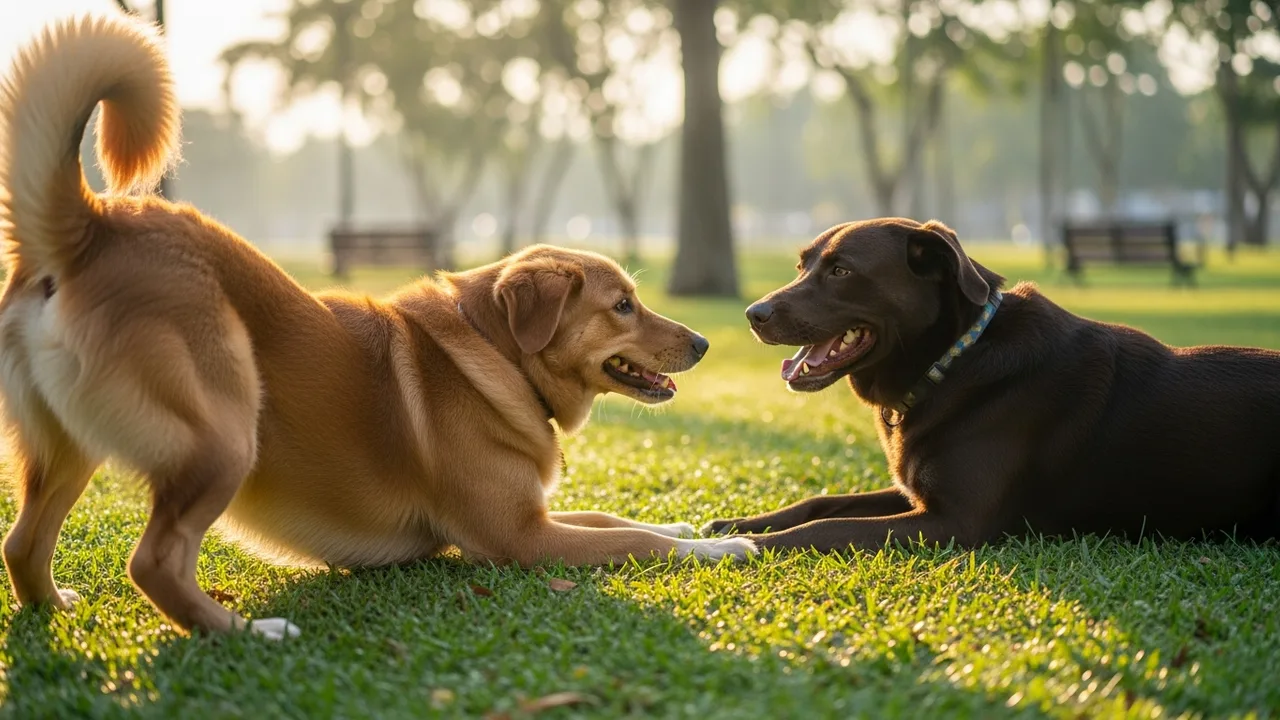
Once the dogs are loose, your job is to watch and read, not to hover anxiously or tune out. Healthy play is loose, bouncy and full of role reversals: the dogs take turns chasing, wrestling and being on top, they pause to shake off and check in, and the whole thing has a springy, elastic quality even when it looks rough and sounds fierce. Those little self-interruptions are the clearest sign that both dogs are still enjoying themselves and keeping the game fair. A useful habit is the brief consent test: gently hold the more boisterous dog for a moment, and see whether the other dog comes back for more or takes the chance to retreat.
Step in when the balance tips. If one dog is always pinning or always fleeing, if the pauses stop, if you see a stiff freeze, a hard stare, raised hackles or a tucked tail, or if the noise escalates without the loose body language of play, interrupt calmly and give both dogs a few seconds apart. Often that reset is all it takes. If the tension comes straight back, end the session on a neutral note rather than pushing your luck. Finishing a little early, while everyone is still happy, is precisely how you make sure your dog looks forward to the next one.
Finding your community
The hardest part is often just finding compatible dogs, and Singapore has more options than a new owner realises. Online, the dog play-group topic on Meetup pulls together several active groups with well over a thousand members between them, including groups that organise walks and hikes as well as pure play meets. Facebook communities such as Dog Lovers@SG are another good place to ask, and breed or neighbourhood chat groups often run informal meets you can join.
Offline, do not underestimate your local dog run. The people who turn up at the same run each week become a loose community, and once your dog has a couple of regular playmates there you have a standing playdate without any organising at all. Be the kind of handler others want their dogs to meet: clean up, supervise, keep your dog’s manners in check, and step in early when play tips over. Do that consistently and the invitations come to you.
Frequently asked questions
How do I organise a dog playdate in Singapore?
How do I screen the other dogs and owners?
Where is the best place to hold a playdate?
What does healthy dog play look like?
What are the warning signs I should end a playdate?
Where can I find dogs to arrange playdates with in Singapore?
Should puppies go on playdates?
Try a little play, then save the moment →A small idea to try, with progress kept in your Pack.