
Rabies serology test
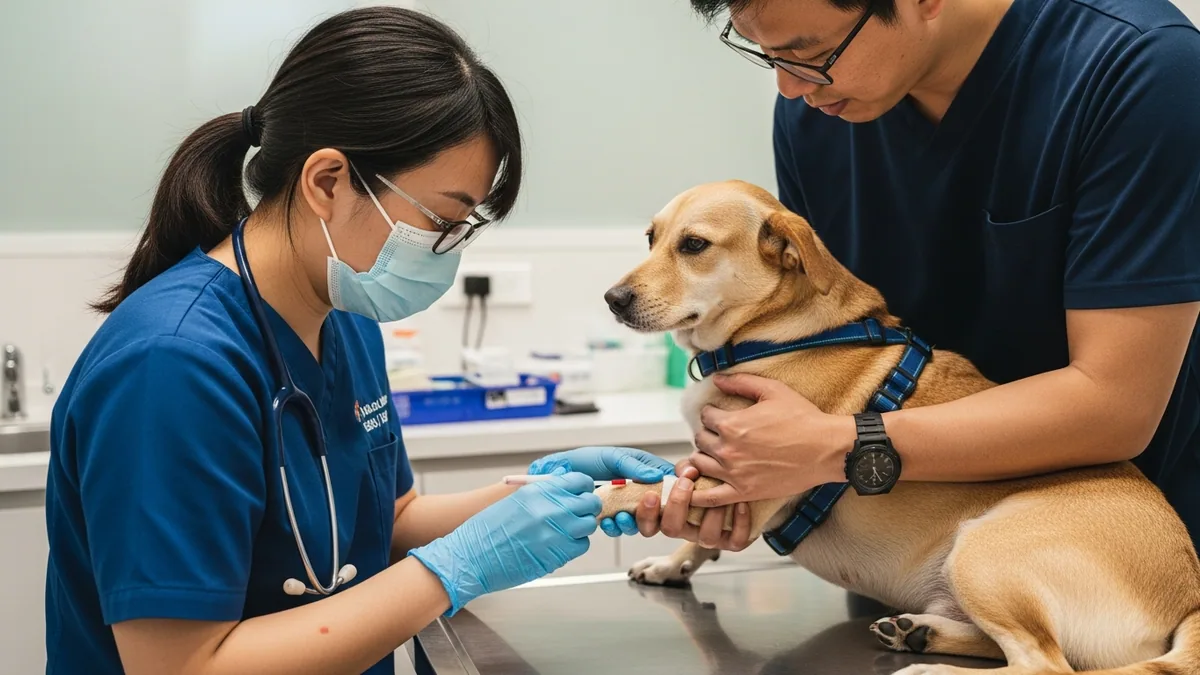
A blood test measuring rabies antibody levels, required for dogs exported to Singapore from Schedule II and Schedule III countries. The sample must be taken at least 28 days after a valid rabies vaccination, and at least 90 days and within 12 months before the date of export.
What it means for you
This is the test that sets your earliest possible flight date, and it’s where most relocation timelines are won or lost. Two waiting periods stack: 28 days after the rabies vaccination before blood can be drawn, then a further 90 days after that draw before your dog may be exported.
So from a standing start, a dog leaving a Schedule II or III country is roughly four months away from being eligible to fly, at best. Nobody enjoys discovering that after booking a container.
There is a ceiling as well as a floor. The blood sample has to be within 12 months of export, so a test done far too early expires and has to be repeated.
How it works
The dog must first hold a valid vaccination against rabies using an inactivated or recombinant vaccine acceptable to NParks and AVS, meaning a valid primary vaccination and any boosters that the vaccine manufacturer’s recommendations call for.
Then the timing conditions:
- Blood sampling at least 28 days after a valid rabies vaccination.
- The sampling must be done at least 90 days before the date of export.
- And within 12 months of the date of export.
Where the test is run matters as much as when. The sampling must be conducted either at a WOAH reference laboratory for rabies, or at a laboratory in a Schedule I or II country approved by that country’s competent authority. A local lab that is not on one of those footings will not satisfy the condition, however good its result looks.
Dogs from Schedule I countries need neither the rabies vaccination nor this test.
Your dog’s microchip number has to appear on all vaccination and treatment records, so chip first, vaccinate second, test third.
Common misconceptions
- The 90-day wait runs from the vaccination.
- The 90 days run from the blood sampling, which itself has to be at least 28 days after the vaccination. The two periods add up rather than overlap.
- Any accredited veterinary laboratory can run it.
- It has to be a WOAH reference laboratory for rabies, or a laboratory in a Schedule I or II country approved by that country’s competent authority.
- A test done years ago still counts as long as the vaccination is current.
- The sampling must be within 12 months of the date of export. An older result has expired for this purpose regardless of the vaccination status.
Sources and last checked
- Importing dogs and cats Animal and Veterinary Service (AVS), NParks Accessed 15 Aug 2026 Page states it was last updated 5 August 2026 and carries the Schedule I, II and III country lists.
This entry describes published rules and veterinary guidance. It is a reference, not a substitute for your vet or for the agency handling your application, and where a decision turns on a fee or a deadline the source links above are the ones to confirm against. If something here has gone out of date, tell us and we’ll correct it and say what changed.