

12 min read
Last updated First published 29 July 2026
Fear responses in dogs range from a brief startle to a full phobic crisis, and Singapore's thunderstorms, fireworks calendar, and HDB environment create triggers year-round. This guide explains what is actually happening, what helps, and when to involve your vet.
We hear this one often: your dog was fine all week, then a thunderstorm rolled in at 3am or the National Day rehearsal started, and now he is pressed behind the toilet bowl, shaking, and you have no idea whether to hold him, leave him alone, or panic alongside him.
Fear in dogs is normal. It is a survival response, and every dog has some threshold beyond which a sound, a situation, or a sensation tips them into distress. The trouble is that Singapore's urban environment and its calendar pile up triggers in ways that owners elsewhere rarely face. Understanding what is happening in your dog's body, and what actually helps, is the starting point for changing things.
Normal fear versus true phobia: knowing the difference
A dog who startles at a thunderclap and then settles within a few minutes is showing a normal fear response. The nervous system fires, the dog reacts, and then the dog recovers. That is healthy. A dog with a true phobia cannot do that last part. The stimulus triggers a response so intense that the dog loses the ability to self-regulate, and recovery takes far longer than the event itself.
Three markers separate fear from phobia:
- Intensity. A phobic dog does not just crouch slightly. He may injure himself trying to escape, lose bladder or bowel control, or hyperventilate to the point of collapse.
- Recovery time. A phobic dog may remain in a heightened state for hours after the trigger has stopped, sometimes for the rest of the day.
- Generalisation. Phobias spread. A dog who begins by fearing fireworks often starts reacting to thunder, then to the distant rumble of motorcycles, then to any loud sound. The nervous system begins pattern-matching on threat cues rather than evaluating each stimulus freshly.
This generalisation matters practically. If your dog's fear seems to be spreading to more and more situations, that is a signal to act now rather than wait for next National Day.
Singapore-specific triggers your dog is likely to meet
Singapore's density and its annual calendar create a particular cluster of triggers that owners in quieter countries never have to plan around.
The calendar triggers
- National Day fireworks. August brings multi-night rehearsals and the main event on the 9th. The Marina Bay display is loud enough to reach dogs in Queenstown, Tampines, and Ang Mo Kio. The unpredictability of rehearsal nights makes it hard to prepare.
- Chinese New Year firecrackers. January or February, depending on the lunar calendar. Legal firecracker discharge is restricted, but the sounds carry, and temple activities and neighbour firecrackers do occur. This period can run across several days.
- Equatorial thunderstorms. Singapore averages over 170 thunder days a year. That is not a seasonal event. It is a near-daily reality from afternoon onwards, and some dogs have to navigate this every single week. For a dog with storm phobia, that is an enormous cumulative stress load.
The everyday HDB triggers
- Lift sounds and motion. The mechanical thud of a lift arriving, the slight motion underfoot, the enclosed space, and the unpredictable appearance of strangers at the doors are all legitimate fear triggers for dogs unused to them. We cover this in more detail at /guides/reactivity-lift-lobby.
- Renovation work in adjoining flats. Drilling, angle grinders, and hammering in a shared wall produce sounds that appear to have no source and no pattern. Dogs cannot locate or predict the noise. That unpredictability is itself aversive.
- Umbrella mechanics. The sudden mechanical snap of an umbrella opening is a genuine and underrated trigger. In Singapore's climate, umbrellas open constantly, at close range, often directly in front of a dog on a narrow five-foot way.
- Motorbike engines in void decks. Delivery riders park and rev in void decks. The engine noise echoes in the concrete space in a way that amplifies it beyond what the dog experiences on an open road.
Reading fear in your dog's body
Dogs signal distress well before the shaking starts. The earlier you read the signals, the earlier you can help, and the less the experience consolidates into a deeper fear memory.
Signs at the mild end, often missed:
- Yawning outside of tiredness
- Lip-licking or nose-licking with no food present
- Blinking or looking away
- A sudden inability to take treats they would normally eat readily
Signs at the moderate level:
- Whale eye (the whites of the eye visible in a crescent at the corner)
- Ears pinned flat or rotated back
- Tail tucked low or under the body
- Panting in the absence of heat or exercise
- Excessive shedding in a short period
Signs at the severe level:
- Trembling or full-body shaking
- Hiding behind furniture, in bathrooms, under beds
- Drooling heavily with no food stimulus
- Attempting to escape: scratching at doors, climbing, jumping
- Vocalising: whining, howling, barking continuously
- Loss of bladder or bowel control
Fear and aggression are closely related. A dog who is fear-reactive in the lift lobby or on the void deck is not a bad dog. He is a frightened dog. You can read more about how that link works at /i-have-a-dog/aggression-singapore.
What does not work: the flooding myth
Flooding means exposing a dog to the full frightening stimulus without escape until, in theory, the dog stops reacting. In practice, it does not work, and it causes real harm.
What actually happens during flooding is that the dog reaches a point of behavioural shutdown, which looks like calm but is learned helplessness. The nervous system has stopped producing visible distress signals because the dog has concluded that nothing he does makes any difference. That is not recovery. That is despair with a quiet exterior. The underlying fear is typically worse than it was before, and the dog's trust in the owner is damaged.
If someone advises you to just leave your dog outside during fireworks to get used to it, or to force him into the lift until he stops fussing, that advice is outdated and harmful. Do not follow it.
What does work: systematic desensitisation with counter-conditioning
Systematic desensitisation (SD) means exposing the dog to a version of the trigger that is mild enough that it does not trigger a fear response, and then very gradually increasing the intensity over many sessions. Counter-conditioning (CC) runs alongside it: the sub-threshold trigger predicts something genuinely good, usually high-value food. Over time, the dog's emotional response to the trigger begins to shift.
For thunderstorm phobia, this might look like:
- Finding a recording of thunder sounds (several are available as dedicated desensitisation audio tracks online)
- Playing it at a volume so low the dog shows no stress signals, while delivering a steady stream of small, high-value treats
- Repeating multiple short sessions at that volume before considering any increase
- Progressing only when the dog is actively looking toward the speaker with an anticipatory expression, not a worried one
The critical rule: if the dog is showing any fear signals, the volume or intensity is already too high. Drop back. Progress is measured in weeks and months, not sessions.
SD and CC are most effective when guided by a certified animal behaviour consultant or a vet with a behaviour qualification, particularly for moderate to severe phobias. Self-guided work is possible for milder fears, but the process requires precision, and mistakes can set progress back significantly.
Calming aids: what they can and cannot do
Calming aids are supportive tools. They can lower the baseline enough that behaviour work can happen, or reduce peak distress during unavoidable events. They are not a substitute for behaviour modification.
- Pressure wraps (such as Thundershirts and similar products) work for some dogs and not at all for others. They appear to help most in mild to moderate fear, and they need to be introduced before the dog is already stressed. Putting one on a dog who is already trembling behind the toilet is less effective than getting them comfortable wearing it on calm days first.
- Pheromone diffusers such as DAP (Dog Appeasing Pheromone, sold as Adaptil in Singapore) mimic a signal produced by nursing mothers. Evidence is mixed, but some dogs do respond, and there is no harm in using one in the weeks leading up to National Day or CNY. Run it consistently rather than starting the night before.
- Calming chews and supplements. Products containing L-theanine, melatonin, or hydrolysed milk protein (Zylkene) have a modest evidence base for mild anxiety. They are not sedatives and will not blunt a true phobia. They are worth discussing with your vet before giving, particularly if your dog is on any other medication. Our guide to ongoing vet costs at /i-have-a-dog/vet-bills-what-to-expect gives a realistic picture of what these conversations tend to cost here.
When medication is the right tool
Medication is not a last resort, and reaching for it is not a failure. For dogs with moderate to severe phobia, behaviour modification done without pharmacological support can be ineffective or actively counterproductive, because a dog who is flooded with fear chemicals during sessions is not in a state to learn. Medication reduces the neurological noise enough for real learning to happen.
There are two distinct categories your vet may discuss with you:
- Situational medication is given before a known event. Trazodone and gabapentin are both used in Singapore for this purpose. Gabapentin in particular has become more widely used for noise phobia because it works on the central nervous system rather than simply sedating the dog. It is worth asking your vet specifically about it if fireworks or thunderstorms are your main concern. The WSAVA animal welfare guidelines support pharmacological intervention as part of a multimodal approach to fear and anxiety in dogs.
- Daily anxiolytics such as fluoxetine or clomipramine are used where the dog's anxiety is generalised, frequent, or where the cumulative stress of near-daily thunderstorms in Singapore means that situational medication would be required so often it is impractical. These require a proper veterinary behavioural assessment to prescribe responsibly.
The right entry point is a conversation with your vet. Some general practices in Singapore are comfortable managing straightforward noise phobia pharmacologically. For complex or generalised anxiety, a referral to a vet with a behaviour interest, such as those at Raffles Vet or a practice that offers behavioural consultations, is worth pursuing.
If your dog's fear is feeding into broader anxiety and time alone is also a problem, the guide at /guides/separation-anxiety-hdb covers how to approach that overlap.
A practical fireworks season plan for Singapore
National Day rehearsals typically begin in late July. CNY preparations start well before the actual date. Planning ahead, rather than reacting on the night, makes a real difference.
- Six to eight weeks before: if your dog has shown any previous fear of fireworks or thunder, speak to your vet now about whether situational medication is appropriate. Do not wait until National Day eve.
- Four weeks before: begin playing desensitisation audio at very low volume during mealtimes or treat sessions. Do not increase volume until the dog is clearly relaxed and associating the sound with good things.
- One week before: identify your dog's preferred hiding spot and make it comfortable. Add familiar bedding, keep the space accessible at all times, and do not block or discourage use of it. Dogs who can choose to hide cope better than dogs who are held in the open.
- On event nights: walk your dog early, before dark. Close windows and draw curtains to reduce sound and the visual flash of fireworks. Put on a radio or television at normal volume for consistent sound masking. If using a pressure wrap, put it on before any sounds start. Remain calm yourself, behaving normally. You can offer comfort without reinforcing fear: comforting a frightened dog does not make the fear worse, despite what older advice claimed.
- After the event: note how long recovery took, and what helped. That information is useful when speaking to your vet or a behaviour consultant about next steps.
Frequently asked questions
Should I comfort my dog when he is scared of fireworks or will it make the fear worse?
You can comfort your dog. The older idea that comforting a fearful dog reinforces the fear has been largely set aside by current animal behaviour science. Fear is an emotional state, not a behaviour being offered for a reward, so responding to it with calm reassurance does not teach the dog to be more afraid. What matters is that you remain calm yourself rather than becoming anxious alongside him, as dogs do read their owner's emotional state.
My dog is terrified of thunder and Singapore has thunderstorms almost every day. What can I realistically do?
Frequent triggers make behaviour modification harder, because the dog rarely gets a full recovery window between exposures. For dogs with significant storm phobia in Singapore, the most realistic approach combines veterinary support (whether situational or daily medication) with ongoing desensitisation work done on calm days using audio recordings at very low volume. Speak to your vet about whether daily medication makes sense given how often your dog is exposed to the trigger.
Can I give my dog melatonin or other calming supplements for National Day fireworks?
Some calming supplements, including those containing melatonin, L-theanine, or hydrolysed milk protein, have a modest evidence base for mild anxiety and are available in Singapore. They are not sedatives and will not adequately manage a true phobia. Discuss any supplement with your vet before using it, particularly if your dog is on other medication, and consider whether a prescription option might be more appropriate for your dog's level of distress.
My HDB neighbour is renovating and my dog trembles every time the drilling starts. How do I help him?
Renovation noise is particularly hard for dogs because it is unpredictable, vibrates through walls, and can last for weeks. In the short term, create a comfortable retreat space away from the shared wall, use white noise or a radio for sound masking, and give your dog something absorbing to do during work hours, such as a filled food toy. If distress is significant or the renovation will continue for an extended period, speak to your vet about whether short-term support is warranted.
How do I find a behaviour consultant or behaviourist in Singapore for my dog's phobia?
Start with your vet, who can refer you to a colleague with a behaviour interest or to an external consultant. Look for practitioners with credentials from the International Association of Animal Behaviour Consultants (IAABC) or the Certification Council for Professional Dog Trainers (CCPDT). SPCA Singapore also offers behaviour advice and can point you toward appropriate resources. Be cautious of trainers who use aversive methods or who recommend exposure-based approaches without proper gradual steps.
Is gabapentin safe to use for my dog's fireworks fear and where can I get it in Singapore?
Gabapentin is a prescription medication in Singapore and must be obtained through a licensed veterinary practice. It is increasingly used for situational noise phobia because it reduces central sensitisation rather than simply sedating the dog. Your vet will assess whether it is appropriate for your dog, discuss dosing and timing, and advise on any contraindications. Do not source it outside of a veterinary prescription.
If you are watching your dog shake through another August rehearsal night and wondering whether you have been managing this wrong, the answer is probably that you just did not have the right information yet. Start with your vet, be patient with the process, and know that fear is genuinely treatable.
More for Singapore dog owners
-
 HDB barking complaints: how to manage your neighbour situation A neighbour complaint about your dog's barking is serious in an HDB context, but it is a problem with a clear pathway through it. This guide covers how to identify the cause, reduce the noise now, manage a formal complaint if one has been filed, and when to bring in professional help.
-
 Vet bills in Singapore: what to expect and how to plan Plan veterinary spending around your dog: ask for written estimates, compare the scope of care, understand insurance terms and prepare for unexpected bills.
-
 Singapore dog vaccination schedule, explained Core vaccines, puppy timing, leptospirosis, kennel cough, titre testing, and how your AVS licence connects to it all. Here is what Singapore dog owners actually need to know about keeping jabs current and records straight.
-
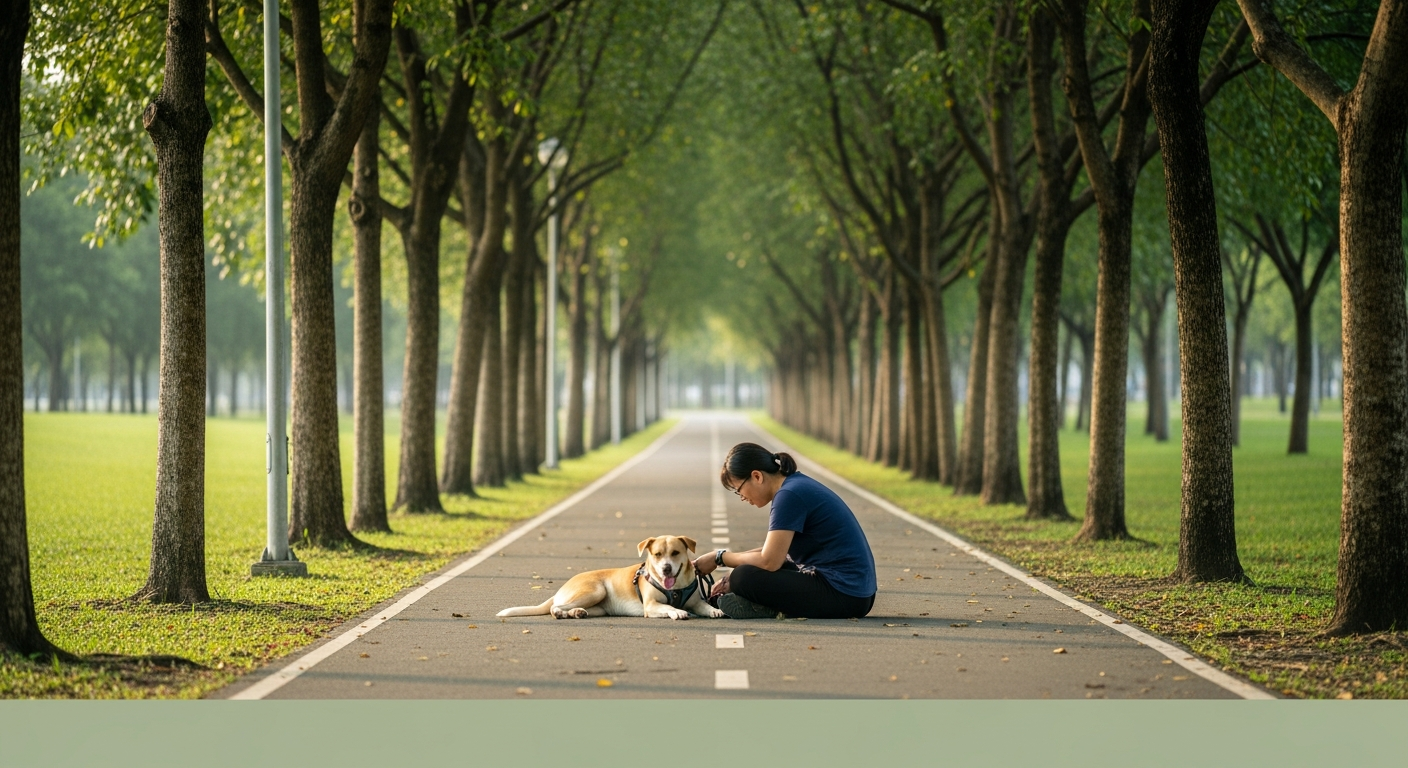 Your rescue dog's first 30 days in Singapore Bringing a rescue dog home is a different experience from raising a puppy, and the first 30 days require patience more than training. This guide covers what to expect during the decompression period, from the first quiet hours in a HDB flat to the point where your dog genuinely starts to feel at home.